
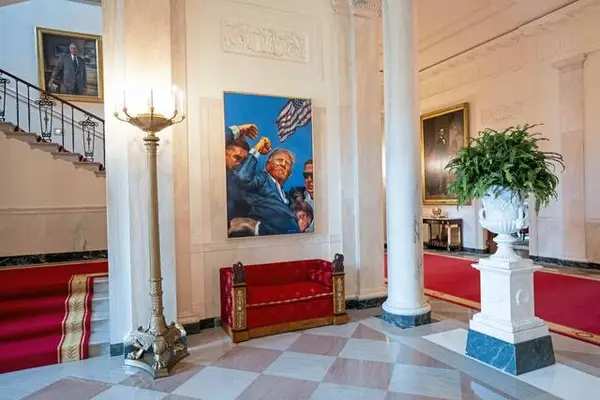
Since moving back in, President Donald Trump has significantly altered the “People’s House.” East Wing: gone. Oval Office: maximalized. Rose Garden: Mar-a-Lago-ified. And the art? Lots of Trump.
Over the past year, The New York Times has captured at least nine paintings, posters, memes, and even a mug shot outside the Oval Office, that Trump added throughout the historic space.
Never before has a sitting president displayed so much of his own image on the White House walls. Many of the selections are gifts from his supporters that highlight his political stature and reinforce the idea that Trump is invincible.
There is an “assertion of symbolic power that he wants to be on view essentially everywhere in that space,” said Cara Finnegan, a communication professor at the University of Illinois and author of “Photographic Presidents: Making History from Daguerreotype to Digital.”
Even outside his current residence, Trump’s visage has proliferated in unexpected places — on banners hanging from government buildings, on National Parks passes and on social media, where he has been likened to a king. There has also been talk of a U.S. Treasury-minted coin with Trump on both sides.
Break with tradition
In recent decades, each president’s official White House portrait has been unveiled in a ceremony hosted by his successor.
The mood has often been lighthearted, with political party tensions melting away.
“I am pleased that my portrait brings an interesting symmetry to the White House collection,” George W. Bush joked in a ceremony hosted by the Obamas. “It now starts and ends with a George W.”
In a break with tradition, Trump did not schedule a ceremony for the unveiling of the Obamas’ portraits during his first term. Joe Biden later did, in a ceremony with a “Welcome Home!” vibe.
Typically, the latest available presidential portrait — often a realistic oil painting — hangs in the main entrance hall, where heads of state are welcomed.
The Obama portrait was in the spot until last April, when Trump replaced it with a painting by Marc Lipp, a Florida pop artist. It depicts a striking moment in 2024 when a bloodied Trump pumped his fist in defiance, soon after being shot at by a would-be assassin during a campaign event.
Presidential historians have criticized the departure from convention.
Though Trump had a portrait commissioned for the Smithsonian’s American Presidents collection after his first term, none was confirmed for the permanent White House collection, and the White House said that this is where that portrait would have hung.
It is not totally unprecedented for a president to hang a painting of himself in the White House during his term. Theodore Roosevelt, William Howard Taft and Grover Cleveland all did, according to the White House Historical Association. But more often than not, paintings of presidents and first ladies are hung after they have left office, historians said.
Flags, fists and faith from fans
In what has become something of a muse for many of the president’s artistic supporters, there are at least three other depictions of the fist-pumping scene in the White House.
The image “is in people’s garages when I walk around my neighborhood,” said Leslie Hahner, a Texas resident and communication professor at Baylor University, who studies visual political culture. “People love that image.”
A sculpted version was spotted in the Oval Office. The sculptor, Stan Watts, told a Utah TV station last year that he believes the president was saved by God that day. Many of Trump’s Christian supporters have echoed that sentiment.
At least two works by a self-described “Christian worship artist,” Vanessa Horabuena, are among Trump’s White House collection. He has called Horabuena, who often paints live in front of an audience, “one of the greatest artists anywhere in the world.”
In 2022, she painted a portrait of Trump at a booth at the Conservative Political Action Conference. When he saw it, he asked to meet her, Horabuena’s representative said. She most recently painted Trump live at a New Year’s Eve party at Mar-a-Lago.
One of her portraits was spotted in the Cabinet Room in January. It shows Trump, his eyes closed, in front of a mountain with a small cross on the top. Horabuena hand-delivered it to the White House, according to her website.
Her other painting shows the president walking through a phalanx of flags. It was seen hanging prominently in a hallway leading to the Cabinet Room and the Oval Office.
“He’s positioned as this embattled warrior in a lot of these images,” Hahner said.
Historical figures Trump adulates are costars in some of the art he has chosen.
In an image created by the team of the White House trade adviser Peter Navarro, Trump is pictured with William McKinley and Henry Clay, who, like the president, championed the use of tariffs.
Another, titled “Great American Patriots,” was painted by Dick Bobnick, an illustrator and Trump supporter from Minnesota. He said he mailed several prints to 1600 Pennsylvania Ave., but he had no idea his work was on the White House walls until a USA Today reporter called him about it.
“I could hardly believe it,” said Bobnick. (He said the print is now his best seller.)
If not in portraits, Trump’s image is reflected on mirrors that he has added to the White House complex.
“Trump is obsessed with his image,” Hahner said. “And he is so controlling of his image.”
Trump everywhere, all the time
One portrait seen in the White House has become a communication tool between Trump and his supporters in the real world — his social media profile picture.
It was seen last October hanging between former first ladies Laura Bush and Barbara Bush in the now-demolished East Wing.
The portrait was painted by Lena Ruseva, an immigrant from the former Soviet Union, who goes by the name MAGALANGELO. Trump invited her to his golf club in Bedminster, New Jersey, in 2022, and she gave it to him as a birthday gift.
“Every time social media or the news quotes the president and I see my artwork alongside it, I feel proud and grateful,” she said.
For a time, the portrait hung next to Hillary Clinton, his political rival and a former first lady.
Supporters at that time lauded the placement on social media.
This example of a positive feedback loop demonstrates how Trump has used social media to redefine the presidency and presidential communication. Ruseva’s portrait was used on social media, hung up in the real world, then photographed and put back on social media by supporters who praised the president.
When Trump was elected to his first term in 2016, Hahner said that scholars referred to him as the first “meme president.”
Trump and his internet fans are used to a meme culture based on irony, and rehashing, repurposing and remixing existing images. The collection of White House artwork — much of it originating from his supporters — sits in an uncanny valley between realism and meme-ism, Hahner said.
Like memes that multiply, Trump’s image has been reproduced in other ways outside the White House.
Last month, a huge banner with Trump’s face was draped outside the Justice Department headquarters; last year, similar signage was strung over the Labor Department building and the Agriculture Department building (this one alongside Lincoln).
At his request, Trump’s portrait was recently updated at the Smithsonian’s National Portrait Gallery.
Still, Trump wants more. The White House has suggested that the National Portrait Gallery add a separate section for Trump-related art.