
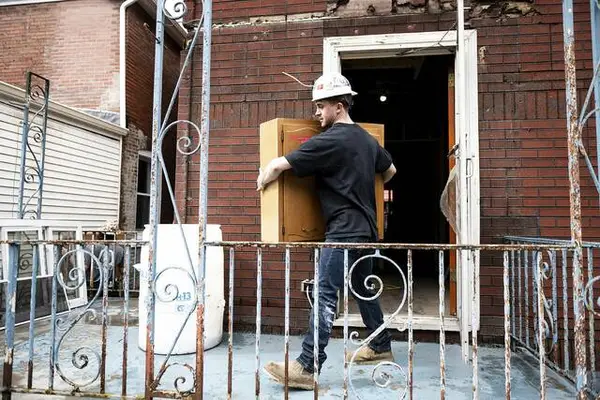
A single-family home in Hazelwood is serving as a testing ground for a renovation project exploring how recycled building materials could cut construction costs and carbon emissions.
“Communities can save a lot of money by not having to purchase new materials, a lot of what holds people back is the thought that the laborers just don’t know how to do it,” said Chris Cieslak, COO of Green Building Alliance, from inside the Hazelwood property on Wednesday.
The project showed that using recycled materials at the Hazelwood property had an estimated reduction of three metric tons of carbon emissions and could further reduce both construction costs and environmental impact in upcoming affordable housing projects.
The nonprofit Hazelwood Initiative Inc., partnered with Volpatt Construction Corporation and Construction Junction, a nonprofit reuse warehouse, to test a strategic reuse approach during the renovation of the single-family home.
The home renovation, located on Renova Street, includes a new roof, siding, structural framing, drywall, insulation, flooring, kitchen, bathroom, HVAC, electrical upgrades and plumbing improvements.
Cutting carbon
Instead of sourcing all new materials through traditional suppliers, the project team bought products from Construction Junction, including: flooring, tile, countertops, paint, lighting fixtures, cabinets, a vanity and a refurbished toilet.
On Wednesday, carpenters had been measuring cabinets from Construction Junction to see how they would fit into the kitchen’s space.
“We actually have an urban woodshop back at Construction Junction that we take salvaged and reclaimed lumber, we de-nail it, we paint it, we bring it back to life basically,” said Melissa Mongelli, executive director of Construction Junction.
The project’s estimated reduced carbon emissions – three metric tons – was calculated using the United States Environmental Protection Agency’s Greenhouse Gas Equivalencies calculator, which converts emissions or energy data to the equivalent amount of carbon dioxide (CO2) emissions.
Three metric tons of carbon emissions saved during the Hazelwood project are equivalent to 50 trees grown for 10 years, 7,500 miles driven by a gasoline vehicle and 150 gallons of gasoline consumed, the news release said.
A proponent in cost-saving
Michael Volpatt, spokesman for Volpatt Construction, said the Hazelwood renovation demonstrated that targeted material reuse can produce substantial savings.
The project’s budgeted cost for select finish materials was more than $9,700, but the project’s actual cost ended up being just under $1,700.
Using recycled materials saved more than $8,000 — about 2.43% of the overall project budget.
“In affordable housing, projects are typically financed with extremely tight margins,” said Nancy Noszka, director of Real Estate for Hazelwood Initiative in a news release.
Hazelwood Initiative is a nonprofit development corporation serving the Greater Hazelwood neighborhood of Pittsburgh since 1999 and more recently led the renovation, preservation, and sale of three dozen homes as well as acquired and stabilized more than 60 rental units.
Next week, Volpatt and Hazelwood Initiative officials will be sitting down to compile a list of every item needed for the next phase of the program, which includes the renovation of 35 affordable housing units in the Hazelwood area.
“We’re going to go through everything, step by step and then go to (Construction Junction) and say ‘Here’s our scope, here’s our shopping list,’” Volpatt said.
Hazelwood Initiative estimates that using recycled materials during the 35-unit renovations will save roughly $280,000 in material costs and reduce carbon emissions by 105 metric tons.
“These savings can allow developers, especially community development corporations, to renovate more homes with the same funding, expand affordable housing programs, and allocate resources to community services and long-term maintenance,” Noszka said.