
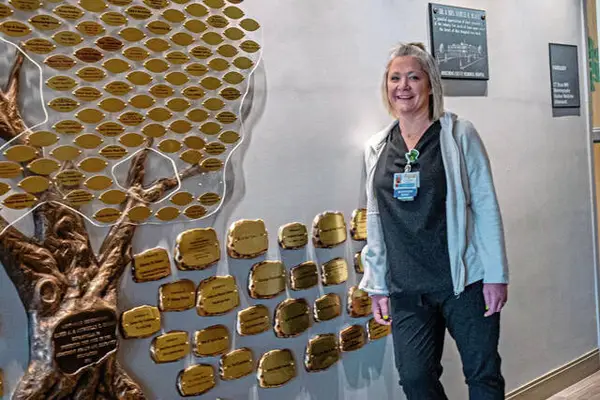
Intuition is what prompted Colleen McGarrity to get a colonoscopy at age 41.
The preventative screening probably saved her life.
The Ford City resident experienced spotty symptoms but had no family history of colon cancer.
A nurse at ACMH Hospital, she considered herself generally healthy.
“My diagnosis came out of nowhere,” McGarrity said. “Hearing it was Stage 3 was terrible and scary.”
McGarrity is among a growing number of people younger than 50 diagnosed with colorectal cancer. The disease has become the No. 1 cause of cancer-related deaths for people 18-50 in the United States, according to a new report from the American Cancer Society.
People born in 1990 have double the risk of colon cancer and quadruple the risk of rectal cancer compared with people born in 1950, according to Dr. James McCormick, chair of Allegheny Health Network’s Colorectal Cancer Program.
“The trend is happening at an unprecedented rate,” McCormick said. “Historically, we didn’t even see that cancer in that (age) group.”
In 2023, there were nearly 20,000 cases of colorectal cancer diagnosed in people younger than 50 across the country, representing a 3% increase for the age group, according to the American College of Surgeons. Since 2004, rates have increased by 14.6%. Instances are increasing at a rate of 3% per year, says the American Cancer Society.
According to data, men face a 1 in 23 chance of developing colorectal cancer, while a woman’s odds are 1 in 25.
Sarah Domasky of Greene County is one of those women.
She was diagnosed with stage 3 colon cancer at 43 despite having no family history and being an active fitness instructor.
The signs started as small changes. Then she noticed blood, but wrote it off as hemorrhoids.
Finally, when the pain started waking her at night, she went to the doctor.
“I was not thinking cancer at all because I’m typically a healthy person,” Domasky said. “Your body goes from enjoying life, to fight mode. I have three kids, so that was hard. At first, I didn’t want to tell them. I thought maybe I could just shield it from them. But, when people come over and are expressing condolences and bawling in your arms, you’re like, I kind of can’t hide that from them now.”
A lifestyle issue
Despite cases like Domasky’s — adults leading healthy lifestyles — McCormick said much of the blame likely is attributable to bad habits.
“We don’t know why this is happening, but it’s not a genetic thing,” he said. “It has to be something environmental. It has to be something we’re eating or drinking, or something we’re not doing, like exercise, that’s causing this.”
Other experts agree.
Jason Thomas, a physician’s assistant at The Square at Latrobe’s gastroenterology offices, said obesity, a sedentary lifestyle, eating ultra-processed foods and too much alcohol can increase risk. He’s seen cases involving people in their 20s and 30s, though some may have had a family history or other factors at play.
Anwaar Saeed, director of the Gastrointestinal Disease Center at UPMC Hillman Cancer Center, said the network is seeing a “significant increase” in young colorectal cancer cases.
In response, it is developing a specialized clinic for young patients, something that is increasingly common at larger cancer institutes, Saeed said.
“This is something that we are hoping to build within the next year or two,” she said.
UPMC also is bolstering its research, she said.
“We’re building databases for colorectal cancer and trying to focus on the young onset colorectal cell cancer to see if there’s differences in the tumor micro-environment between this group versus the older group,” she said.
Though treatment doesn’t change based on age, considerations do, she said.
“There are questions that arise that would not arise in the older population,” she said. “For example, fertility preservation and females who are in their 20s, 30s, early 40s — this comes up a lot when we do chemotherapy at this young age. Now, we actually collaborate a lot with the fertility clinics. We do a lot of referrals to them to address this.”
She said, in some instances, the chemotherapy used can cause peripheral neuropathy, a form of nerve damage that can cause numbness, tingling and pain.
“While it does not impact significantly the quality of life of an older person, it will impact the younger population,” she said. “Particularly those who have hobbies like drawing, playing pianos or if their job is mechanic and they need to use their fingers a lot.”
She said no definitive cause for young onset colorectal cancer has been found, but inflammation and imbalanced microbiome bacteria are often blamed.
Diet and exercise also play a fundamental role, she said.
What to do
Saeed recommends people with no family history get screened at 45 and look for warning signs such as bloody or black stool, regular constipation or diarrhea and unexplained weight loss.
With March being Colorectal Cancer Awareness Month, medical experts offered tips to mitigate risk including:
• A healthy diet — the Mediterranean diet is optimal because of its load of fresh fruits, vegetables and seafood.
• Limit or eliminate alcohol and sugar.
• Be active for 30 minutes a day, five days a week.
• Focus on a healthy weight.
“Things we know are associated with diagnoses are ultra-processed food, obesity and a sedentary lifestyle,” McCormick said. “We want to make it doable for people, so red meat, for example, becomes a treat rather than a staple.
“Take a half hour and go for a walk around the mall or hop on a bike.”
Dr. T. Cristina Sardinha, system chief of the colon and rectal surgery service at Catholic Health, told the New York Post that regular exercise is as important as a healthy diet in lowering colorectal cancer risk.
Sedentary behavior, often associated with obesity, increases the risk by at least 20%, she said. Getting at least 150 minutes of activity a week cuts risk by up to 25%.
The deaths of “Black Panther” star Chadwick Boseman in 2020 and “Dawson’s Creek” star James Van Der Beek this year, both from colorectal cancer, have triggered a spotlight on the disease.
But more people need to pay attention to their bodies, experts said.
Thomas estimated a third of people ages 45 to 49 don’t get screened. At-home stool tests can be beneficial, but the gold standard is a colonoscopy.
“There are a lot of people out there that could be getting screened,” he said.
McGarrity, 43, said her colonoscopy revealed a large mass that was found to be malignant. She underwent eight rounds of chemo, 30 radiation treatments and had surgery in May 2025. The cancer had metastasized to her lymph nodes but had not spread any farther.
She wore an ostomy bag for two months and is now cancer-free.
“I tell everybody if they have any issues, anything that’s different or they have blood or pain, go to your doctor,” McGarrity said. “If you think you need to get a colonoscopy, advocate for yourself.
“You can be saved as long as you catch it.”
Domasky also is proof of that.
In August 2024, she underwent colon resection surgery to remove the mass followed by three months of chemo. She is part of a five-year clinical trial at UPMC Hillman to monitor microscopic trace amounts of cancer in her blood.
Right now, she has no cancer in her body and will be officially deemed cancer-free when the trial ends.
“I’m not a worry wart,” she said. “I only went to the doctor if I knew I definitely needed something or something was off. So just listen to your body. You know, once those signs started creeping in … your disease is already advanced.”
According to the American Cancer Society, localized disease carries a five-year survival rate of 95%.
McCormick realizes the topic can be awkward. He said people uncomfortable talking about symptoms can use an online tool to assess their risk. A checklist is available at facs.org/crc, and can be printed and taken to an appointment.
“It’s very important to catch it early,” McCormick said. “Stage 1 carries a 90% chance of removal and cure.”
TribLive staff writers Ember Duke and Renatta Signorini contributed.