
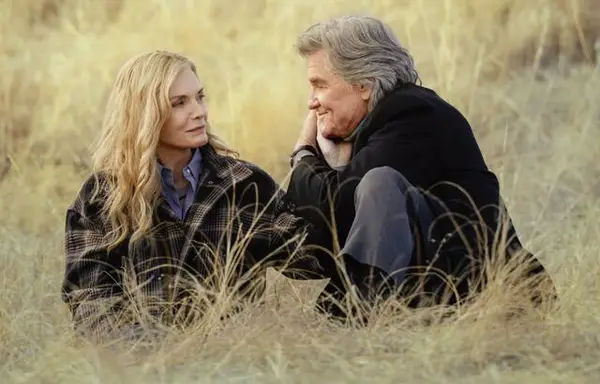
The latest Paramount series written and created by Taylor Sheridan arrives this weekend with Saturday’s debut of “The Madison,” another show set in Montana — but it’s not a “Yellowstone” spinoff.
“The Madison” moves at the snail’s pace of Sheridan’s “1923” — and the music score sometimes sounds nearly identical — but “The Madison” also borrows some of the humor that’s made Sheridan’s “Landman” a hit.
Michelle Pfeiffer’s Stacy Clyburn isn’t as sarcastic and profane as Billy Bob Thornton’s Tommy Norris, but Stacy displays more backbone and bite than viewers might expect from a wealthy Manhattan socialite who believes in giving to charity and good manners. (Stacy scolds her adult children when they consider talking on their cellphones in a restaurant, something she considers rude to fellow diners and the restaurant’s staff.)
Stacy has a long, loving marriage to Preston (Kurt Russell), with whom she (unbelievably) says she’s never had a fight in 30 years (that’s gonna paint Sheridan into some drama-free corners when it comes to flashbacks). She’s a city mouse, he’s a country mouse who enjoys fly fishing with his brother, Paul (Matthew Fox, “Lost”), during getaways to Montana.
When a tragic event brings Stacy and her family to Montana, she swears off Manhattan for a new life in the sticks.
Selfish daughters Paige (Elle Chapman), whose words and behavior bring to mind Ainsley (Michelle Randolph) from “Landman,” and Abigail (Beau Garrett) and their families are less sure about Stacy’s new interest in a state she only experiences through the 1992 film “A River Runs Through It” before visiting it.
“It’s about fishing,” Stacy says of the film before watching it. “How sad can it be?”
Of course, by the time she’s done watching the movie, Stacy is sobbing. (The first “Madison” episode is dedicated to the memory of “A River Runs Through It” director Robert Redford.)
Following events of the first episode, viewers get to know the Clyburn family through a mix of present-day Montana scenes and flashbacks to their lives in Manhattan.
In Montana at the start of episode two, the city slickers encounter hornets in an outhouse and get stung all over their nether regions, scenes played for laughs that sit awkwardly alongside the knowledge of the tragedy that ended episode one.
Episode three features Paige and Abigail in a catfight, leading to another lecture from matriarch Stacy. The first three episodes stream March 14; the final three episodes stream March 21.
Throughout the six-episode first season, there’s a running theme of city values versus country values with the city values depicted as rude and hectoring compared to principled country folk.
When Montana cowboy neighbor Cade (Kevin Zegers) brings condolence provisions to the Clyburns, one of the Clyburn grandkids objects to him referring to a dish as “Indian tacos.”
“You can’t call it that,” the girl says. “It’s racist.”
“That’s what the Indians call ’em,” a chastened Cade replies, leading to another lecture from Stacy, who has a preternatural understanding of Montana folks’ ways despite never before visiting the state.
New romances get telegraphed a mile away and, like the first season of “1923,” the first season of “The Madison” feels like a prologue to a series that might finally start to take off in its second season, which has already been filmed.
In a virtual interview Monday, “The Madison” director Christina Alexandra Voros, who previously directed episodes of Sheridan’s “Yellowstone,” acknowledged “The Madison” is, in part, a meditation on grief, but that’s not all that it’s about.
“That’s really just the key that unlocks the front door,” she said. “It’s an exploration of identity, an exploration of love. It is a meditation on how the land and the environment changes us.”
Voros related to those themes. She grew up in Boston and lived in New York for 15 years before meeting a cowboy and moving to West Texas.
“I never saw that trajectory for myself. I never saw myself leaving New York,” she said. “(‘The Madison’) is a beautiful meditation on what is possible if we open ourselves up to the impossible. Sometimes it takes something happening that’s beyond our control to force us to grow in a way that is elemental. … It takes a tectonic shift sometimes to shake us into a different reality that we would never take the leap of faith to do on our own.”
Regarding Sheridan’s use of humor amid tragic circumstances, Voros said while tragedy is universal, it is not absolute.
“There is absurdity in tragedy. There is humor in the things we have to do to navigate tragedy,” Voros said. “Humor, in many ways, is the convergence of two opposite ideas, and that happens a lot when bad things happen, and so they co-exist. I think what was tricky to navigate is, we just had this very deeply emotional moment, can we go to this (comedic) place that fast? And the answer is yes. If you commit to it, absolutely, it will work. (This cast’s) commitment to their individual experiences of grief in the story was profound. And part of the reason the humor works is no one’s playing into the joke. They are playing into the absurd thing that ends up being funny to the audience that absolutely is not funny to the person experiencing it.”