
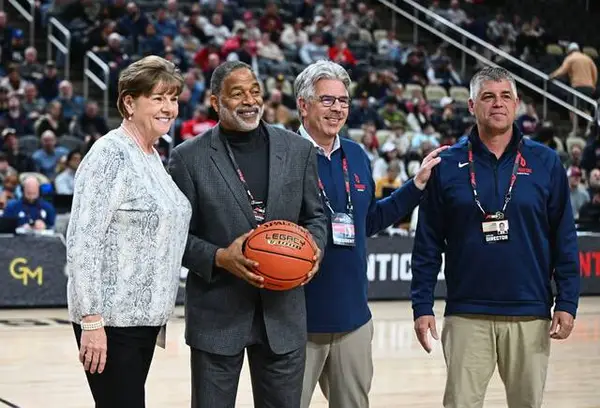
Fifty years after launching the league’s first men’s basketball tournament in Pittsburgh, the ongoing Atlantic 10 championships again have been a success this week at PPG Paints Arena, according to conference commissioner Bernadette McGlade.
All 14 A-10 teams are playing in town this week with the championship game set for 1 p.m. Sunday.
The A-10 leader spoke with reporters before the third day of the tournament began Friday as fans rolled into the Uptown venue for four games featuring No. 1-seeded St. Louis, No. 2 VCU, No. 3 Saint Joseph’s and No. 4 Dayton, along with host Duquesne, which won its second-round game 67-61 on Thursday.
“It’s a great championship. We are excited to be back here in Pittsburgh,” said McGlade, who is retiring after 17 years leading the conference. “And to celebrate the 50th anniversary, it’s really kind of serendipitous that we’re here.
“The agreement, the handshakes, the papers that were signed, back in ‘76, were actually right here in Pittsburgh. So, really kind of a nice opportunity for not only the current student-athletes, coaches in our membership, but to sort of reflect, we’ve been celebrating many historical moments for this great conference over the course of the year.”
Duquesne, led by future NBA great Norm Nixon, won the initial tournament at the end of the 1976-77 season, when the league was known as the Eastern 8 Basketball League.
The men’s tournament was played in Pittsburgh from 1978-82 at the Civic Arena and returned to PPG Paints Arena in 2017. This week is the seventh time Pittsburgh has hosted the event.
McGlade touched on several topics Friday:
• The new world of revenue-sharing and NIL in college athletics has impacted conferences and athletics departments across the country, including some of the smaller institutions in the Atlantic 10, a basketball-centric conference.
McGlade has encouraged the conference’s schools to remain committed to athletics and to be competitive with spending in an ever-changing environment.
“Whoever is at the bottom end of the conference can only (go) so low,” she said. “Because the conference schedule playing each other impacts each team. … I think every conference is having that conversation and it does come back to the realities of … how much institutional support can be generated versus how much third-parties support can be generated.”
• On the primary focus for her successor, McGlade pointed to finances and membership being crucial for the Atlantic 10 at large.
“The financial stability of any conference is really critical, because even though the drivers of our financial revenue are the sport of basketball in our basketball-centric league, we have 23 sports and 23 championships, and we support over 6,000 student-athletes,” she said. “So the financial stability, and then in terms of what we do with our postgraduates, scholarships, for all of our 14 member institutions, so that’s pretty important.
“And then fundamentally, conference realignment and membership is always something that is top of the agenda for every meeting I have with our athletic directors and our presidents, and I would assume that whoever replaces me will continue to be focused on conference membership.”
• McGlade spent 11 years in the ACC before being named A-10 commissioner in 2008. She helped bring in Final Four participants George Mason, Loyola Chicago and VCU, and Elite Eight participant Davidson as A-10 members.
She also negotiated a new media rights package in 2012 which was expanded in 2023.
And she worked to involve other markets in the hosting schedule for the men’s basketball championships and a neutral site for the women’s tournament at Henrico Sports & Entertainment Center in Virginia.
McGlade also has been a member of the men’s and women’s basketball committees.
Along with that list of accomplishments, she cited a need to increase branding and awareness for the A-10 from the moment she took the job.
“I made a mental note during that first 12, 14 months that that was something that I really wanted to try to weave together better for the membership,” she said. “And I think we’ve accomplished that. I think if you go on any campus, I think everyone that’s a member of the A-10, proud to be in the A-10, and you see it. You see it on their gear, you see it hanging on their walls, you see it on their baseball fences.
“And there’s a real sense of camaraderie and support within the league. And I think that’s been really important.”
• McGlade said she doesn’t focus much on the legacy she will leave when she retires at the end of the school year.
“I think when individuals have a legacy, those things, like, sort of develop,” she said. “It’s sort of a byproduct of your commitment to your craft, to your profession. I just hope leaving that the A-10 is in a better, stronger, healthier space in Division I, which I believe it is.”