
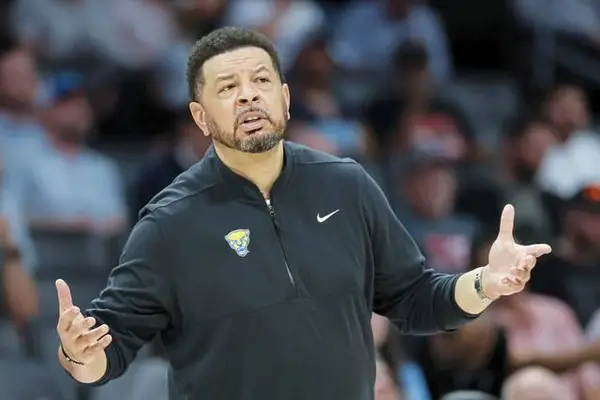
Long before Pitt’s season came to an end, athletic director Allen Greene knew he had a major decision to make regarding the stewardship of the men’s basketball program.
Despite the disappointment of coach Jeff Capel’s eighth year in charge, which saw Pitt go 13-20 (5-13 ACC), to say nothing of his overall body of work and mounting fan pressure for a leadership change, Greene announced Friday that Capel would be retained for 2026-27.
“Over the past several months, I have spent a great deal of time evaluating every aspect of our men’s basketball program,” Greene said in an open letter to fans, outlining his decision. “That process included conversations with Coach Capel, a review of our staff and our roster, our program structure and the transfer portal landscape as well as our investment in the program. … After that comprehensive evaluation, I have made the decision that Jeff Capel will continue to lead our men’s basketball program.”
Were Greene to have fired Capel, significant financial implications for Pitt athletics would have followed.
Per USA Today, Capel’s post-extension annual base salary is listed at $3,590,613 annually for the past two seasons.
While precise numbers surrounding Capel’s buyout are unknown, with four years and more than $14 million remaining of his contract, the Panthers would have been on the hook for an eight-figure payment in order to part ways.
Instead, Capel, who is 127-127 (60-92 ACC) over eight years at Pitt, will be back, seeking to right the ship after a disappointing regression this past season.
“To be blunt, this season fell well short of our expectations,” wrote Greene, who relieved women’s hoops coach Tory Verdi of his duties March 3. “Our level of investment in this year’s team was sufficient enough for us to reach the NCAA Tournament at a minimum. Simply fighting to qualify for the ACC Tournament is not good enough, and I am sure you feel the same way. At the same time, our student-athletes continued to compete with effort, pride and resilience through a difficult season.
“They fought until the end and represented this university with toughness. Effort alone is not enough. We must be better going forward. I know it. Jeff knows it. And you know it. Jeff and I will continue to examine every aspect of the program and will make the necessary changes.”
Hired at Pitt to replace Kevin Stallings in late March of 2018, Capel took over a program that had quickly spiralled from the consistency of the Jamie Dixon era (2003-16).
Stallings went 24-41 in his two years, leading to his own firing, with Capel, who had formerly led VCU to the NCAA Tournament (2003-04) and Oklahoma to the Elite Eight (2008-09), joining Pitt after serving as an assistant under Mike Krzyzewski at Duke from 2011-18.
Capel’s first Panthers squad in 2018-19 showed modest improvement from Stallings’ final season, which saw Pitt go 0-18 in ACC play. At year’s end, Pitt had a 14-19 (3-15) record.
Pitt went 16-17 (6-14) the following season and 10-12 (6-10) during the covid-condensed 2020-21 campaign.
It got no better in 2021-22, when Pitt recorded its most losses in Year 4 under Capel, going 11-21 (6-14).
But the following season, things finally coalesced under Capel, who brought in transfers Nelly Cummings, Blake Hinson and Greg Elliott, powering Pitt to a 24-12 (14-6) record and the program’s first Big Dance appearance since 2016.
For his efforts, Capel earned 2023 ACC Coach of the Year honors, with Pitt advancing to the Round of 32.
In 2023-24, Capel added more help through the portal in Ish Leggett and Zack Austin, along with true freshmen Jaland Lowe and Bub Carrington.
That year’s squad went 22-11 (12-8) but was surprisingly excluded from the NCAA Tournament field. After the snub, Pitt declined an invitation to the NIT and a few months later, former athletic director Heather Lyke rewarded Capel with a multi-year contract extension.
The defining characteristics of Lyke’s relationship with Capel were patience and trust.
Lyke stuck with Capel for four seasons before he posted a winning record and NCAA Tournament berth in 2022-23, and in the summer of 2024, extended him as coach at Pitt through 2029-30.
But immediately thereafter, regression followed for Pitt, as in 2024-25, despite a strong roster, the Panthers stumbled to a 17-15 (8-12) record following a promising 13-2 start.
In the spring of 2025, a roster exodus ensued, as Damian Dunn, Leggett and Austin graduated, while Lowe, the Diaz Graham twins (Jorge and Guillermo) and others transferred.
One year later, Pitt plummeted even further, with Capel acknowledging the season’s shortcomings.
“I’m not going to make any excuses,” Capel said after Pitt’s season-ending loss in the ACC Tournament. “We didn’t play to the standard which we feel like we’ve tried to create in this program. We just didn’t get the job done. I didn’t get the job done.”
Looking back at the 2025-26 campaign, the first bump in the road came Nov. 13, when the Panthers were thumped by 22 points at West Virginia.
Even more embarrassing moments followed, such as mid-major losses at home to Quinnipiac (Nov. 23) and Hofstra (Dec. 7).
Perhaps the lowest Pitt sank was Jan. 17, when Louisville came to Petersen Events Center and crushed the Panthers, 100-59, in one of the most lopsided defeats in program history. Losses by large margins transpired over the course of Capel’s tenure — Pitt lost 22 total games by more than 20 points.
After the Louisville shellacking, Capel told his players to prepare to be booed at home.
Granted, as Greene noted, Pitt displayed competitiveness in most of its ACC games, even if the vast majority resulted in losses. It was something Capel applauded as a brutal season continued.
Furthermore, Capel’s players, to their credit, never gave up on him, each other or an irretrievably compromised season.
Pitt won four of its final six games, qualified for the ACC Tournament and beat Stanford on a thrilling final-second bucket by Damarco Minor to advance to the second round, where the Panthers fell to N.C. State.
“This has not gone anywhere near how any of us thought it would be,” Capel said in January. “It’s been challenging, it’s been frustrating, it’s been hard. The thing I’m grateful for and I appreciate is that our guys have shown up and we’ve fought and battled in every game. There’s been one game in-conference where we haven’t, and that was Louisville. But other games, we’ve fought.”
So what did Capel expect this season, after the Panthers underperformed with a veteran roster in 2024-25?
He certainly didn’t anticipate projected starting center Dishon Jackson being lost for the entire season due to a medical condition.
But Jackson, whom Pitt acquired via the transfer portal from Iowa State, previously missed the entire 2022-23 season while playing at Washington State as a result of the same issue. (Capel said during the preseason that Pitt was aware of Jackson’s condition during the recruiting process).
That created a gaping hole on the floor that Pitt never came close to filling.
Forward Cam Corhen was forced to deputize out of position at center at times, while Capel also tried to establish some size and rim protection with true freshman Kieran Mullen and Papa Amadou Kante.
Kante then was lost for the season in January, with fellow forward Amdy Ndiaye departing the program at the same time.
Guard Brandin Cummings, before undergoing season-ending ankle surgery in mid-February, led Pitt in scoring when healthy but missed several games prior to his ankle procedure.
Pitt was neither constructed nor able to absorb the injury woes that befell it before and during the season, with on-court shortfalls exacerbating things further.
Still, Capel found a gem in South Alabama transfer Barry Dunning Jr., while Corhen toughed it out through injury late in the year and was always steady.
Australian true freshman Roman Siulepa was also a solid find by Capel, and Iowa State transfer guard Nojus Indrusaitis provided useful scoring depth.
At multiple points during the season, Capel lamented the impact of having a limited number of scholarship players in practice settings and during games, when the Panthers were reduced to using rotations of six or seven players.
Mullen and fellow true freshman Macari Moore, both of whom Capel initially expected to redshirt before injuries forced the two to step into roles this season, both only played just north of five minutes per game.
With hopes of an NCAA Tournament appearance, the NIT or any postseason play having evaporated months ago, Pitt battled for just about the only remaining achievable goal: making the ACC Tournament.
That goal was achieved March 7 when the Panthers topped Syracuse on the road in overtime, triumphing in their regular-season finale with a trip to the league tournament on the line.
With Capel staying put, an important offseason can now commence, with general manager Jay Kuntz soon to get to work in the transfer portal.
Pitt also will have an interest in retaining Cummings, Siulepa, Indrusaitis and possibly othersfor 2026-27.
Bringing in Kuntz, who was hired in May, signalled that Greene sought to help Capel compete on the recruiting trail in the era of revenue-sharing/NIL.
Kuntz helped Pitt put together what 247Sports ranks as the No. 12 recruiting class nationally for 2026, featuring four-star signees Anthony Felesi, Chase Foster and Jermal Jones.