
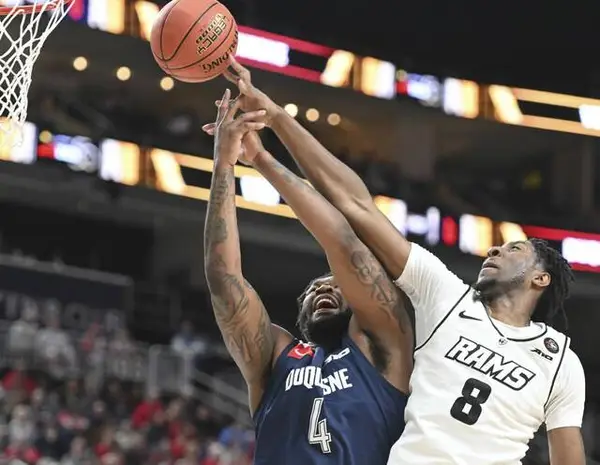
Duquesne head coach Dru Joyce III talked about it after his team’s final road game of the year, a 64-52 loss at Rhode Island.
The Dukes’ defense held URI to just 9-25 shooting from the floor (1-11 from the three-point arc) and 19 points in the first 20 minutes.
But Duquesne wasn’t much better, posting only 24 points themselves and missing 15 of their first 22 shots. It was a lot of defensive energy left unfulfilled by offensive inefficiency.
The vibes around the second half of Friday night’s 71-66 Atlantic-10 quarterfinal loss to VCU at PPG Paints Arena were all too familiar to that contest.
Duquesne came out of the locker room down 39-29. Eight minutes later, the Rams had only posted two field goals and five total points. But the Dukes couldn’t get the deficit any lower than three points.
“There was a (moment) in the first half that we missed some shots. We have some possessions that could have been better, and when those things happen, the solution is you’ve got to get tougher, and we find ourselves down by 10 points because we weren’t tough enough,” Joyce said. “We didn’t have enough grit to make sure that (next) defensive possession is going to be better. So we flipped the table in the second half, regardless of make or miss. We made some shots during that run. We missed some, but we continued to get stops no matter what.”
VCU coach Phil Martelli Jr. was somewhat reluctant to throw all of the credit at the feet of his own defense for holding the Dukes at bay.
“We had some defensive breakdowns in that stretch, and they just missed some shots. But when we were playing it right, we were pretty good,” VCU coach Phil Martelli said. “I thought we gave up some shots, but I also thought we did a good job, rearing into some of those Duquesne guys — into their legs. So now those shots — (Tarence) Guinyard had a wide open one that was short — I think it’s because he had to play yesterday, and now we’re picking up 94 feet every play. So it all flows together.”
That’s been an unfortunate consistency for Duquesne the last three weeks of the season. It was a team that made significant strides defensively during the course of the season, but the offensive efficiency faded.
Starting with their 62-61 win against La Salle on Feb. 18, the Dukes averaged just 65.5 points per game over the last eight contests. Over the first 12 conference games, Duquesne posted 78.2 points per game.
“We played like our backs were against the wall, and we had nothing to lose. We just played grittier, from the start of the second half,” senior Alex Williams said after a 20-point effort against VCU. “The game just kind of shifted a little bit in our hands. Creating those turnovers, trying to get some momentum. Just try to fight, fight, fight. We came up short. But I can’t really be too upset about it, because I know everybody did everything in their power. Everybody played hard, everybody gave everything they had. So if we do that, I’m cool with the result.”
For a seven-game stretch from Jan. 24-Feb. 18, Duquesne’s offense and defense meshed to the degree that they won six of them and were able to rise up to a third-place tie in the conference.
“Transition defense wasn’t really the best at times, picking out our matchups, running back to our matchups. So it kind of put us in bad situations,” Dixon said of the team’s early season performance. “We improved upon that, especially down the stretch — getting back on defense better, sprinting back, especially underneath the basket. We corrected.”
But that nexus hit its high point a little too early as the Dukes dropped five of their final seven outings.
Against the second-seeded Rams, the seventh-seeded Dukes simply couldn’t afford to have that mix off as much as it was in those crucial moments of what eventually became a one-possession game.
“You have some shots that you can make, and you just miss,” Joyce said. “I thought in the first half, our ball movement got slow. Our pace got slow. In the second half, we got some makeable shots. We were down three. We had three from three that were really good looks that we didn’t make. We had chances around the basket as well.”
To Williams’ point, Duquesne’s effort against a potential NCAA tournament team was worthy and one he should be able to live with in defeat.
Unfortunately, until November of next year, the program is going to have to do exactly that.