
GRINDAVIK, Iceland — As a swarm of earthquakes and volcanic eruptions began to rip through southwestern Iceland in late 2023, a firefighter named Helgi Hjorleifsson jumped into action.
Lava was heading toward the evacuated town of Grindavik, a power plant and the Blue Lagoon — one of Iceland’s most popular tourist attractions.
Hjorleifsson was tapped to lead a team of firefighters trying to do the unimaginable: Cool the lava enough to control it.
The firefighters and other emergency responders managed to protect the power plant, the lagoon and most of the houses. But now, another eruption could be imminent. And when it comes, Hjorleifsson, 47, will be ready.
“The earth is ready to blow up,” Hjorleifsson (pronounced hyor-LAYV-son) said on a recent afternoon as he drove a New York Times reporter and a photographer around the eruption site in southern Iceland, where the lava field still steamed in the freezing air.
If and when that happens, Hjorleifsson — 6-foot-5, soft-spoken and with a strong aversion to public speaking — most likely will be back in front of cameras to explain one of Iceland’s biggest crisis management efforts in recent memory. And he would most likely face another bout of dangerous front-line work that keeps him away from his three daughters — who are 15, 17 and 22 — and his wife, an opera singer.
But he knows he has a duty: He is Iceland’s only “lava cooling manager” — or “hraunkælingarstjori” in Icelandic.
“It’s definitely going on my tombstone,” he joked.
‘It’s So Crazy, This Idea’
More than two years ago, as the earth seethed, Icelandic officials scrambled to make a plan.
The first eruption in that area came just days before Christmas in 2023. Within hours, lava was about a mile and a half from the fishing town of Grindavik, whose 3,500 residents had fled their homes. Billowing smoke and lava fountains reached more than 300 feet into the air.
So they came up with a daring idea. If they could not stop it, could they at least steer it?
“It was a little bit of an experiment,” Hjorleifsson said.
They knew that was possible — at least, in theory. Icelanders had managed to protect a harbor from lava once before, in 1973.
But there were few records about how they had pulled it off, Hjorleifsson said.
So they were basically flying blind.
First, they built curved earthen barriers that towered some six stories high to act a bit like levees on a river. As the lava approached, Hjorleifsson said, they realized that they would also need to cool it down so it couldn’t flow over the barriers.
The theory of how to do that was almost absurdly simple, he said: “If you put a lot of water on hot stuff, it is going to be cold.”
They gathered all the spare pumps and hoses they had, but soon realized the equipment was too small. So Iceland bought enormous pumps and hoses the width of dinner plates, which branched off like arteries into smaller hoses to move the water faster.
Firefighters lugged those up the barriers and pointed the nozzles at the edge of the flowing lava.
They had to be careful, Hjorleifsson said. Too much water could weaken the barriers. If water got trapped, it could lead to an explosion of steam. And cooling the wrong spot could send lava streaming in the wrong direction.
“You cannot spray water wherever you want,” he said. “You can do a lot of harm instead of good.”
Sometimes they worked late into the night as the northern lights flickered green overhead.
At news conferences, Hjorleifsson tried to reassure skeptics that the miles of new hoses and pumps Iceland had bought would be worth it.
“There were a lot of people that said: ‘You’re stupid,’” he said. “‘This is pointless.’”
He added, “I completely understand. Because this idea — it’s so crazy, this idea.”
‘If You Don’t Try, You Never Find Out’
Fighting lava, like fighting fire, is dangerous. But fire burns quickly. Lava is slow.
That means whoever leads a team of so-called lava coolers needs a marathoner’s mentality to maintain morale, keep up safety standards and attack each day with a quiet intensity.
When Hjorleifsson was 10, his mother — fed up with his boundless energy — sent him to help out on a farm.
The first day was excruciating, he said. He had to shovel out a sheep barn. By nighttime, when the farmer came to check on him, Hjorleifsson held out his small, blistered hands.
He asked for gloves. The farmer gently said no. “‘Helgi,’” Hjorleifsson remembered the farmer saying with a smile, “‘gloves and cream are only for old people.’”
Soon, his palms hardened. During summer after summer at the farm, he said, he learned to never complain and to always keep going.
“That made me the man I am today,” he said, driving over a new road created after lava had buried the old route. The barriers were high, curved walls with a tumble of black lava on one side and a parking lot for the Blue Lagoon geothermal spa on the other.
“One thing I just hate is people that just say, ‘Oh, you cannot do this. This is not possible,’” he said.
“At least try!” he continued. “If you don’t try, you never find out.”
Olafur Loftsson, project manager for volcano response efforts by the country’s civil defense agency, said that Hjorleifsson grew into the role and became the leader that Iceland needed during the chaos.
“It’s not like you run to the store and buy the handbook ‘How to Cool Lava,’” he said. “Helgi has become a kind of expert.”
‘My Dad Can Do Everything’
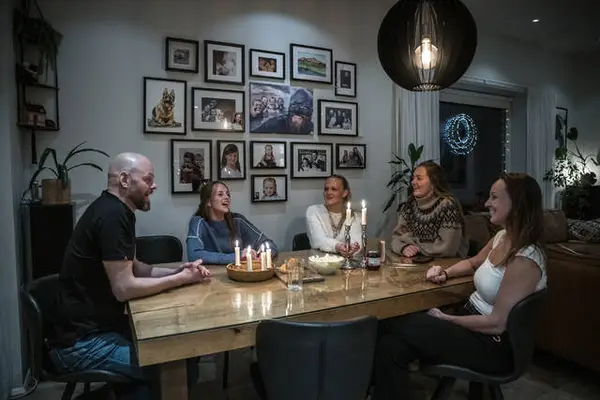
Until the lava, firefighting was just a job, Hjorleifsson said. He worked his shifts. He built houses in his spare time. And he and Maria Jonsdottir, his wife, ate dinner nearly every night with their three daughters at home in Kopavogur, a town south of the capital, Reykjavik, and about a 45-minute drive from the eruption site.
She would cook, sometimes roasting a lamb from his sister’s flock. He would carve. The girls would tangle on the couch as they bubbled about successful swim meets or bemoaned having to read Icelandic sagas in school.
When the lava started to flow, Hjorleifsson began putting in long days, returning home just to sleep.
His children weren’t scared — “My dad can do everything,” Berglind Ran Helgadottir, their eldest, said before a recent dinner — but the worry was always there.
“It just stays with you in the back of your mind,” said his wife.
Early on, she joined him to help evacuate Grindavik. Families had mere hours to pack up their homes, which could soon be lost to lava or cracks in the earth.
Many grabbed essential documents or jewelry. But one man, a composer who was fighting cancer, just wanted to be with his piano. So Jonsdottir stood behind him as he played, singing one of his pieces in her ringing, clear voice. Hjorleifsson watched, comforting the man’s wife as she wept.
For that moment, the frenzy stilled as one couple helped another say goodbye to their home as best they could.
‘I Want to Be Here When That Happens’
Soon, there may be more destruction. The inflow of magma to the area has reached a record amount, according to Iceland’s meteorological office.
In the worst-case scenario, another fissure could strike the protective barriers around the lagoon and power plant, said Magnus Tumi Gudmundsson, a volcanologist who advises the civil defense agency. And then, no amount of water or equipment could stop it.
“For that,” he said, “you would need the Nile.”
Icelandic officials plan to conduct a larger assessment of whether the lava cooling was worth the cost, once the volcanic activity calms. But Runolfur Thorhallsson, the director general of the civil protection unit, said the plan was to continue as before.
“The initial assessment is in favor of lava cooling,” he said. “It had benefits.”
Most houses in Grindalvik were still empty, though officials hoped to reopen the school. Hjorleifsson said the very fact that the town was still standing meant the fight against the lava was worthwhile.
“The town would not be there, and the power plant would not be there, and the Blue Lagoon,” he said. “That would be all gone.”