
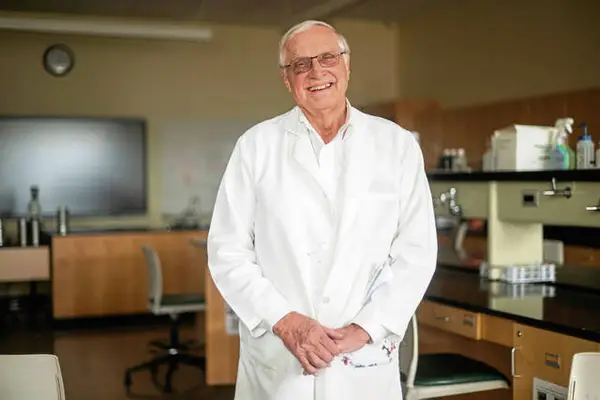
Microbiology professor Francis Maxin has taught at Community College of Allegheny County since it opened its doors 60 years ago. He has no plans to retire anytime soon.
“How can I retire? The college can’t afford my retirement present,” Maxin joked. “I want a BMW with a heated steering wheel.”
Maxin, the fourth youngest in a family of 12 children, grew up in Coraopolis. He discovered his love of teaching after graduating from high school and enrolling in a biology program at what is now Gannon University in Erie.
He taught two years at Duquesne University before joining the community college’s inaugural staff of 75 educators in 1966. At the time, about 1,500 students — ranging from ages 16 to 61 — were enrolled at the college’s Allegheny campus on Pittsburgh’s North Side and at its Boyce campus in Monroeville.
Maxin recalls people looking to be among the college’s first students waited in a line that wrapped around the admissions building.
Some courses that year were taught in hallways in the absence of sufficient classroom space for the incoming students working toward degrees in fields such as liberal arts, business administration, data processing and computer programming, mechanics and commercial art.
Today, the college employs more than 1,800 full- and part-time faculty and staff. It offers more than 130 academic programs across four campuses and educates more than 14,700 students, as of the start of the spring semester.
The majority of the college’s employees — 77% — live in Allegheny County, contributing nearly $107 million in income to the local economy, according to a 2025 economic impact report. The 18% of students who come to the college from outside of the county add more than $26 million to the region, the report says.
The hundreds of thousands of students who remain in the county after graduation added about $2 billion to the local economy in 2023-24, according to the report.
But, in Maxin’s assessment, at least one aspect of the college hasn’t changed across six decades — and it’s what drew him to apply for his job in the first place.
“We’re not the typical campus where you get students between the ages of 18 and 24. And I think we get students that are not on the rich side of life,” Maxin said. “I think most of them come from limited means like I do, and I thought that population would (better) fit my career. Because, after all, I’m from a family of 12 myself.”
President: ‘We had to … rightsize our institution’
It hasn’t all been smooth sailing for the college.
Enrollment has been on a steady decline since 2008-09 — when colleges and universities nationwide saw a surge in student populations ahead of the Great Recession.
Nearly 40% of the country’s young adults, between ages 18 and 24, were enrolled in either a two- or four-year college in October 2008, according to Pew Research Center. Exactly one year prior, this figure was just shy of 11%.
Allegheny County’s community college enrolled more than 31,200 students in 2008-09. In 2019-20, enrollment dropped to about 24,300. Enrollment has remained steady — between 17,300 and 17,600 students — since 2022-23.
About 14,700 students have enrolled so far this school year. Late spring and summer session enrollment has yet to be factored in.
The decline in enrollment forced the college to rethink and pare its previous 160 academic programs, said college President Quintin Bullock. The college dropped about 30 programs because of low student interest, he said.
“We had to repurpose, redesign and rightsize our institution based on the current environment we are in,” he said. “That’s what CCAC has done successfully to position the college to continue to do the work that everyone is passionate about and ensure that we are offering what the demand is versus just continuing to do what we’ve always done.”
College leaders, for example, reworked the engineering program to focus more on mechatronics and applied engineering, said Chief Academic Officer Stephen Wells.
“It prepares our students for what employers in the region need them to be able to do,” he said.
The college plans to renovate the biology lab and make multiple roof repairs at its Boyce campus starting this summer, Bullock said. The project will be supported by nearly $6 million from the state Department of Education, according to a statement from state Rep. Brandon Markosek.
It’s an example of one of the college’s goal for the next 60 years, Wells said.
“Going forward, that’s what the college hopes to maintain: to have state-of-the-art facilities and committed and well-prepared faculty coming in to teach,” he said. “A lot of our faculty could teach anywhere, and they choose to teach here at CCAC, because they love being in the classroom with our students.
“We try to give them what they need to support that.”
‘The college of second chances’
Wells attended the college as a student after previously studying forestry at Virginia Tech, serving in the Air Force and getting laid off from a construction job.
He was hired as an English professor at the college in 2002 but has worked as an administrator for 2½ years.
“I like to think of us as the college of second chances, third chances, because it was my second chance, maybe third,” he said. “I have a lot of students who fit into that group.”
Maxin estimated that he has taught more than 20,000 students throughout his tenure. Many of them are looking to pivot their career path — including military veterans and people with doctorates aiming to start in a new field. He’s taught a few senior citizens who have enrolled in his class to learn something new.
“We have serious students. We have not-so-serious students,” he said, “and I think the community college has supplied the genius to take those non-serious students and put them into a career.”
Maxin keeps a file on his highest achieving students. A stack of them is tucked away neatly in a filing cabinet in his office.
After years of familiarity with the subject, he teaches his microbiology lessons without notes, drawing the information directly from his memory.
He ropes his light-hearted humor — or, as he calls it, his pizzaz — into each lesson.
And he tells his students the same life lesson every semester.
“My wish that I give to every student is that I hope they find the career that they’re going to be as happy with as I have been with mine.”