
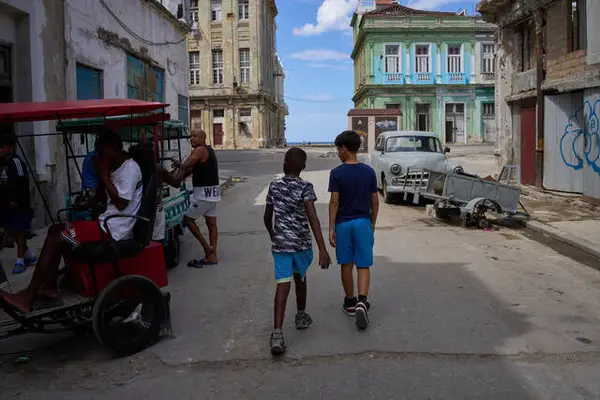
President Donald Trump on Monday raised the possibility of the United States “taking” Cuba, telling reporters at the White House, “I do believe I will be having the honor of taking Cuba.”
“Taking Cuba. I mean, whether I free it, take it. I think I can do anything I want with it,” he said. “They’re a very weakened nation right now.”
Trump: Cuba, it's a beautiful island. Great weather. I will be having the honor of taking Cuba. Whether I free it, take it. I think I can do anything I want with it, if you want to know the truth pic.twitter.com/Po7J9tJMr2
— Acyn (@Acyn) March 16, 2026
The president’s words came on the same day that Cuban officials planned to announce at an evening event that the country’s communist government would open itself to foreign investment, including from the United States.
“Cuba is open to having a fluid commercial relationship with U.S. companies, also with Cubans residing in the United States and their descendants,” Cuba’s deputy prime minister, Oscar Pérez-Oliva Fraga, told NBC News in an interview published Monday morning.
It is unclear how widely Cuba intends to open its economy, or how the moves compare to those made a decade ago during the years when Barack Obama was president. But the announcement comes as the island’s communist government faces a severe humanitarian and energy crisis, with some experts saying the island could run out of fuel within weeks because of a de facto blockade by the Trump administration.
For the past three months, the United States has choked off Cuba’s access to foreign oil, blocking shipments from Venezuela and elsewhere. Frequent blackouts have followed — including a broad power outage Monday — and hospitals have had to postpone some procedures, deepening a humanitarian crisis that has also involved food shortages and has led to rare protests on the island.
The Cuban government responded online Monday to the NBC interview, saying that “Cuban citizens living abroad, in places like Miami, will be able to invest in the private sector and own businesses in their native country.”
The Obama administration also opened business opportunities for American investors in the Cuban private sector, but the Cuban government stalled the moves, and the Trump administration rescinded Obama’s measures.
The government will also announce that it is open to investments beyond the private sector, including in the country’s aging infrastructure, Pérez-Oliva Fraga also reportedly told NBC.
But because of the decades-long U.S. embargo, Cuba is not easily able to attract U.S. capital, said the deputy prime minister, a key figure in its economic policy.
A person close to the negotiations said that the Trump administration was waiting to see whether the changes announced Monday would be truly structural and meaningful — not simply cosmetic — before deciding whether to issue licenses that would allow such investments. The person asked not to be identified because he was not authorized to speak publicly about sensitive diplomatic matters.
Carlos Gimenez, a Republican member of Congress from Florida who is Cuban American, said on social platform X on Friday, in Spanish, “There will be ZERO investment from the US unless there is MAJOR political change on the island.”
The Trump administration has warned that if Cuba does not make changes, it could face a fate similar to that of Venezuela. In January, the U.S. military captured the Venezuelan leader, Nicolás Maduro, after he refused to step down.
On Friday, Cuban President Miguel Díaz-Canel acknowledged in a televised appearance that his government was engaged in talks with Trump administration officials to resolve the standoff.
In his 90-minute appearance, Díaz-Canel said that a decision to be announced Monday would “greatly facilitate” the participation of Cubans abroad in the island’s “economic and social development program.” It appeared to be a strong suggestion of a change in economic policies to allow Cuban Americans and others around the world to own businesses and invest in the private sector on the island.
Demographers estimate that more than 2 million Cubans have left the country in the past five years. In his address, Díaz-Canel said, “It is our responsibility as the government to embrace them, listen to them, tend to them and offer them a space to participate in the economic and social development.”
Some Cuban exiles in Florida and elsewhere have for years pushed for the Cuban government to allow Cubans overseas to invest in the nation’s economy.
Cuban officials have signaled to some Cuban Americans that Monday’s announcement will involve allowing exiles to return to the island freely and to run a type of enterprise that was legally recognized by the government in 2021. Those entities are allowed to import goods, provide services and create jobs, and they have quickly become crucial to the Cuban economy. Private supermarkets, for instance, have higher prices than state-run stores but carry a far broader selection of food.
For more outsiders to enter and run businesses in Cuba, the U.S. government would have to ease restrictions on traveling and doing business on the island.
Hugo Cancio, a Cuban American in Miami, has been running perhaps the most visible U.S.-owned business in Cuba for years. His e-commerce platform, Katapulk, has become a sort of Cuban Amazon, allowing Cubans abroad to order and ship goods to their friends and relatives still in Cuba.
Cancio built Katapulk as a U.S.-based entity with a special license to form partnerships with businesses in Cuba, which deliver the goods on the ground. But that structure has been complicated, and U.S. government restrictions have at times hamstrung operations, he said.