
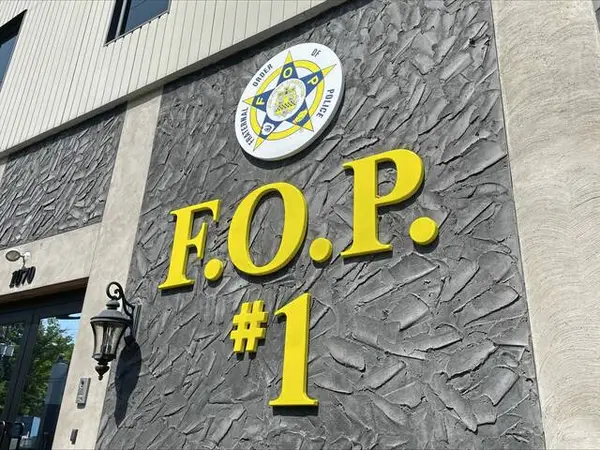
Pittsburgh police union leaders fear city officials may plead poverty Wednesday morning when they furnish new information to arbitrators preparing to set the terms of the police bureau’s next contract.
Last week Mayor Corey O’Connor revealed the city’s finances were in worse shape than he knew and warned this year’s budget could face a $40 million shortfall.
Contract talks stalled late last year under then-Mayor Ed Gainey when the Fraternal Order of Police Lodge No. 1 declared an impasse in negotiations.
The matter went to a three-member arbitration panel Dec. 19, less than two weeks before a contract covering most of the city’s nearly 800 police officers expired.
But things have changed for Pittsburgh since December.
O’Connor, sworn in days after City Council approved a 20% property tax hike, stressed Pittsburgh needs to tighten its financial belt to address gaping budget holes.
The city, which ran an $8.6 million budget deficit last year, had to spend $44 million from its reserve fund to make ends meet.
“It’s not going to be easy, the decisions we have to make,” O’Connor told reporters.
Pittsburgh’s move to reopen the record to “present additional financial information” after the contract already had headed to arbitration is “unprecedented,” according to police union president Robert Swartzwelder.
City officials asked permission from arbitrators in January to provide additional, unspecified information, Swartzwelder said. The panel agreed on Feb. 27 to allow it.
The meeting between both sides is set to take place Downtown in the City-County Building at 10 a.m. Wednesday.
City officials are in the midst of contract talks with the police union and the Teamsters, which together represent police, public works employees and animal control staff. Their resulting contracts will cover more than one-third of the city’s entire union workforce.
The Teamsters union did not respond to multiple emails and phone calls seeking comment.
Most of Pittsburgh’s roughly 3,500 city-paid employees are represented by a union — more than 75%, according to Dan Gilman, O’Connor’s chief of staff. The Fraternal Order of Police, which represents rank-and-file officers, signs the city’s largest union contract.
Swartzwelder, who attended O’Connor’s recent budget press conference, declined to discuss ongoing contract talks. So did city officials.
O’Connor earlier this month told a TribLive reporter he was not aware of the city’s move to reopen the arbitration record.
Mayor’s focus
Several union leaders, including those representing Pittsburgh firefighters and paramedics, told TribLive they couldn’t think of a time when a municipality supplemented the record in a pending arbitration over a contract.
“When I heard about it, I was pretty surprised,” Pittsburgh firefighters union head Ralph Sicuro said.
“I have 50 police departments and I can’t think of any time that has happened,” added Carl A. Bailey, who leads Teamsters Local 205, which is based in White Oak and represents dozens of police forces throughout Western Pennsylvania.
The latest development, though, might be less about finances than a new mayor wanting to weigh in on the city’s largest labor deal.
“Contracts sometimes expire with the end of a mayoral term — I wouldn’t say there’s rules about it but it happens,” said Philadelphia-based attorney Richard G. Poulson, who’s worked for nearly 30 years in labor law. “Collective bargaining doesn’t happen in a vacuum … every new mayor wants to pay special attention to the police contract. And, if I were a new mayor, I’d want input in that process.”
Another expert stressed what’s typical or not typical in talks such as these is relative.
“It might be unusual — if by unusual you mean it doesn’t usually happen,” said Christopher Gabriel, a longtime Pittsburgh-based labor attorney who represents municipalities in contract talks. “If you’re not the one requesting this, you’re going to say ‘We shouldn’t do this!’ and ‘It’s irregular!’ ”
Gabriel said there might be an overarching strategy at work.
“Most times, it would be an attempt to influence the arbitrators’ decision,” Gabriel said. “There may be times it doesn’t make a difference … and there are times the elected officials change, and everything changes.”
‘No money’
Experts say governments and unions alike need to keep the bottom line in mind during contract talks.
“I always want to fight for the best wages and benefits for my guys,” Pittsburgh EMS union president Jon Atkinson said. “But the city only has so much money.”
When the city wasn’t on such hazardous financial footing, the EMS union inked a contract with Gainey in 2024 that handed 200 paramedics and EMTs a 15% pay raise over four years, making Pittsburgh “the best compensated paramedics in the region,” Atkinson said.
Sicuro secured a 2024-2028 firefighters contract with the Gainey team that provides 21.5 % in raises over five years.
“Pleading poverty is a constant,” Sicuro said recently. “There’s always ‘no money.’ ”
Sicuro said he is encouraged by what he’s seen so far in the O’Connor administration.
“I’ve always worried about city finances, no matter what,” he said. “But I have confidence in this new administration, that they’re prepared to deal with the short-term issues … and I think they also have a long-term plan.”
Staffing scramble
Police staffing continues to be a problem in Pittsburgh. Last summer, the city’s police ranks plummeted to a 20-year low as the city confronted weekend chaos on the South Side, tackled persistent concerns about Downtown crime, and prepared to keep crowds safe during the 2026 NFL Draft in April.
In August 2025, the police bureau employed 755 sworn officers — its fewest since 2005. That number is up to 783 officers this month.
The Gainey administration, if its negotiations last year with police are a gauge, offered contract terms that could make things worse, experts say.
One deal the Gainey team offered would have increased Pittsburgh police salaries 8% over three years, with 1% the first year, according to documents reviewed by TribLive.
Poulson, the Philadelphia labor attorney, called the proposal for the first year “ridiculous” and “insulting.”
“You know what 1% is going to do? If they’re understaffed now, it’s going to make it worse,” Poulson said. “If you’re understaffed, you have to invest in the people working in your police department.”
“I don’t know how Pittsburgh even gets guys,” added Bailey, from the Teamsters union. “I’ve got — what? — 15 departments that are paying six figures.”
Data show Pittsburgh police are paid less than most of their peers in Allegheny County — and throughout the state.
Under the city police union’s most recent contract, a rookie in Pittsburgh makes $65,000.
Nationwide, the mean salary for a police officer was $79,320 in 2024, the most recent data available, according to the federal Bureau of Labor Statistics. In Pennsylvania, that figure was higher: $83,130, putting the Keystone State roughly on par with Florida, Arizona, Minnesota and Connecticut.
Looming decision
The three-member arbitration panel often takes about three months to pen its binding decision once talks have reached an impasse, according to the police union’s Swartzwelder.
With the matter going to arbitration in mid-December, a decision could arrive this month or next.
There is nothing, though, from stopping the two sides from making a deal when they meet Wednesday, Poulson said.