
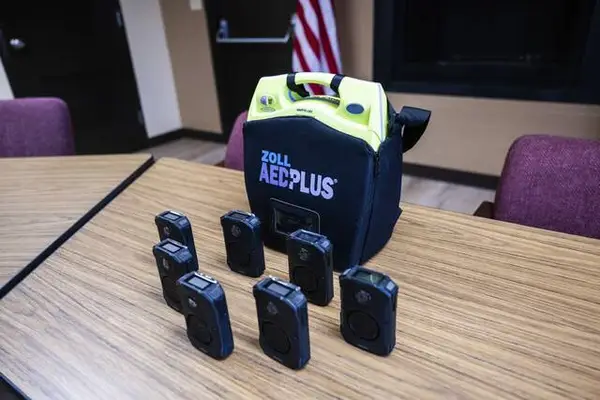
Arnold Mayor Shannon Santucci said getting body-worn cameras for police officers was one of her top priorities coming into office.
Now that the department has them, she hopes they’ll help to protect those officers and the community.
“(It will be beneficial) if there are any questions of legal disputes on use of force — sometimes we get complaints on how they talk to people, how they treat people, how people respond to them as well,” Santucci said.
The equipment’s $13,350 cost was split with Westmoreland County District Attorney Nicole Ziccarelli’s office.
Santucci said the city will pay for its half over three years.
In a written statement, Ziccarelli said it is a “privilege” to enhance the resources for public-serving agencies.
“It takes the burden off of our municipalities while keeping our streets safe and preventing criminal activity,” Ziccarelli said.
Police Chief Robert Haus said the cameras can improve transparency, accountability, public health response and officer safety. He said department policy is for officers to turn the cameras on for all calls.
“Body-worn cameras assist the police and public with liability,” he said.
Footage also will be used for officer training.
Reviewing officer responses will help the department be more cognitive of how it is interacting with the public, Haus said.
Leah Jacobs, a social work professor at the University of Pittsburgh, said research on body-worn cameras shows mixed results.
“The most influential study was done in 2015 and that found some significant reductions in use of force,” Jacobs said.
Subsequent studies, however, show the effects are more varied and depend more on whether officers had discretion in terms of turning their cameras on and off, Jacobs said.
She noted a recent Campbell Systematic Review study released in 2020 that states body cameras can reduce citizen complaints, but it couldn’t determine whether they reduce use of force.
A more recent study released in 2024 by the Pennsylvania Legislature’s Joint State Government Commission reached similar conclusions that there is evidence that body cameras in the state have led to more positive interactions between police and the public, but the study was unable to conclude the cameras reduce use of force by police because of the wide range of incidents recorded by the cameras.
A little more than half of the municipal police departments surveyed responded to the commission. Key findings of the survey include:
• 75% of the responding departments have 22 or fewer fulltime officers;
• Of the respondents, 77% use body cameras;
• 95% use camera footage for supervisor review;
• 96% use camera footage for evidentary review;
• More than 80% use camera footage for officer training.
Last year, all State Police stations were equipped with body worn cameras for troopers to wear on duty.
Jacobs said using footage for training would be a great use of the equipment as long as the person reviewing footage had ethical discretion and wasn’t “vulnerable to a lot of the incentives that exist within law enforcement to hide problems.”
While police accountability should include studying equipment benefits, she said, it should also ask questions beyond that.
“Because the evidence is mixed, that means that they could be causing more problems in some places, no change … in other places, and improvements in some places,” Jacobs said. “Policing is a very complicated institution, and it has very strong internal culture and structural factors at play.
“With any kind of reform, we have to think beyond these sorts of individual technocratic solutions to also encompass broader work to shift police culture towards community accountability.”
Santucci said the cameras will show the full account of police action, making for more accurate accounts of interactions.
“As a retired police officer, I just feel like if officers are doing everything the right way, it’s just an extra shield of protection for them to ensure that you know the public is not just misjudging what they’re doing or making judgments on police officers when they’re trying to do the right thing,” she said.
The department also received an automated external defibrillator, donated by the ZOLL Corporation.
Haus said it’s a great benefit to the force as early action is key to preventing cardiac arrest-related death.
He noted a situation in October when he and his wife administered CPR and AED services to a Lower Burrell man at a grocery store.
“It can happen to anyone at any time,” he said.