
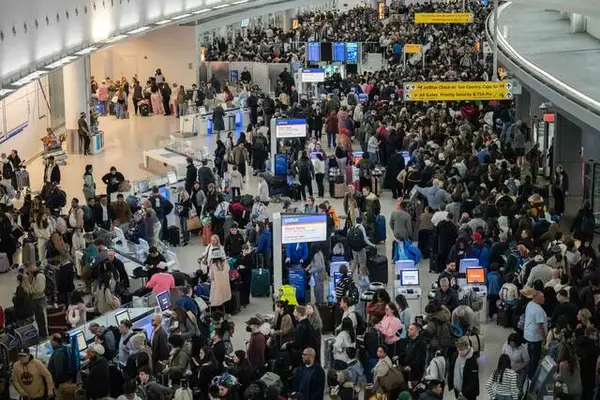
Tom Homan, the White House border czar, confirmed Sunday that Immigration and Customs Enforcement agents will be deployed to U.S. airports Monday, casting the operation largely as an effort to ease long lines that have caused frustration among travelers during one of the busiest travel seasons.
President Donald Trump announced the measure Saturday, first as a threat aimed at pressuring congressional Democrats to agree to a deal to fund the Department of Homeland Security, which includes the Transportation Security Administration, and then as an aggressive operation. He said agents would “do security like no one has ever seen before,” which would include “the immediate arrest of all illegal immigrants who have come into our Country.”
In an interview on CNN’s “State of the Union” on Sunday, Homan said that his agency was drawing up plans for deployment and stressed that ICE agents would help support security officials whose ranks have thinned as thousands have gone without pay amid a partial government shutdown.
“It’s a work in progress, but we will be at airports tomorrow, helping TSA move those lines along,” Homan said.
With the deployment less than 24 hours away, administration officials apparently have not nailed down many details. Homan said that “his opinion” was that agents would concentrate on airports with long wait times at security, prioritizing ones with lines of about three hours. He said that agency heads were still discussing how many agents to deploy, how quickly to deploy them and to where.
He said more concrete plans would be made this afternoon.
“When we deploy them more, we’ll have a well-thought-out plan to execute,” Homan said.
Homan noted that ICE agents were already working in airports, doing immigration enforcement and conducting investigations into reports of criminal activity such as smuggling. He also said that the ICE agents — who are still being paid while TSA agents are not — are also “well trained” in security and identification.
But he indicated that the bulk of their work would be to cover exits and other areas that TSA workers are now staffing in order to free up agents to do screenings and other functions to help reduce lines.
“This is about helping TSA do their mission, and get the American public through that airport as quick as they can, while adhering to all the security guidelines and the protocols,” he said. “We’re simply there to help TSA do their job in areas that don’t need their specialized expertise.”
Rep. Hakeem Jeffries, D-N.Y., the minority leader, blasted Trump’s idea Sunday.
“The last thing the American people need is for untrained ICE agents to be deployed at airports across the country potentially to brutalize or to kill them,” he said during an interview on CNN’s “State of the Union,” referring to the killings of two American citizens in Minneapolis in January.
Mike Gayzagian, a TSA officer at Boston Logan International Airport and the president of the American Federation of Government Employees Local 2617, which represents TSA employees across New England, said he was unsure whether ICE agents would show up to airports in his region Monday. If they did, he said, they were not likely to be of much help, especially if they were stationed at exits as Homan suggested.
Gayzagian said the administration’s move shifted attention from the larger issue at hand: “None of this would be happening if Congress had just simply decided to pay us,” he said.
Johnny Jones, a TSA officer at Dallas Fort Worth International Airport and a secretary-treasurer with the American Federation of Government Employees, the union representing nearly 50,000 TSA officers, said stationing ICE agents at airports would “be a distracting scenario to say the least.”
He said ICE agents’ presence could make airports less safe because of the widespread public anger at immigration officers’ recent conduct. He added that placing paid immigration agents next to unpaid TSA agents would inflame frustrations.
“All we want is a paycheck,” Jones said. “We don’t need all these optics.”