
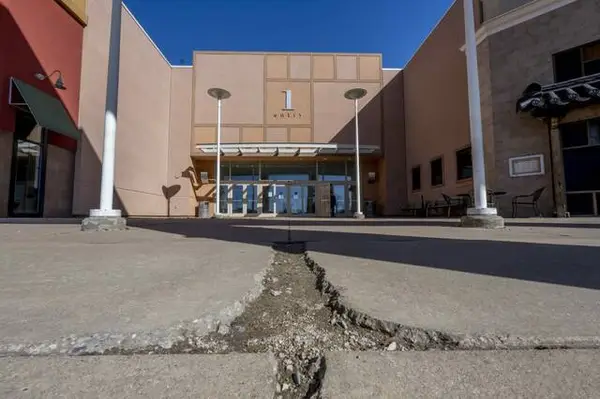
With spring weather could come accountability for Pittsburgh Mills mall owner Namdar Realty Group.
At least that’s what Frazer Zoning Officer Bill Payne is hoping for.
“Since all the roads and all the other code enforcement stuff were on the exterior of the property, and with all the weather and the snow we’ve had, there was a lull in everything,” Payne said.
Namdar is the Long Island-based owner of the individual limited liability companies that operates what is formally known as the Galleria at Pittsburgh Mills. It has been slowly making long-awaited repairs throughout the complex.
Before winter hit, shoppers at the Mills complex saw the milling and paving of pothole-riddled Village Center Drive, which runs in front of Lowe’s, Ross and Aldi. Galleria Drive, just off Pittsburgh Mills Boulevard, the site’s main entrance, quickly followed.
Despite the slow and steady progress shoppers were seeing, the property owners are at risk of having a warrant issued for their arrest, according to court documents.
In a January hearing before District Judge Micheal Girardi, the owners pleaded guilty to citations regarding the mall’s pylon signs that can be seen from the road. Fines from that hearing amounted to around $3,000, Payne said. According to court documents, each of the four LLCs was fined more than $700.
The full payment was due Feb. 17. Those fines have not been paid, Girardi’s office said in response to a request from TribLive.
Because of the nonpayment, a payment determination hearing is scheduled for Monday, March 23 before Girardi.
If fines are not paid or representatives of the LLCs do not appear at the hearing, a warrant will be issued, the magistrate’s statement said.
Current condition
As the weather warms up, township officials remain in contact with Namdar, Payne said.
“I would ultimately like to see all the roads be done,” Payne said.
Pittsburgh Mills Boulevard, Fashion Drive, Retail Drive, Value Drive and the mall’s rear entrance road, Mills Drive, need to be repaved, he said.
In addition to road conditions, Payne previously issued citations regarding high grass and landscaping, neglected sidewalks and mall doors being rusted shut. He said those issues have not been addressed.
“They had some concrete work that needs to be done that couldn’t be done through the winter,” Payne said. “The exterior doors were hard to resolve at that time as well.”
He said Namdar is aware they need to continuously address issues on the property.
Namdar officials did not respond to TribLive requests for comment.
Millions owed in fines
So far, Namdar owes the township $17.6 million in fines after a November hearing before Allegheny County Judge Thomas Flaherty.
James Berent, an attorney representing Namdar, and Alexandra Farone, an attorney representing Frazer, did not respond to inquiries about how much, if any, of the $17.6 million in fines have been paid.
According to court documents, a non-jury trial is scheduled for Monday, March 23 in front of Allegheny County Judge Jill Rangos for criminal charges filed by the Allegheny County District Attorney’s Office in April 2025.
Namdar was charged with one misdemeanor count of creating a public nuisance.
Efforts to keep improvements on track have been time consuming, Payne said.
“It’s definitely consuming a lot of manpower, if not a lot of energy for the township,” Payne said.
He said there have been many conference calls between Namdar and the township in an attempt to keep the projects moving forward.
“This is the first week it hasn’t been miserably cold and that it’s trending to stay warmer,” Payne said. “Now we can actually hold them accountable for doing those things. … It just wasn’t fair for us to hold them accountable when they couldn’t do the work.”
Payne said he expects more activity on Namdar’s part in the coming months.
“They are actively trying to sell the mall, so we will see where that goes,” Payne said.
Buyers of last resort
Manus Clancy is head of data strategy at LightBox, a commercial real estate information and technology platform. He called the Mills mall one of the biggest losses the industry has ever seen.
He said the past 10 years have been very hard on shopping malls, and they almost have to be marketed as a lifestyle center to be successful. While the Mills was marketed as such when it opened in 2005, Clancy called its failure an outlier.
“It met the lifestyle destination that should’ve done better than it did,” he said.
In the mall industry, a “lifestyle center” is defined as combining upscale specialty stores with dining, entertainment and sometimes residential or office space, as described in a 2023 report from Chicago-based commercial real estate investing company Tri-Land. The spaces focus on leisure and experience rather than transactional shopping.
Entertainment, lifestyle and restaurant tenants are the name of the game in the current retail industry, according to Robb Paltz, associate managing director at Moody’s Ratings.
“Retail is so dynamic,” Paltz said. “It changes so frequently.”
There are a few shifts that could lead to a mall failing, he said, including a shift in the demographics of those who have access to the mall, or a change in environment or the economy.
“It could ultimately lead to the owner of the mall not reinvesting in the mall to get tenants that bring people into the mall to create that synergy,” Paltz said.
The lack of reinvestment leads to the exit of tenants and, with them, customers.
“You’re left with a property that has much less value,” Paltz said.
Malls create a shared ecosystem where landlords and tenants work off each other to get the most value they can out of a property.
He said the underlying value of a mall is a tenant’s profitability. And it falls to the landlord to create an environment that draws shoppers into the mall, Paltz said.
Official: Frazer’s legal pressure driving action
Despite seeing more action by the realty group lately, it has taken years to get to this point, Payne said. He credits this movement to the township’s wins in court.
“I would imagine losing in court is a significant motivating factor for them,” Payne said. “The way they run their business is typically done like this in every community. Most communities can’t get as much success at the local magistrate and then at the appeals court that we’ve been able to.”
Payne said he’s grateful for how seriously Girardi, the local magistrate, and Flaherty, the county judge, have taken the matter.
Township Secretary Lori Ziencik declined to comment on the matter.
“Namdar itself hasreallybeenabuyeroflastresort,”Clancysaid.
He said the realty firm frequently buys mall properties at pennies on the dollar and makes money from the rent it collects from tenants without investing any money back into the property. An October 2024 TribLive story, “Empty Promises: How Namdar Realty Profits from Pittsburgh Mills and Other ‘Dying’ Malls,” reported on Namdar’s tactics.
Clancy said it’s usually to the community’s disappointment since there’s hope the property could be refurbished or even rebuilt into something profitable.
Namdar purchased the Mills property in 2018 for $11 million.
“Rarely will they pour new dollars in,” Clancy said. “They just want to run it until the wheels fall completely off.”
Clancy said Namdar is well within its rights to operate this business model.
“There’s nothing illegal about this,” he said.
Looking ahead
Payne remains frustrated about the condition of the Mills property.
He said he sees businesses in the area investing money in their spaces to better the community. As an example, Payne said, SpringHill Suites Pittsburgh Mills, located across the street from the mall, is coming to the end of a five-month renovation project that addressed the exterior and interior of the building.
He said the Walmart located on the Mills property is making additions to its vendor list with the recent opening of a Dunkin’.
“They’re putting money back into the community and making the area better,” Payne said.
According to court documents, a public hearing is scheduled for April 16 in Girardi’s office regarding 32 continued citations stemming from the condition of the property’s sidewalks, walkways, stairs, driveways and parking spaces.
Possibilities
Namdar has been shopping the Mills property to prospective buyers for the past eight months.
An email received by some local real estate agents in June from Namdar Realty Group’s chief operating officer, Dan Dilmanian, said Namdar is “quietly exploring an off-market sale.”
Experts say the property can be used for various purposes should a sale happen. While it’s hard to re-create a mall, there are options for property use if a new owner enters the situation.
“In failed malls, when you’re repositioning it, the real estate that works best is really the part that stops behaving like a mall,” Paltz said. “That’s the pad sites and former anchors that might have value on their own.”
A pad site is a parcel that’s not attached to the mall but on the edge of the property’s parking lot.
Clancy said some of the more successful remedies he has seen are when the land is repurposed for housing, medical offices or creative spaces.
Taha Ahsin, assistant professor of finance at the University of Pittsburgh, said that a way to market a poorly performing or nonperforming real estate asset is to conduct a distressed sale.
“Here, the price will be the primary mechanism through which buyers are attracted to the property,” Ahsin said in an email. “A seller can also put more work into the property to make it ready for sale. This can include renovations, zoning permits or marketing it for alternative use.”
A prospective buyer likely won’t have a desire to keep the property as a mall, Ahsin said.
“Most buyers in this scenario won’t look for an opportunity to bring back to life a real estate asset with a specific use case that failed in the first place,” she said. “Instead, you will have buyers looking to rezone or renovate a nonperforming mall for office or residential real estate.”
She said large properties have the potential to be repurposed into something completely different.
“For example, Walmart purchased Monroeville Mall in early 2025,” Ahsin said. “Alternative uses for commercial real estate may also include residential units, either fully reused or integrated into a mixed-use transformation.”