
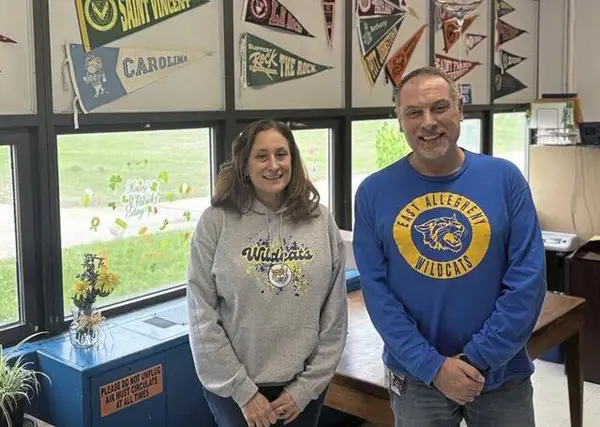
Emilia Mattucci and Joseph Pedulla, school counselors at East Allegheny Jr./Sr. High School, try to avoid what Mattucci calls “random acts of guidance.”
Rather than being reactive to students’ needs, the counselors focus on data-driven, planned lessons and conversations with students on topics ranging from social and emotional learning, to career readiness, to attendance.
This month, East Allegheny earned national recognition from the American School Counselor Association, receiving the Recognized ASCA Model Program designation for its school counseling program.
“The program is exceptional,” said R.J. Long, the school’s principal. “These two individuals do everything to provide services for our students.”
The East Allegheny School District serves East McKeesport, North Versailles,Wall and Wilmerding.
East Allegheny Jr./Sr. High School was also awarded the designation in 2014 and 2017. It is one of two schools in Pennsylvania to earn the recognition this year.
The designation recognizes schools whose counseling programs align with the ASCA’s national model. To be recognized, schools show that their counseling program proactively supports student success and provides access to academic, career and social and emotional development.
“It recognizes that you’re using a true framework and curriculum,” Mattucci said. “You’re not just doing random acts of guidance. You have goals, and are working with the school community and with students.”
One of East Allegheny’s focus points is reducing chronic absenteeism. Three years ago, the high school had a 51.2% chronic absenteeism rate, Long said. Now, it is down to 28%.
Chronically absent students miss more than 10% of the school year. The state average for chronically absent students is 26%.
Pedulla said some of the work counselors do to improve attendance includes small group and classroom lessons, and individual counseling with students who are chronically absent or are at risk of being chronically absent.
One of the barriers to school attendance, Mattucci said, is that students say they aren’t engaged in school. Long remembers a conversation with a student who didn’t think missing 31 days of school was a lot.
“They don’t see the importance of coming to school, therefore, they don’t come to school,” Mattucci said. “A lot of what is communicated with them is what their interests are, and that school is a path to their future.”
East Allegheny has offered incentives for students to have good attendance, Pedulla said, which in turn has led to a more positive school culture and climate.
Pedulla is the counselor for students in seventh through ninth grades; and Mattucci is the counselor for sophomores through seniors.
Mattucci has been in her position since 1995 — and the role has evolved over the years, she said.
East Allegheny’s student population has become more transient, she said, and has shrunk — when she started, classes were around 150 students; now it’s around 100.
Mattucci has also experienced Duquesne City high school students integrating into East Allegheny in 2007, and the growth of charter schools, she said.
Individual student needs have also grown. Students are more anxious and have less coping skills and resiliency than in the past, Mattucci said.
“There’s been a shift in coping skills and problem-solving because they have these mini computers in their pockets every day,” Pedulla said.
The counselors work with students on social and emotional learning and conflict resolution. Socialization skills also transfer over into career readiness as students get older, Mattucci said.
“Joe and Emilia are the vehicles to giving families access to mental health resources,” Long said. “We have agencies available, and Joe and Emilia meet with students and can connect their families with resources.”
East Allegheny will be formally recognized during the 2026 ASCA Annual Conference in New Orleans this July.