
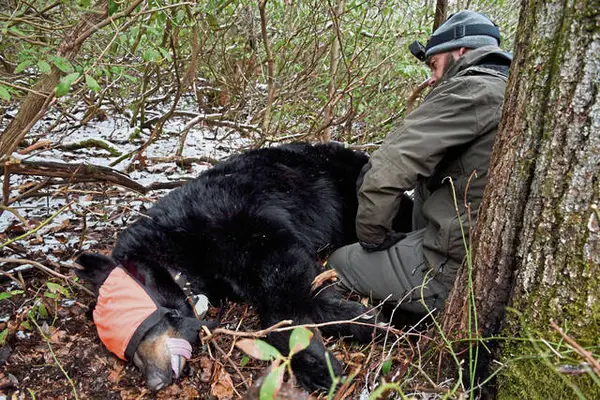
On a biting morning with a dusting of snow on the ground, a doctor and his assistants crowded around a patient in the woods.
They checked her vitals, prodded her, weighed her and monitored her heartbeat with careful precision.
This was no ordinary patient. The doctor was a Pennsylvania Game Commission veterinarian, and the patient was a 175-pound black bear, tranquilized and masked to keep her calm.
The checkup was part of a sprawling statewide project to determine the health of the Keystone State’s bear population, according to Andrew Harvey, education supervisor for the Game Commission’s 10-county Southwest Region. On this day, the team also processed four small cubs — weighing them, recording their sex and clipping numbered tags into their ears.
The female bear had spent the winter in an above-ground den hidden by rhododendron in a remote section of the Laurel Ridge State Forest. The Game Commission tracked her to the vast wilderness because she had been collared with a GPS unit in 2013. She was originally tagged as a cub to serve as a potential surrogate mother, Harvey said.
“We’ll be able to see their movements and their survival rates across the board — the yearlings, both male and female,” said Brandon Snavely, a Game Commission bear biologist.
The study, which began in August 2024 and runs through the winter of 2028-29, will help the state estimate survival rates and better understand how bears utilize habitats, said Abby Weber, a Penn State doctoral student collaborating on the project.
“We are really targeting (the cubs),” said Weber, who studies at Penn State’s School of Ecosystem Science and Management. “Not much is known about them or the risks they face.”
The project is ambitious: The state aims to collar 160 bears annually to see if there are seasonal or gender-based differences in how they navigate the landscape.
The five-year statewide study is budgeted to cost about $4.13 million, which includes the supplies such as the collars and traps, salaries for the personnel involved and the analysis conducted by Penn State, said Joshua Zimmerman, a Game Commission spokesman.
To capture bears for research or to relocate a nuisance animal, the commission uses culvert-style traps, often baited with donuts.
“Bears walk into the trap to get the donuts and the door shuts behind them,” Harvey said. The traps are mobile, allowing the commission to easily transport and release the sedated animals.
Pennsylvania’s black bear population is estimated at 18,000 — a number Harvey characterized as “very healthy.” While the highest densities are in the north-central and northeast regions, they are common throughout Southwest Region counties including Armstrong, Cambria, Fayette, Indiana, Somerset and Westmoreland.
Black bears are generally not aggressive and prefer to avoid people.
“Our tagging program helps to determine bear population by seeing how many bears were tagged versus how many were harvested in hunting season or killed on the roadways,” Harvey said.
One of the most vital aspects of the tracking program is the surrogate mother system. If a sow is killed by a vehicle or abandons her den, the commission can introduce the orphaned cubs to a collared female known to have her own litter.
“Black bears have cubs every other year, and the cubs stay with her for a year and a half,” Harvey said, noting that litters typically range from one to five cubs.
The goal, Harvey said, is simple: “We always want to keep the wildlife wild.”