
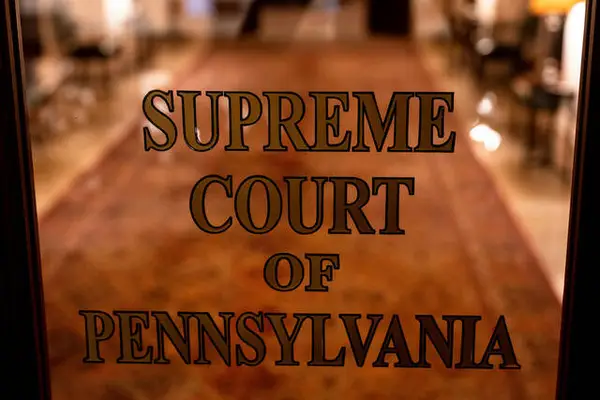
The Pennsylvania Supreme Court ruled Thursday that mandatory life in prison for those convicted of second-degree, or felony, murder is unconstitutional.
“We determine that a mandatory life without parole sentence for all felony murder convictions, absent an assessment of culpability, is inconsistent with the protections bestowed upon our citizens under the ‘cruel punishments’ clause of our Commonwealth’s organic charter,” Pennsylvania Supreme Court Chief Justice Debra Todd wrote for the majority.
The decision, which will impact more than 1,100 people in Pennsylvania, stems from a 2014 case out of Allegheny County.
Derek Lee, 37, of Penn Hills, was convicted of second-degree murder stemming from an Oct. 14, 2014, home invasion in Pittsburgh’s Elliot neighborhood.
Investigators said that Lee and a co-defendant, Paul Durham, entered the home of Leonard Butler that day and demanded money from Butler and his girlfriend.
Lee ordered the two into the basement, and then he went upstairs in the home, leaving Butler with Durham.
Butler attempted to lunge at Durham, Butler’s girlfriend testified at trial, and Durham shot him.
Both men were found guilty of second-degree murder, which, in Pennsylvania, carries a mandatory penalty of life without parole.
Lee appealed his conviction, and in October, the state Supreme Court heard arguments.
His attorney, Bret Grote, the legal director for the Abolitionist Law Center, argued that the penalty is unconstitutional in a case where a defendant never intended to kill the victim.
Among the questions facing the court were the mechanism to address the more than 1,100 people in Pennsylvania already serving that punishment.
Grote suggested that the General Assembly ought to rewrite Pennsylvania’s parole code, setting a minimum prison sentence for those convicted of second-degree murder before they become eligible for parole.
An alternative would be to resentence those already convicted of the crime — as happened with juveniles in Pennsylvania who had been convicted of murder and sentenced to life without parole.
However, there were only about 500 juveniles subject to resentencing.
During oral arguments in the Lee case, more than 200 people packed the courtroom as a show of support for him.
The state Supreme Court also received several friend-of-the-court briefs on Lee’s behalf, including from two former Pennsylvania secretaries of Corrections and Pennsylvania’s former attorney general, now-Gov. Josh Shapiro.
They argued that holding those convicted for decades — long after they have passed the age they are likely to commit new crimes — is fiscally irresponsible.
The cost to house one person in prison for a year was $66,000, and for a person who is elderly and infirm, the cost is more than $217,000 per year.
In his brief, Shapiro also argued that it is “simply wrong” for a person who didn’t intend to kill to receive the same sentence as a person who intended that result.
Shapiro said about half of all those convicted of second-degree murder in Pennsylvania committed the killing.
The others participated in another felony — like robbery or kidnapping — that led to the death.
In a statement Thursday, Shapiro said he has “long believed this law is unjust and wrong.”
“Common sense and true justice dictate that we need different penalties for different conduct. For example, the getaway driver shouldn’t get the same sentence as the person who pulls the trigger,” Shapiro said.
Shapiro said the General Assembly now needs to “come up with a thoughtful, just process to address those who are serving life sentences for second-degree murder.”
Tom Fontaine, TribLive’s director of politics and editorial standards, contributed.