
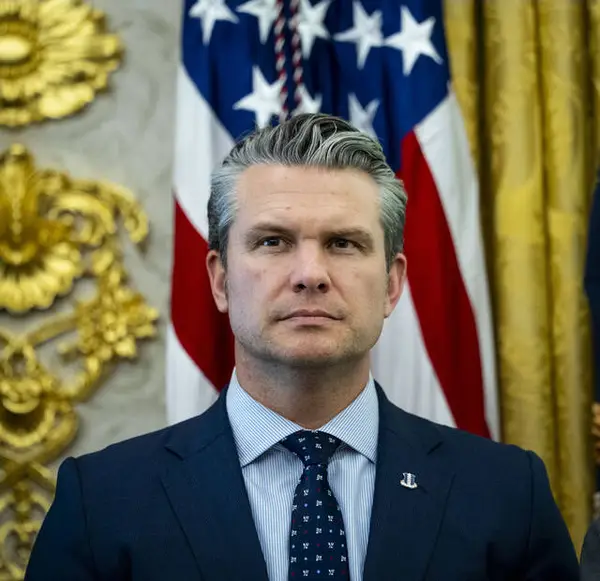
WASHINGTON — Defense Secretary Pete Hegseth is blocking the promotion of four Army officers to be one-star generals, a highly unusual move that has prompted some senior military officials to question whether the officers are being singled out because of their race or gender.
Two of the officers targeted by Hegseth are Black and two are women on a promotion list that consists of about three dozen officers, most of whom are white men, senior military officials said.
Hegseth had been pressing senior Army leaders, including Army Secretary Daniel P. Driscoll, for months to remove the officers’ names, military officials said. But Driscoll, citing the officers’ decades-long records of exemplary service, had repeatedly refused.
Earlier this month, Hegseth broke the logjam by unilaterally striking the officers’ names from the list, though it is not clear he has the legal authority to do so. The list is currently being reviewed by the White House, which is expected to send it to the Senate for final approval. A few female and Black officers remain on the list, military officials said.
It is exceedingly rare that a one-star list draws such intense scrutiny from a defense secretary. The battle highlights the bitter rifts opened by Hegseth’s campaign to reverse policies that he says are prejudiced against white officers.
Hegseth has said repeatedly that he is determined to change a culture corrupted by “foolish,” “reckless” and “woke” leaders from previous administrations. But his heavy scrutiny, especially of female and minority officers, is eroding confidence in a promotion system that is supposed to be apolitical and merit based, his critics have said.
This article is based on interviews with 11 current and former military and administration officials who requested anonymity to discuss sensitive personnel matters.
The frustrations with Hegseth’s approach came to a boil last summer during a heated exchange between Ricky Buria, Hegseth’s chief of staff, and Driscoll about a separate promotion.
Buria chastised the Army secretary for selecting Maj. Gen. Antoinette R. Gant, a combat engineer who served in Iraq and Afghanistan, to take command of the Military District of Washington, said three current and former defense and administration officials familiar with the exchange. The command provides security and performs ceremonial duties in the nation’s capital, and its commander often appears alongside the president at Arlington National Cemetery.
Buria told Driscoll that President Donald Trump would not want to stand next to a Black female officer at military events, the officials said.
Driscoll was shocked. “The president is not a racist or sexist,” he told Buria, according to the officials. Driscoll then raised the issue with a senior White House official who agreed with his assessment of Trump.
Hegseth’s office retreated. Gant began serving in the position last summer and was promoted to two-star rank this month.
Buria called the account of his interaction with Driscoll “completely false.”
“Whoever placed this made up story is clearly trying to sow division among our ranks in the department and the administration,” he wrote in a text message. “It’s not going to work, and it will never work when this department is led by clear-eyed, mission-driven leaders unfazed by fake Washington gossip.”
The Pentagon did not address Hegseth’s decision to strike the four officers from the promotion list or respond to questions about Buria’s interaction with Driscoll.
“Under Secretary Hegseth, military promotions are given to those who have earned them,” said Sean Parnell, the department’s chief spokesperson, in a statement. He defended the process as “apolitical and unbiased.”
White House press secretary Karoline Leavitt declined to discuss the list or Buria’s reported remarks. But she praised Hegseth, saying he was “doing a tremendous job restoring meritocracy throughout the ranks at the Pentagon, as President Trump directed him to do.” The Army declined to comment.
Hegseth came to the Pentagon last year focused on undoing the work of former President Joe Biden and his defense secretary, Lloyd Austin, who pushed to diversify the military’s top ranks, which had long been the domain of white men.
Austin, a former four-star Army general, was the first African American to serve as defense secretary. He and Biden selected Gen. CQ Brown Jr. of the Air Force as the second African American to serve as chair of the Joint Chiefs of Staff, and they picked Adm. Lisa Franchetti to be the first woman to lead the Navy.
Today, about 43% of the 1.3 million troops on active duty are people of color. But those leading the military are overwhelmingly white and male. Austin pressed promotion boards to look deeper into the ranks to ensure qualified women and minorities were considered for senior positions.
In his 2024 book, “The War on Warriors,” Hegseth disparaged many of the senior officers who rose up under Austin’s tenure as “cowards hiding under stars” and “whores to wokesters.”
“The Left captured the military quickly, and we must reclaim it at a faster pace,” he wrote. “We must wage a frontal assault. A swift counterattack, in broad daylight.”
Since taking office, Hegseth has fired or sidelined at least two-dozen generals and admirals, including Brown and Franchetti. Currently, the chair and vice chair of the Joint Chiefs of Staff, all five service chiefs and nine of the military’s 10 combatant commanders are white men, a return to the status quo that existed for decades.
Last summer, Hegseth signed off on a sweeping overhaul of how officers are selected for promotion and command. To lead the process, Hegseth tapped Anthony J. Tata, a retired brigadier general, who once called President Barack Obama a “terrorist leader” and whose history of Islamophobic comments prevented him from being confirmed to a senior Pentagon position in 2020. In 2025, Trump selected Tata to oversee personnel policy in the military.
Tata has worked closely with former Marine Lt. Col. Stuart Scheller, who in 2021 pleaded guilty to dereliction of duty for publicly excoriating senior military leaders who oversaw the bloody and chaotic retreat of U.S. forces from Afghanistan.
Shortly after the two began their personnel overhaul, Hegseth ordered the Army to shutter a program that sought to ensure that all officers, regardless of race or gender, had a chance to compete for top jobs. The Command Assessment Program, which began as a pilot during the first Trump administration, was later institutionalized under Biden’s Army Secretary Christine Wormuth. It supplemented traditional personnel evaluations with peer reviews and double-blind interviews in which the identities of the candidate and interviewer are hidden.
Tata and Scheller also began to review the officers on the military’s one-star lists for Hegseth, military officials said. The officers on the Army’s list were selected by a board of generals that met in November 2024. Only about 5% of eligible colonels become generals, making it the most competitive promotion in the Army.
Hegseth and his aides ordered Driscoll to remove the four officers from the list.
Those struck included a Black armor officer and combat veteran, who was singled out because he had written a paper nearly 15 years earlier that analyzed why African American officers historically have opted for support jobs over front-line, combat positions, military officials said.
Military officials said a female logistics officer was targeted because she had served in Afghanistan during the bloody 2021 withdrawal. Current and former military officials said she performed her job well amid the chaos and intense pressure that followed the collapse of Afghanistan’s government and security forces. Hegseth has blasted the operation as “disastrous and embarrassing” and vowed to hold officers who took part in it to account.
It’s unclear why Hegseth removed the other two officers — another logistics officer and a finance specialist — from the list, military officials said.
A fifth officer on the list, Col. Dave Butler, was the spokesperson for Gen. Mark Milley, a former chair of the Joint Chiefs of Staff whom Trump loathes and has accused of disloyalty. Hegseth had repeatedly asked Driscoll to fire Butler. The Army officer resigned in February in the hope that his departure would convince Hegseth to send the list to the White House, military officials said. Butler is a white man.
Senior officials in Hegseth’s office have been debating for months whether Hegseth has the legal authority to strike names from a one-star list before he sends it to the White House, military officials said.
In his role as defense secretary, Hegseth is supposed to review and approve the list. But to protect the military’s officer corps from being politicized, he has only two options under military regulations, officials said. He can reject or accept the entire list.
The last time a one-star list drew such intense scrutiny from a defense secretary was 2007, during the height of the Iraq War. Defense Secretary Robert Gates had grown frustrated that the Army’s one-star promotion boards were passing over the service’s most innovative battlefield commanders.
Fixing the problem was so important to Gates that he summoned Gen. David Petraeus, then the top commander in Iraq, back to Washington to oversee the board. At the time, military experts described Gates’ decision to bring Petraeus back from a crucial combat mission as unprecedented.
Senior military officials said they could not recall any previous instance of a defense secretary seeking to remove individual officers from a military board’s list.
Until the one-star lists are approved by the Senate, the names are supposed to remain confidential. It is not clear if Hegseth or his aides have tried to remove officers from similar Navy, Air Force or Marine Corps lists.
In his speech last September to several hundred officers at Marine Corps Base Quantico, Hegseth said that his work to remake the military’s officer corps was just beginning.
“The leaders who created the woke department have already driven out too many hard chargers,” he said. “We reverse that trend right now.”