
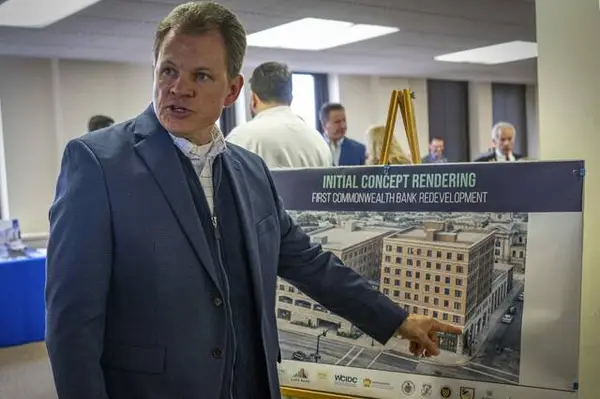
A century-old downtown Greensburg landmark could become a $70 million residential hub under a new proposal unveiled Friday.
The project would transform the First Commonwealth Bank building into 111 apartments aimed at empty nesters, students and young families.
City officials say the proposed redevelopment of the seven-story building on Main Street could be the linchpin to reinvigorate downtown and specifically the Main Street corridor.
The building is owned by the Westmoreland County Housing Authority, which purchased it in 2016. It was initially targeted as a potential site for low-income housing and later for students at the Seton Hill University-affiliated Lake Erie College of Osteopathic Medicine, but local officials now envision it as a multigenerational housing complex.
Early plans call for units to average just less than 1,100 square feet. The overall project includes common space and more than 10,700 square feet designated for commercial use. First Commonwealth Bank currently occupies three floors and holds a valid lease through 2029.
The project calls for the expansion of the existing building and new construction on what is now adjacent green space and a parking lot.
“Obviously, a complex of this size would bring more people into the downtown area and would be an economic driver for the existing and future businesses,” Greensburg Mayor Robert Bell said.
Tipping Point Development, based in West Virginia and Ohio, was hired by the housing authority to oversee initial planning. Tipping Point President Jim Ambrose said funding is being sought from both public and private sources.
Officials said funding from a $1 billion housing program investment fund pitched by Pennsylvania Gov. Josh Shapiro could be tapped for the project. Rich Vilello, deputy secretary for the state Department of Community and Economic Development, said the governor’s housing action plan is geared toward redevelopment projects such as the one proposed for the bank building.
“We need to make investments in buildings like this. It’s never been more critical,” Vilello said.
The housing authority’s long-term involvement is still to be determined. Erik Spiegel, the authority’s director of architecture and engineering, said revenue generated through leases or a sale of the renovated building will be pumped back into the authority’s coffers to pay for new affordable housing options for low-income residents and seniors in the county.
“We will not serve as lead developer of this project and we don’t know what our role will be moving forward,” Spiegel said.
Ambrose said talks with funding sources are ongoing.
“If you can get this anchor development down, it will change the Main Street corridor,” Ambrose said.
City officials said multiple studies have concluded there is both a need and desire for downtown housing in Greensburg. The housing authority maintains an option to purchase the neighboring former PNC bank building, and plans are underway to demolish the blighted former Royer’s department store building across Main Street.
Meanwhile, an effort to develop the site of the former Advance Furniture building at the south end of Main Street is progressing. The county’s redevelopment authority knocked down that structure in 2024.
“It’s all very ambitious but very realistic,” said Alec Italiano, Greensburg’s director of planning and development. “We know there are some companies that are very interested; now we have to get them to write a check.”