
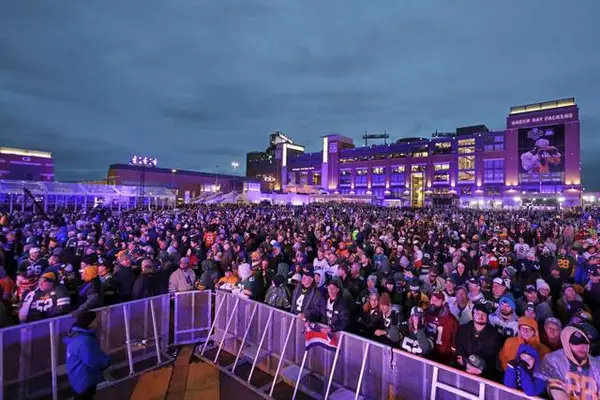
Kyle Cousineau created lasting memories in his hometown of Green Bay when it hosted the 2025 NFL Draft last April.
Cousineau, a lifelong resident, is a die-hard Packers fan. He grew up watching the team and was eager for the country to experience the city he loves during the NFL Draft.
“I think we were lucky enough to get the draft because of the history and our stadium — Lambeau Field — being iconic,” said Cousineau, who is 46. “Much like the Steelers, the Packers are a blue blood organization in the NFL, and there’s only a few of us that exist.”
He planned ahead to make sure he could enjoy the experience.
Living five miles from Lambeau Field and working just a mile away, Cousineau worried that draft traffic would choke his business. A real estate appraiser who crisscrosses the area, he and his partner even considered shutting down for a week.
“There were all types of road closures,” Cousineau said. “Lambeau Field is basically at the intersection of residential streets.”
He said the NFL’s draft campus was so sprawling it shut down major west-side highways for days.
That kind of footprint lands differently in Green Bay, the league’s smallest market. As Green Bay police Chief Chris Davis noted, the city has about 100,000 residents, with roughly 270,000 across all of Brown County.
“You can’t overplan this event,” Davis said. “We spent a better part of a year planning for it here. … We knew going into the event that this would tax our resources in a way that you wouldn’t see in a larger city.”
Making things work
In an effort to welcome hundreds of thousands people into the city, Davis’ department worked with surrounding community emergency service agencies, county services and the local sheriff’s office.
Davis said they broke public safety planning into pieces.
Wisconsin State Police took the lead on the traffic plan to broaden the scope from traffic around the immediate area of the field, to roads throughout the region. Having traffic mediation begin from miles away created a trickle-down effect that helped things run smoothly close to the draft footprint.
“One of the big things we had to plan for was traffic,” Davis said. “We took a regional approach.”
The plan paid off, Davis said. He said traffic wasn’t an issue during the event.
Cousineau, who kept his real estate appraisal business open during draft week, agrees with the police chief. Using his knowledge of the “ins and outs” of the city roads, he found it easier to get around than he expected.
“Now looking back on it, it wasn’t the inconvenience that we thought it could have been,” Cousineau said.
Attending the show
The NFL Draft in Pittsburgh opens on April 23, a Thursday, and runs through April 25. Cousineau’s biggest advice for fans heading to Pittsburgh: Timing is everything.
“Get there early on Thursday,” he said.
Cousineau spent the draft’s opening night in a big crowd of his own — friends who flew in, some he hadn’t seen in years, plus locals and family all joining in.
Before the draft, the group stopped at nearby bars and lingered — “a beer or two too long,” Cousineau said. By the time they cleared security, the theater was full.
“We screwed up,” he said.
They watched the first round from the big screens alongside Lambeau Field on Lombardi Avenue.
From a public safety perspective, Davis recommended that people traveling in groups take a photo when they arrive. In case the group gets separated or someone gets lost, officers will have the most recent photo of them when looking for them.
He said Friday and Saturday were much easier to navigate.
“The crowd was probably 25% of what it was on Thursday night,” Cousineau said of the following draft days.
Saturday seemed to be the designated family day, Cousineau said. He took his daughters Atlee, 5, and Emryn, 8, to see the sights. Both girls are following in their father’s footsteps of being Packers super-fans.
The three of them sported green and gold and enjoyed the day.
“It wasn’t even to be there to watch the draft picks in the fifth and sixth rounds,” Cousineau said. “It was just being down there, letting my daughters experience such a cool event. It was awesome.”
Managing the crowd
Davis, the police chief, said he and other Green Bay officials consulted with offices in cities that previously hosted the draft, such as Detroit.
“Even though we had a very detailed plan, we maintained some flexibility,” Davis said. “Your plan only survives until the event starts. … You will always be confronted with something you didn’t think of.”
Something Davis didn’t expect was the sheer number of people who showed up to the mile-long NFL Draft campus all at once. Davis said his department sees around 77,000 people in the same area during a regular-season Packers game. There were around 150,000 people there on the first day of the draft.
“I have never seen that many people in that footprint,” Davis said. “It was packed from one end to another.”
He said a section of the campus experienced a “bottleneck” effect with so many people packed together, trying to move in different directions. Stampeding became a brief concern for public safety officials, Davis said.
“In our footprint, because it was really long from east to west and it was kind of all in a line, we ran into some pedestrian congestion problems,” Davis said.
The department’s mountain bikes were a handy solution. A large number of officers were assigned to general patrols of the area on bikes. They were able to maneuver through the crowds and direct pedestrian traffic.
“You weren’t getting a car through there,” Davis said.
Drone incursions became a regular issue throughout the draft. Davis said the department worked with federal law enforcement to secure a temporary flight restriction over the NFL campus, but some operators still flew drones overhead.
Officers on mountain bikes tracked down the operators and forced the drones to land.
Green Bay spent more than $1 million on public safety measures, Mayor Eric Genrich said, while Brown County and the Green Bay suburb of Ashwaubenon combined to spend about $500,000. He said the entities entered a state grant program that reimbursed them for almost the full amount spent on public safety measures.
Genrich acted as middleman for communication with the county, city and village.
Over the entirety of the event, there were two arrests total, Davis said. A few ejections and citations took place over the three days as well. Officials estimated that 600,000 people attended the draft.
“As an organization and as a city, I think we deserve to be proud of the fact that we got 600,000 people through this event and everybody had a good time and it was safe,” he said.
Pittsburgh officials expect 500,000 to 700,000 draft attendees.
Local hopes
“One of the other big responsibilities I felt like I had was to make sure we were maximizing the community benefit of hosting an event like this,” Genrich said.
To do so, Genrich said the city organized events in the city’s downtown, rebranded as “Touchdown Downtown” for the week, to get businesses and locals involved.
“It was complementing what was being planned at the draft footprint and maximizing our chances to expose people to everything we have to offer within the community,” Genrich said.
He said city officials wanted to make it clear to residents that the draft wasn’t “just some big party for tourists.” Davis said there were city-hosted activities like fireworks and live music for residents who didn’t want to be in the draft footprint.
Genrich recommended that business owners “manage their expectations” for draft week when hoping for a surge in business.
“If you’re not in close proximity to the draft, or if you’re not in close proximity to something the city may be planning, just manage those expectations,” Genrich said.
Staying true to the city
Cousineau said before the big day, the NFL transformed the area where the draft was set to be hosted.
“It didn’t look anything like the Lambeau Field that I’ve been to hundreds of times and driven past hundreds of thousands of times,” Cousineau said. “It was wild.”
He said the stadium itself looked the same, but things like the signage around the makeshift campus, security checkpoints and the infrastructure of the draft theater changed the area from something he knew like the back of his hand to a whole new experience.
“It was cool to see it all be constructed in the few weeks leading up to the event itself,” Cousineau said.
At the same time, Cousineau felt the NFL showcased Green Bay’s essence as a city quite well.
“Green Bay is so unique because of the small-town atmosphere coupled with this historic franchise,” Cousineau said.
Genrich, the mayor, called the draft a fantastic time. He said it had a positive economic impact on the city and gave Green Bay great visibility.
While he recognized locals’ worries about traffic and a high volume of visitors, the event ended up running smoothly. “We really have no regrets about hosting it,” Genrich said.
“It’s a lot of fun,” Davis said. “I remember encouraging people in our community to go check it out. This might be the only time in your lifetime to go to something like this.”