
Utilities and health care are the two expenses Westmoreland County residents worry about the most, a nonprofit community organization’s recent survey on affordability found.
With those results in hand, Voice of Westmoreland is organizing residents to appear before the county commissioners in April and share their stories, in hopes of getting help.
“We want to make a visible accounting of our concerns before them,” Jocelyn Burns, of New Kensington, said Saturday at a gathering on the survey and the issue at The Tomb in Arnold. “We want them to see us and hear our voices.”
Voice of Westmoreland surveyed 469 people throughout Westmoreland County over six weeks ending March 21, chapter Director Amanda Rose Piern said.
It asked residents how often they worry about five expenses — health care, utility bills, food, housing and child care.
About 55% said they worry every day or frequently about health care and utility bills, followed by food at 44%, housing at 35% and child care at 10%.
Piern said the results show that many worry the most about the bills they can’t predict.
“You don’t know what those bills are going to be until you get them,” she said.
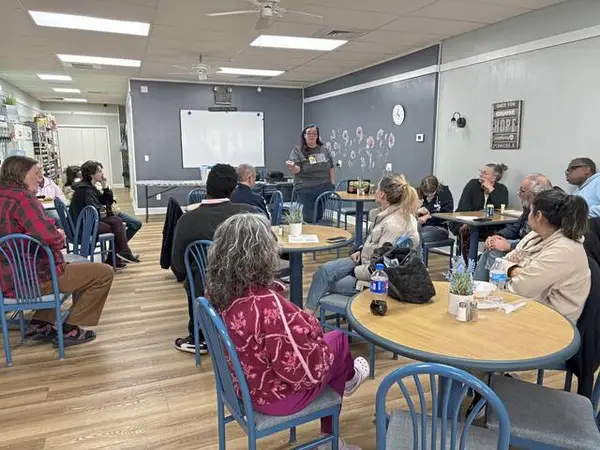
About two dozen people attended the gathering on the survey in Arnold. A second meeting was held at the same time in Greensburg.
After sharing their stories about affordability, those in Arnold described how they were feeling with words such as sad, disgusted, angry, upset, discouraged, worried, exhausted, frustrated and concerned.
Peggy Sterling of New Kensington fluctuates between hope and giving up. At 74, she still works as a software developer.
“I worry if the old systems go away, they’ll let me go. I don’t know if I can find another job if I lose the job I have,” she said.
Sterling said she moved to New Kensington from Virginia to share expenses with her brother, who has since died. She said she’d go back but her son, who lives with her, has a good job with benefits he’s never had before.
“I just worry about him,” she said. “He’s not going to find any help when I’m gone.”
With the costs of food, utilities and gas going up, everyone is overwhelmed, said John Zullo, of Lower Burrell
“You don’t know where to turn,” he said. “It’s a losing battle.”
Piern said they are seeing more people in precarious situations where they are a matter of days away from not being able to pay their bills. The “American dream,” she said, is now to have enough money saved to be able to pay an emergency bill.
“We’re in a place now where not a lot of people have that savings account, or there is very little in it,” she said.
While the state House this week voted to increase Pennsylvania’s minimum wage from $7.25 an hour to $15 by 2029, Piern said that’s what it should have been five years ago. The equivalent now would be $21.50 — and higher than that by 2029, she said.
The current minimum wage “is not enough to take care of your children on,” Piern said.
While they don’t yet have the power to go to the state or federal levels of government, Piern said they can act at the county level.
“We do have some power in this room,” she said.
Voice of Westmoreland is organizing residents to attend the April 16 county commissioners meeting in Greensburg. They hope to get 200 people to fill every seat in the room, and to have between 10 and 20 people speak about how affordability is affecting them.
“It is sharing our stories that changes hearts and minds,” Piern said. “It is people in the room that makes the difference.”
Transportation to Greensburg from the New Kensington-Arnold area will be provided if enough people express interest.
While he had not seen the survey’s findings, Commissioner Ted Kopas agreed that affordability is a major issue that “doesn’t show much chance of changing any time soon.”
“The cost of everything keeps rising. The action in Washington, D.C., recently is not helping, whether it’s health care or the price of gasoline and oil, which eventually trickles down to almost everything we rely upon,” he said. “These are difficult economic times for sure.”
Commissioners Sean Kertes and Doug Chew could not be reached for comment Saturday.
As for what the county could do, Kopas said there are limits to commissioners’ authority.
“We have no role to play in health care, for example. However, over the years the county has worked hard to provide affordable housing opportunities for those who need it,” he said. “Certainly we’re the backbone of the social safety net for those who are in need of services whether that’s the hungry, the homeless. Those systems, too, are somewhat overtaxed.
“I look forward to seeing the particulars of their findings and try to determine a path where the county could be helpful.”
Piern said they want to let county officials know where residents are hurting the most so they can see what solutions they can come up with.
“We’re going to make an ask. We’re going to demand that they meet with us,” Piern said.