
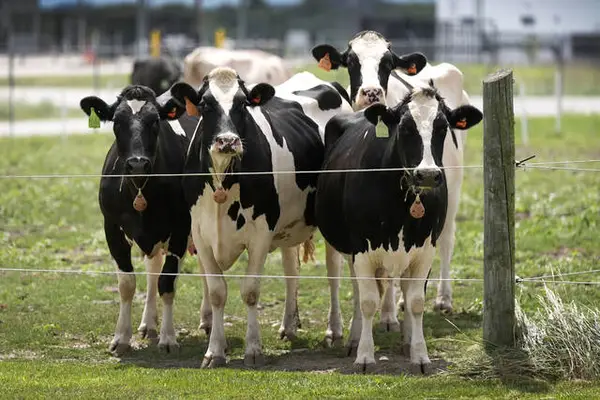
Jesse Filion, who raises chicken, pigs and cattle on 100 acres in Walterboro, South Carolina, made a tough decision in March. He will add a fuel surcharge of $5 for deliveries of his Keegan-Filion Farm meat to homes and the 20 restaurants he serves.
Simply raising overall prices wasn’t an option for the fourth-generation family business. Filion, the owner, said the company’s “products are already expensive” because the animals are “raised as free-range and processed in a humane facility.”
“People are only going to pay so much,” he said, adding that “the $5 surcharge is a way to be transparent, but also to cover some of the increased fuel prices that we’re seeing.”
The United States’ food industry is highly sensitive to fluctuations in oil prices and is among the first sectors to feel the impact of a sharp rise in the cost of fuel. Diesel is used for the tractors and combines on farms, and powers the trucks that haul burger patties to restaurants and avocados to grocery stores. In the U.S., trucks transport 83% of agricultural products and 92% of dairy, fruit, vegetables and nuts, according to the Agriculture Department.
The price of a barrel of Brent crude, the international benchmark, has risen 56% since the war with Iran began. The average price of diesel is up 44%. Should the war continue, the cost pressure on businesses up and down the supply chain is likely to worsen.
Fuel surcharges are already being added to the shipping cost of certain food items, such as fruits that are highly perishable or seafood that is imported from far-flung locations, analysts said.
Salmon caught off the southern tip of Chile, for example, are first taken to Puerto Montt and then sent on trucks to Santiago. From there, they are flown to Miami and delivered on trucks to restaurants and grocery stores all over the country.
The wholesale price of salmon has risen to $6.48 a pound from $6.25 in February. The price increased just before the Easter holiday, when many chefs will highlight the fish on their menu, said Janice Schreiber, who tracks the seafood industry at Expana, a market data provider for the agriculture and food industries.
“It all has to be done rather quickly, and at each of the different points, there is a fuel surcharge being added,” Schreiber said. “All during one of the highest periods of demand for salmon.”
Grocery stores, restaurants, hospitals and even schools are most likely seeing costs for their food shipping climb. Many of the nation’s largest food distribution companies, including Sysco, U.S. Foods and Performance Food Group, have fuel surcharges that move in tandem with national diesel prices.
Before the war shocked energy prices, for example, UNFI, a U.S. food distributor, tacked on about $35 for each delivery when the average national diesel price reached $3.81. Last week, the average national diesel price was $5.38 and UNFI’s surcharge was $65.
UNFI declined to comment.
The Independent Grocers Alliance, a group of 2,600 independent grocery stores, said on its website last week that price increases on shelves might not be apparent until midsummer, noting that it will take time for various fees to work their way through the supply chain.
For every 10% rise in the price of fuel, the group said, food prices could go up 2% to 3%, based on historical averages. That comes on top of existing food inflation in grocery stores, which is on track to be about 2.4% this year, according to the Labor Department
Costs for beef and dairy will rise the most because of fuel and energy costs associated with animal raising, slaughtering, processing, transporting and refrigerating, the group said. The cost of packaged goods is also expected to rise because of higher energy costs.
But passing along those higher fuel expenses to shoppers is a delicate dance. Consumers, already fatigued from several years of food inflation and other rising expenses, may not be willing to absorb much more. And now that people are being squeezed at the pump, they may cut spending in some areas.
“We’ve been talking about the price of food for the past five years,” said David Ortega, a food economist at Michigan State University, noting that grocery store prices are nearly 30% more than they were before the covid-19 pandemic. “Particularly for lower-income households, food is a necessity, and they will protect their food budgets, which means they will cut down on other things like eating out.”
Historically, when gas prices climbed above $4 a gallon, consumers cut back on spending at restaurants and on other leisure activities, according to a 2022 study by Technomic, a research and consulting firm for the food industry.
“Already, the shopper is stressed,” said John Ross, the CEO of the Independent Grocers Alliance. “For people who spend every nickel they have on daily expenses, if grocery prices go up $5, that $5 has to come from something else. But it’s hard for the grocers to eat it also. For every $1 that consumers spend at the register, the grocery store is keeping about two pennies. There’s very little room there.”
While grocers can try to negotiate better promotions or bundles with manufacturers — like buy one, get one free — or direct consumers to lower-priced store brands of ketchup or spaghetti sauce, those are short-term fixes, Ross said.
“Over the long run, the rising input costs will be borne by the consumer,” he said. “There’s no other way around it.”