
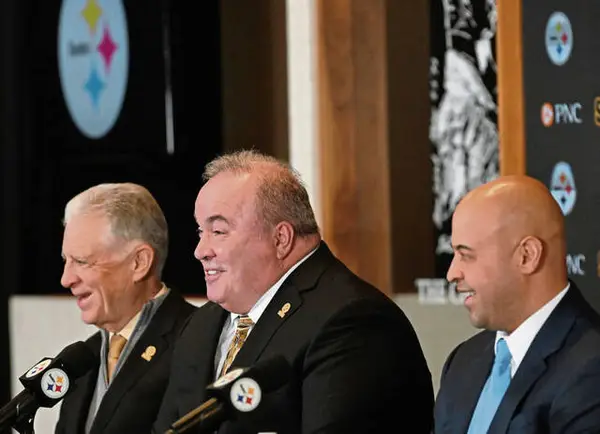
PHOENIX — Though they are in their first offseason together as the primary power brokers for the football operations of one of the NFL’s higher-profile franchises, this is not the first spring that Omar Khan and Mike McCarthy have been involved in the process of an NFL team’s draft.
Now the coach and general manager, respectively, of the Pittsburgh Steelers, McCarthy and Khan in 2000 served as offensive coordinator and in the front office of the New Orleans Saints.
Safe to say that plenty has changed in the quarter-century since in regards to how teams prepare for a draft.
“The technology and the AI has made it so much easier,” Khan said from the site of the NFL owners meetings this week. “Back in the day when I was doing it in New Orleans for the Saints and when I first got to Pittsburgh, it was all manual. Looking back, everything was manually done. It’s a lot easier now. We all have programs now where we put values on every pick.”
From the era of hand-written cards and dry-erase “big boards” to the robotic-level powered spreadsheets of today, McCarthy has remained involved in the draft process as his coaching career has progressed.
Now in his first season with the Steelers after 13 seasons heading the Green Bay Packers and five coaching the Dallas Cowboys, McCarthy has increasingly developed a hands-on approach as a coach providing his input and in aiding in the overall draft process.
“I love it,” McCarthy said of draft prep. “I love that this is, I’d say, the most involved (he has been) of the three teams (he’s worked for). I think that’s just probably has gone with the arc of my career, too.”
Head coaches to varying degrees wield influence on team’s draft decisions, with some of the 32 across the league holding virtual final say whereas others are (in effect) told that coaches coach while general managers, scouting staffs and (sometimes) even ownership makes the draft personnel decisions.
The Steelers over Mike Tomlin’s 19 seasons as coach increasingly trended toward the former model. And while that perhaps was never more true than the past three years when Khan was a neophyte general manager who took over after longtime GM Kevin Colbert retired, Khan has three drafts under his belt that have generally gotten positive reviews.
That doesn’t mean, though, that he isn’t heavily collaborating with McCarthy. As McCarthy’s stature in the industry and experience resume has risen over the past two decades, he’s been much more active in draft evaluation decisions than he was as a 40-something new coach of the Green Packers starting in 2006 when Ted Thompson was an established NFL executive.
“But I loved our relationship and how we did personnel then,” McCarthy said from the AFC coaches breakfast at the Arizona Biltmore resort. “Ted’s one thing with me was always, ‘I’ll never give you a player you don’t want because there’s just no sense in that.’ That’s how he treated those moments.
“Dallas, the coaches were very involved. It was a very coach-friendly process there. And it’s probably similar to Pittsburgh. Our coaching staff’s very involved.”
At least, Steelers coaches are involved as much as time allows them to be. As a first-year staff working to coalesce together, to learn its inherited roster and communicate and bond with its new players, the draft simply cannot be the priority it can be during a more “normal” offseason.
McCarthy prides himself on adapting his playbook — even down to the terminology — to his new team.
“We’re trying to keep the newness (for players) to a minimum,” McCarthy said. “That’s time-consuming, is my point. The coaches staff, they’ve been grinding. So, this next month is going to be a lot of fun. We’ll basically split our day between (spending mornings) trying to get the players acclimated with our systems, and we’ll be in the draft meetings in the afternoons.”
Through coordinator Patrick Graham, McCarthy intends to keep the Steelers defensive scheme relatively unchanged from what it was in the past. And though as a longtime offensive-minded coach McCarthy has his own ideas for the types of players he might want on offense, he is a believer during the draft process that physical traits don’t make the ideal prospect alone.
“You’re looking for people that fit your culture,” McCarthy said, “and that fit Pittsburgh, Pennsylvania. That’s definitely a big part of the conversation.
“I’ve never really felt as a head coach of a football team that you never had enough talent. I always feel that there’s enough there. It’s really the connection, the emotional connection. That’s how you win championships. So you’re definitely looking for quality people, without a doubt.”