
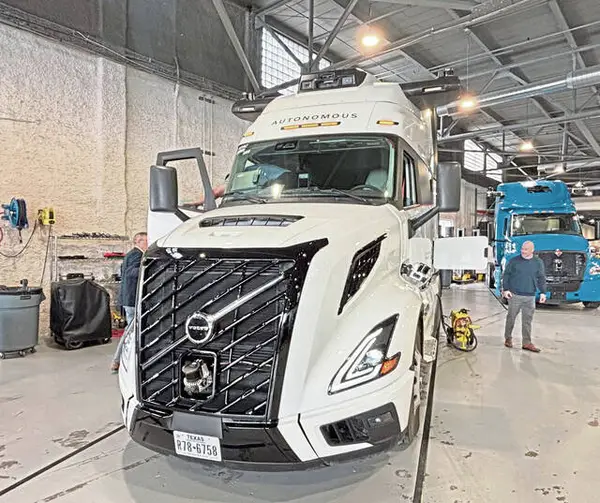
Autonomous big rigs could be close to mass adoption, and the U.S. doesn’t have a law on the books specifically governing them.
The least productive Congress in more than a half-century seems like an unlikely bet to finally deliver legislation on driverless trucks.
Aurora Innovation, a Pittsburgh-based firm with pole position in the emerging industry, sees an opportunity nonetheless.
Lawmakers in Washington have an end-of-September deadline to reauthorize multi-year funding for the nation’s highway, transit and rail projects. Backed by close allies in Congress, the publicly traded company wants the bill’s next iteration to override disparate state rules on autonomous trucking with a national regulatory framework, Aurora executive Gerardo Interiano told TribLive last week.
State-level stances range from California’s near-ban on these vehicles to Texas’ embrace of the driverless trucks. Some places have yet to pass any rules.
Pennsylvania allows certified companies to operate autonomous vehicles, including trucks, without a driver on board, but none are doing it yet.
“You can’t have a patchwork of legislation, particularly when it comes to interstate trucking,” said Interiano, senior vice president of government affairs at Aurora. He started at the tech company in 2019, two years after its founding.
Uneven regulations are partly why Aurora’s commercial routes are limited to the Sun Belt, where states are generally taking a light-touch approach, though mild weather and strong demand are also factors.
About 10 tractor-trailers equipped with Aurora’s autonomous driving system were doing deliveries in the region last year. The firm is adding another 200 this year.
Aurora CEO Chris Urmson recently described 2026 as the “inflection point where the market recognizes self-driving trucks have arrived.”
Philip Koopman, an autonomous vehicle safety expert at Carnegie Mellon University, sees value in national rules for this technology. Traditional trucking is already overseen by federal agencies — namely the Federal Motor Carrier Safety Administration and the National Highway Traffic Safety Administration — to standardize operations across state lines.
But he argues the state-by-state variation on autonomous vehicles is of the sector’s own making. The Autonomous Vehicle Industry Association tries to get the most permissive possible law passed in each state instead of going for consistency, according to Koopman.
“If they want to complain about patchwork, they should look in the mirror,” he said.
The Autonomous Vehicle Industry Association disagreed with Koopman’s characterization of its lobbying efforts.
“The AV industry supports state and federal policies that encourage the safe deployment of autonomous vehicles across the country,” Jeff Farrah, the group’s CEO, said in a statement.
‘Momentum’
Interiano spoke favorably of a few bills working their way through Congress, which could stand on their own or, in what he sees as the more likely scenario, be folded into surface transportation reauthorization.
U.S. Rep. Bob Latta proposed the SELF DRIVE Act in February. The Ohio Republican and member of the House Energy and Commerce Committee is calling for the creation of autonomous vehicle safety standards and a national crash database covering these vehicles.
The law would also limit state and local powers on the issue, checking a critical box for the industry.
In July, U.S. Rep. Vince Fong, R-Calif., introduced a bill specifically about self-driving trucks. The proposed legislation is just under 1,000 words, and is mainly meant to outmuscle stricter state requirements.
“I think there’s momentum,” Interiano said about autonomous vehicle legislation broadly.
In Western Pennsylvania, Interiano mentioned U.S. Rep. Guy Reschenthaler, R-Peters, as a champion of autonomous vehicles. Reschenthaler did not return requests for comment.
U.S. Sen. Dave McCormick, R-Squirrel Hill, showed enthusiasm for autonomous trucks on a February tour of an Aurora plant in Lower Lawrenceville, but stopped short of taking any policy stances.
“I have a lot to learn,” McCormick said during his visit.
He did not return requests for comment, either.
Aurora has also spoken to staff for U.S. Reps. Chris Deluzio, D-Fox Chapel, and Summer Lee, D-Swissvale, according to Interiano. Deluzio’s office confirmed a meeting took place, but did not provide further information. Lee did not return requests for comment.
Congress nearly passed significant federal legislation on autonomous vehicles in 2018. The bill was scuttled because Senate Democrats had concerns about “privacy, safety and federal preemption,” Bloomberg Law reported at the time.
Lawmakers should require driverless trucks to meet certain cybersecurity standards and bear some kind of identifying marker, in the view of Byron Bloch, an independent auto safety expert in Maryland. He’s proposed purple or turquoise lights to let motorists know they’re sharing the road with a robot.
Autonomous trucking legislation could also be a shot at overdue safety improvements to tractor-trailers. Bloch is a major advocate for guards that go on the sides of big rigs and keep cars from sliding underneath.
“There are so many trucking-related areas of safety that have been overlooked or have been subverted by pushback … that need to be corrected at long last,” he said.
Major impacts
Aurora claims its trucks have a sterling safety record with zero collisions caused. A report commissioned by the company and released March 19 estimates that by 2035, self-driving technology could prevent nearly 500 deaths a year.
There’s an economic case Aurora likes to make, too.
Autonomous trucks don’t get tired, and can blow past the 11-hour limit federal regulators set for human drivers before they must take a break. They also reduce fuel waste through what the company says are more efficient breaking and acceleration, saving money.
Steer Group, the consulting firm hired by Aurora to do the study, projects the industry will contribute up to $70 billion to America’s gross domestic product, again by 2035.
Richard Mudge, president of consultancy Compass Transportation and Technology, believes even that staggering figure undersells the transformative power of driverless trucks.
“It’s like what the interstate did, what the internet did, what wireless did,” said Mudge, who is also a board member for the Transportation Channel, an industry media platform. “All these things created new industries no one ever thought about.”
For now, though, Aurora is a highly valued company with precious little revenue looking to popularize a concept some find off-putting.
It is hamstrung by regulations in some states, and appears likely to remain focused on the Sun Belt for the near future.
Aurora has received interest from Pittsburgh-area companies, according to Interiano, but he could not offer a timeline for when its driverless trucks will take to local highways.