
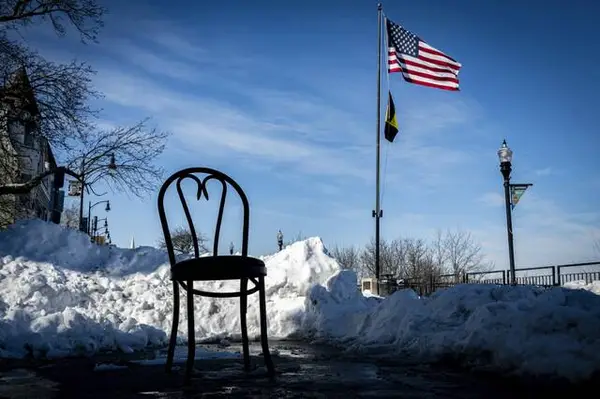
Don’t worry, New Kensington isn’t declaring war on the Western Pennsylvania “parking chair.”
A Facebook post, masquerading as a city announcement and posted on April 1, was exactly what is was meant to be: an April Fools’ Day prank.
The post surfaced in a Facebook group simply titled “New Kensington,” but the page is not affiliated with the city. It was styled to appear like legal advertisements local governments are required to publish when adopting new or amended ordinances.
City Clerk John Zavadak confirmed the post was not made by the city and said he is not sure who wrote it.
“It really did look official, even though we didn’t have anything to do with it,” Zavadak said.
Still, it garnered dozens of angry responses, ranging from criticisms that the city has more important issues to address to those just mad it would target the beloved parking chair.
The post claimed the city would crack down on those reserving parking spots with “chairs, cones, crates, or similar items,” even threatening that city crews would remove the items if found.
Arnold resident Chris Wiley told TribLive he spotted the prank right away because of the date of the post.
“I pretty much knew it was a joke the whole time,” Wiley said.
Another telltale sign the post was a prank: it was signed by the non-existent Director of Parking and Rules Enforcement “Karen Catchall.”
The post also claimed the city would begin to crack down on those parking against the flow of traffic on city streets starting May 1, warning that violators could be fined $250. The fine money, the post said, would be used for street maintenance in the city.
Like many good pranks, that part of the post contains a grain of truth. Parking against the flow of traffic on public streets really is against the law in Pennsylvania, according to the state’s traffic code.
As far as the parking chair, the law is a bit murky. While the state traffic code makes it clear that parking on public streets is open to anyone and reserving spots is not allowed unless a resident has obtained a handicapped parking designation, it does not specifically address the parking chair, though individual communities can if they chose to. Philadelphia, for example, has an ordinance that forbids using items to reserve parking spots on city streets.
In Western Pennsylvania, the parking chair has become an emblem of residential parking, especially during heavy snowfall like the region experienced several times this winter.
The unwritten rule to not move someone’s parking chair became commonplace in the mid-1900s, according to Positively Pittsburgh.
Pittsburgh Mayor Corey O’Connor even asked residents during January’s snowfall of more than 11 inches to “respect the chair law,” according to oneBURGH.
Zavadak said New Kensington has a limited number of parking spots, so the city has never really enforced the state parking regulations harshly.