
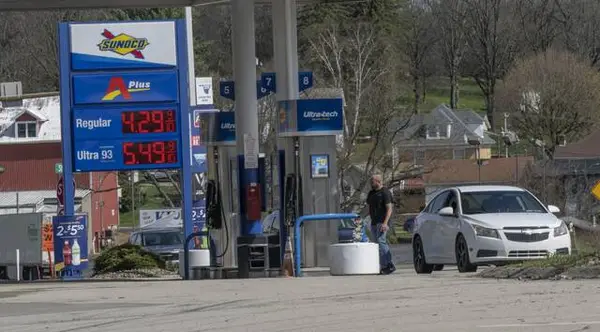
Western Pennsylvanias felt a pinch at the pumps this week as some local gas stations offered fuel at $4.19 per gallon or more — about two months after the onset of the Iran war.
Gas prices jumped to just shy of $4 per gallon two weeks ago. Friday, the statewide average cost was $4.11 — up 17 cents from one week ago and up 74 cents from this time last year, according to the American Automobile Association, or AAA.
In Pittsburgh, gas prices stood at $4.12 per gallon Friday — the 7th highest among the state’s 19 metropolitan areas and one cent shy of the national average, according to AAA.
Gas prices rose to $4.19 per gallon Friday at some local gas stations — including the Sheetz along Harvey Avenue in Greensburg and the GetGo on Tarentum Bridge Road in New Kensington, according to GasBuddy.
Price shifts, taxes, variables
Just a day prior, gas costs climbed to nearly $4.30 per gallon at the Sunoco on Route 66 in Delmont. The rate dropped down to $4.19 per gallon on Friday, according to GasBuddy.
Seemingly overnight gas price changes may be the result of gas stations competing with one another, said Jim Garrity, the automobile association’s director of public and legislative affairs.
“Gas stations generally don’t make much (profit), if anything at the pump,” he said. “It’s generally coming from the convenience store. Gas stations will compete with one another to get people to come to their station and then in the door.”
Some Pennsylvania lawmakers, meanwhile, are exploring a temporary suspension of the state’s gas and diesel prices.
Pennsylvania imposes some of the highest taxes on gasoline and diesel fuel in the nation. The state’s gas tax stands at 57.6 cents per gallon, which as of January was the fourth highest in the nation, while its diesel tax of 74.1 cents per gallon ranked second highest, according to the federal Energy Information Administration.
Many variables contribute to what drivers pay, including:
Competition: Local stations adjust rates to remain competitive with nearby retailers.
Seasonal demand: Usage typically spikes as winter conditions lift and travel increases, according to the Energy Information Administration.
Environmental regulations: Federal rules require a more expensive “summer blend” of gasoline starting June 1 to prevent evaporation in heat.
Global conflict: Military unrest can disrupt oil exporters and shipping channels, tightening global supply.
Iran war, global ripple
While seasonal shifts typically cause a 40-cent difference between January and August, Garrity said rising temperatures are not the primary culprit for the current surge.
“That’s a direct reflection of what’s going on with oil, which is being impacted by what’s happening in Iran,” Garrity said.
Oil accounts for 50% to 60% of the final gasoline product. Last year, a barrel of oil traded for between $60 and $70 on average; as of Friday, the cost hit $112, according to MarketWatch.
Garrity noted the last comparable jump occurred during the 2022 Russia-Ukraine conflict, which sent Pennsylvania prices to a record high of $5.07 per gallon.
The strain is largely tied to the Strait of Hormuz off the coast of Iran, a channel that carries about a fifth of the world’s oil supply. With shipping disrupted by war, global supply has dropped while demand remains steady.
“Even though we don’t import Iranian oil in America, it is a global market,” Garrity said. “When you have a splash across the planet, the ripples make their way over to us.”
Garrity noted that while the connection between oil and gas is direct, there is often a delay as a barrel moves from sale to refiner and finally to transportation routes.
“That oil has to be sold. It has to be shipped to the refiners. It has to be turned into gasoline. It has to go down the transportation routes to the gas stations,” he said. “You see a direct reflection at the pump, but sometimes it’s delayed because of the life of a barrel of oil and the process it has to go through to become gasoline.”
To stretch their fuel, he encouraged drivers to lessen the load in their vehicles, combine errands, service their vehicles and maintain steady speeds.
Until oil prices drop, however, a respite is unlikely.
“When (oil) goes up, you expect to see it go up at the pump,” he said.