
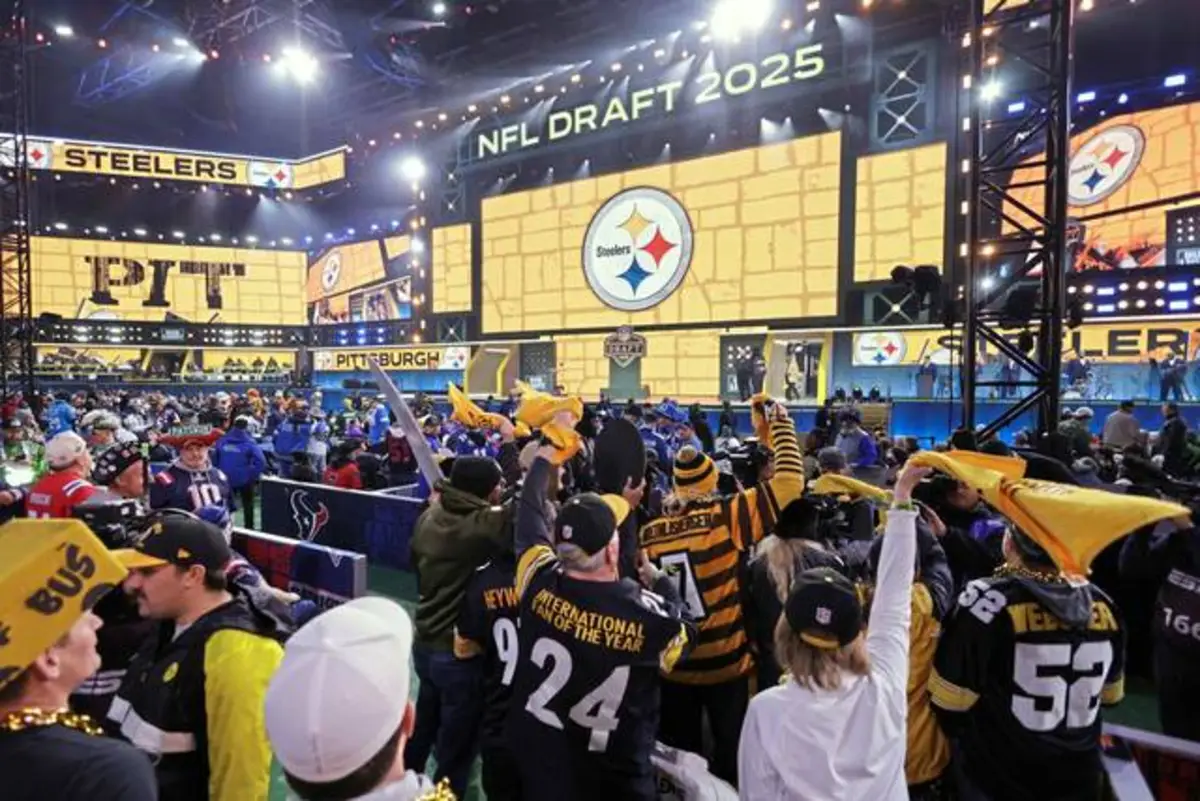
Kroll’s West restaurant expected to be bustling when Green Bay hosted the 2025 NFL Draft.
Located across from iconic Lambeau Field, home of the Green Bay Packers, the Wisconsin eatery seemed to be in an ideal spot just outside the event’s footprint.
There were high hopes for a surge in hungry customers, said Ann Pierquet, one of the restaurant’s managers.
“We expected wall-to-wall people, busy from morning to night. We had a full crew on, full staff, full menu, extra product, extra everything,” Pierquet told TribLive recently.
But those hopes were dashed. The restaurant, Pierquet lamented, “wasn’t busy at all.”
Once people went through the draft’s entry gates, she said, they didn’t venture out to spend money at local businesses outside the perimeter.
“We had a lot left over,” Pierquet said.
She estimated the restaurant is typically about 50% to 75% busier during a regular-season football game than it was during the draft.
Asked what she would tell Pittsburgh businesses that are gearing up for the event, Pierquet offered a note of caution: “I would say don’t rely on the draft to bring extra business.”
Unanswered attendance questions
Officials in Pittsburgh have tossed out eye-popping numbers when talking about how much money the NFL Draft could generate when it takes over Downtown and the North Shore this month.
Tourism agency Visit Pittsburgh predicted the three-day event, from April 23-25, will draw upwards of 500,000 fans and generate an economic impact in the range of $120 million to $213 million.
Jerad Bachar, president and CEO of Visit Pittsburgh, said those estimates are based on what other cities experienced when hosting the draft in recent years. Various factors — such as how well the weather cooperates — could impact the final figures.
Although the numbers may sound impressive, it doesn’t actually mean that more than a half-million out-of-towners will descend on the Steel City’s hotels and Airbnbs. It also doesn’t necessarily mean local businesses — or the city itself — will see the surge of desired income.
Bachar earlier this year told TribLive that when officials say between 500,000 and 700,000 people will come to the draft, they’re counting in that tally locals who already live in and around Pittsburgh. But they’re also expecting lots of football fans to make the trip from other NFL towns that are relatively close, like Cleveland, Philadelphia and Baltimore.
Visit Pittsburgh has not provided a breakdown of its expectations for local versus visiting fans.
It also has not clarified whether projections reflect unique visitors or repeat counts of the same person on multiple days, a practice employed at other drafts.
In a statement, Visit Pittsburgh’s draft organizing committee said the tourism agency will work with Sportsimpacts, a market research firm focused on sports, to conduct an independent economic impact assessment after the event.
“The analysis will focus specifically on spending attributable to the NFL Draft, including visitor lodging, dining, transportation, retail and entertainment, as well as event-related operational spending,” the statement said.
The analysis will include spending during the three-day event, as well as related travel and longer stays before and after the draft. It will focus on Allegheny County and consider surrounding areas “experiencing measurable draft-related visitation.”
Based in St. Louis, Sportsimpacts assessed the economic impact of the last two drafts in Green Bay and Detroit, and conducted analyses for Super Bowls and NCAA championships, according to Visit Pittsburgh’s draft committee.
Sportsimpacts did not respond to multiple interview requests.
$104 million impact
Green Bay, which has about 107,000 residents, drew more than 600,000 fans to last year’s draft over three days, according to the NFL and Discover Green Bay.
But there’s a catch.
“If you go all three days, you’re counted as three people,” said Brad Toll, president and CEO of Discover Green Bay.
The total number of unique individuals was actually around 360,000, Toll said.
Still, Green Bay exceeded economic impact projections. Officials had estimated the draft would generate about $94 million. They were pleasantly surprised when the figure turned out to be more than $104 million, Toll said.
To come up with that number, officials surveyed people attending the draft and tracked aggregate credit card usage, he said.
Hotels, he said, were full. He couldn’t estimate how packed they typically would be at that time of year without a major event.
No screams for ice cream
Despite the impressive economic impact figures, Toll said, some businesses — like Kroll’s West — found the experience lackluster. They didn’t see the throngs of customers they expected.
Toll said some businesses that fared better offered shuttles to and from the draft. Making it convenient for people to get back to the main event, he said, seemed to be a key to success.
The local Cold Stone Creamery found few football fans willing to sneak away for dessert.
The ice cream shop closed early one day because business was so bad, assistant manager Isac Rios said. Staffers archly posted to social media a video captioned “The Draft is going to bring in so many people!” that showed the shop empty and the freezers full.
“We were expecting a huge rush,” Rios said. “We overprepared.”
Dinner timing
Makenzie Wolters, a spokesperson at Visit Kansas City, said Green Bay’s experience wasn’t singular. Kansas City saw the same phenomenon when hosting the draft in 2023.
That year, the draft spurred nearly $109 million in direct spending at businesses and hotels during the three-day event, Wolters said. That figure, she said, balloons to $164 million when factoring in “indirect spending,” like businesses buying more food or the NFL hiring subcontractors to prepare a stage for the event.
Still, she said, the spending was “very focused on the draft footprint right there” with less of a boost for businesses beyond the event’s location.
Wolters said part of the challenge for local restaurants was that the key moments in the draft coincide with peak dinner time — meaning people opted to stay at the NFL’s event when local restaurateurs had hoped they would venture out for a bite to eat.
“At 7 p.m., when you might want to be out getting dinner with your friends and family, everybody wanted to be at the draft site,” she said.
Wolters said some people who would typically patronize local businesses shied away, wary of the crowds.
“We potentially overstressed how busy it would be at times, which led to some regular visitors who could come for vacation or to visit family — and even residents who live here — kind of avoiding the downtown area,” she said.
Not a lifeline
Visit Pittsburgh’s Bachar told TribLive that the city’s tourism agency is conscious of the troubles that plagued businesses in past host cities. He acknowledged that businesses outside the event footprint shouldn’t “overprepare for a large influx” of customers.
“These fans are focused on the site itself,” he said. “They want to be where the excitement is. They want to be where the energy is.”
Jake Haulk, president of the Allegheny Institute for Public Policy, fears the impressive numbers the NFL and tourism agencies cite are “carried away.”
For example, a host city might see its hotel occupancy reach 100% during the draft. But if hotels would normally be 68% full around that time of year — as is the case in Pittsburgh — then the draft is increasing business for hotels by about 32%. Therefore, Haulk contends, analysts should count only about 32% of spending at hotels as a boost from the draft.
Restaurants that already fill up won’t realistically be able to do that much more business, Haulk said, even if people do venture outside the draft footprint. A restaurant that would typically be full anyway can push capacity only so far.
Pittsburgh businesses that spoke to TribLive have offered mixed assessments of their expectations. Some anticipate business will boom. Restaurants underscored seating limitations.
The draft is drumming up a lot of interest, but Haulk said it’s important to remember it lasts only three days.
“That’s less than 1% of the days in the year,” he said. “It’s not going to be a lifeline to the city’s overall health. You’d need to have this happen 40 or 50 times a year — of course, people would get tired of having those crowds.”
‘Drain on resources’
The draft also comes at a cost.
Though hard to quantify, part of that comes in the form of headaches for people who live and work in the city, Haulk said. They may find themselves stuck in traffic trying to get to their offices or struggling to find a place to park.
Pittsburgh Public Schools endured backlash for its decision to pivot to remote learning during the event.
Plus there’s the tangible cost of taxpayer dollars supporting the event.
Pennsylvania is chipping in $10 million for site preparation, marketing efforts through Visit Pittsburgh and reimbursement of some public safety costs such as police overtime, according to Gov. Josh Shapiro’s press office.
Allegheny County is using $3 million in hotel tax revenue to support the event.
The county is confident it will recoup its outlay through levies like the hotel tax and sales tax, according to county spokeswoman Abigail Gardner and estimates compiled by the county’s budget office.
But the city of Pittsburgh is unlikely to make much money — if any — from the event, Controller Rachael Heisler said.
“The reality is the draft is going to be a financial expense for the city,” Heisler told TribLive. “It’s a drain on resources, and we need to be prudent where we can.”
The city is facing a serious budget crunch, with officials scrambling to find millions of dollars to cover basic expenses like bridge maintenance, legal judgments and retiree health care costs.
The draft, Heisler said, isn’t likely to generate revenue to fill the gaps.
Pittsburgh collects an amusement tax on event tickets, but that won’t be a factor for the draft because admission is free.
The city may see a modest boost to its parking tax, Heisler said. She is urging officials to ensure parking tax revenue is collected even from “pop-up” parking lots where people sell spots on private property not typically used as parking lots.
The halo effect
Most officials are bullish on the draft.
Millions of people will tune in from around the world to watch the event live — and take in glitzy shots of the host city.
“That’s marketing you can’t buy,” Kansas City’s Wolters said.
Toll, of Green Bay, said he was impressed by the NFL’s efforts to support minority-owned and smaller businesses when the event was in his city.
Green Bay had a “fantastic year” last year when it came to drawing other events, according to Toll. He couldn’t directly link that upswing to the draft but said his tourism agency has been highlighting the city’s success in its pitches to other event organizers.
A recent study also showed that people who had watched the Green Bay draft on television were more likely to see the city as a good place to start a business, go to college or retire than people who hadn’t tuned in.
“In the industry, we call it the halo effect,” Toll said. “There’s definitely a halo from hosting the draft. A lot of cities are vying to try and have an opportunity to host it.”