
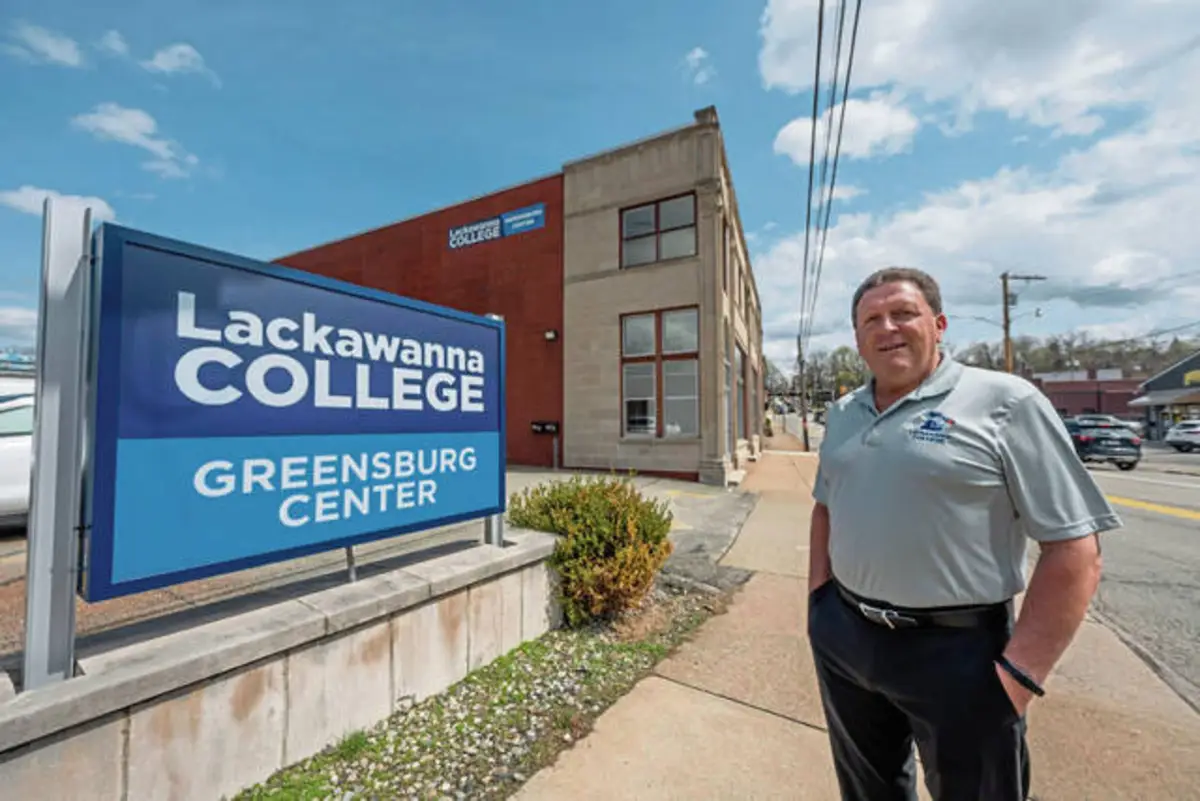
Scranton-based Lackawanna College is opening a satellite campus in Greensburg dedicated to welding and electrical programs to address what it said is growing demand for workers.
Founded in 1894, Lackwanna has nearly a dozen locations statewide — most of which are located in northeastern and central Pennsylvania. It was approved in September by the Middle States Commission on Higher Education to open three satellite centers focused on the skilled trades — in Bethlehem, Chambersburg and Greensburg.
The Greensburg Center is along East Pittsburgh Street in a building that formerly housed Stone Bridge Brewing Co. The brewery, whose first location opened in 2018 in Johnstown, operated on East Pittsburgh Street for about two years before moving to nearby location last year.
Lackawanna College officials have brainstormed about opening more locations statewide for several years, said Chief Operating Officer T.J. Eltringham. Seeing the increased need for skilled trades training prompted the college to make the jump, he said.
The expansion into Greensburg, specifically, was inspired by the closure of Triangle Tech, Eltringham said.
The technical college closed in 2024 after 80 years in operation, shutting down all six of its campuses, including those in Pittsburgh and Greensburg. Pittsburgh Technical College, located in Allegheny County’s North Fayette, also closed in 2024, citing declining enrollment, market pressures and inflation.
Lackawanna College already has a presence in Western Pennsylvania. It offers dual enrollment programs at Western Area and Parkway West career and technical centers, in Chartiers and North Fayette, respectively — allowing students to receive college credits while in high school.
“Greensburg made a lot of sense to us,” Eltringham said.
Western Pa.‘Home of the next industrial revolution’
Western Pennsylvania also was an attractive market for the college, as experts suggest the region could play host to an industrial boom of data center development, Eltringham said.
“There’s a lot of documentation that suggests it’s the home of the next industrial revolution, with the rise of data centers and the need for energy to help push them forward,” he said. “We know that’s going to be a significant part of the economy for years to come.”
With data centers comes more jobs in the skilled trades, Eltringham said.
“You can’t do any of this without welding. You can’t do any of this without skilled electricians,” he said. “It was hard to hire electricians before the rise of data centers, and it’s only going to get worse.”
Electrical equipment and component manufacturing jobs are projected as the fifth fastest growing industry nationwide, according to a report released in August by the federal Bureau of Labor Statistics. About 48,400 jobs are expected to be added to those fields by 2034.
High schools, colleges see ‘growing interest’ in trades
The demand for skilled trades training also is visible among local educational institutions, said Anthony Underwood, vice president of student affairs for Westmoreland County Community College.
The college this semester reported a 26% increase in enrollment to their technical and trade programs. These include welding, HVAC, culinary, allied health and graphic design, Underwood said. But the majority of the increase is attributed to the skilled trades programs, he said.
The increase, Underwood said, reflects “a growing interest by families and students having technical skills.”
High school career and technical centers are seeing a similar growth in skilled trade interest. Enrollment in vocational education increased nearly 14% nationwide in fall 2024, according to the nonprofit National Student Clearinghouse.
“Careers are not linear things,” Underwood said. “Sometimes, you’ll have eight or nine careers in your life. Having those technical skills makes you incredibly valuable, and folks are beginning to understand that.”
Lackwanna aims to ‘have an impact’ on local economy
Construction is underway at the Greensburg Center, which will welcome its first cohort of students in the fall, Eltringham said. Electrical technology and welding and fabrication programs will be offered, but officials aim to offer more programs at the Pittsburgh Street campus in the coming years.
“When we put these locations up within communities, we’re training individuals that live here — born in Greensburg, raised in Greensburg,” he said. “They’re going to work in Greensburg. They’re going to buy houses. They’re going to buy cars. They’re going to have an impact in the economy.”