
Crowds of football fans are expected to flood the North Shore and Point State Park during the three-day NFL Draft — and many will be sharing the experience online.
With attendance estimates nearing half a million, questions remain about whether the city’s cellular service can handle the surge in posts, photos and messages.
Officials at Verizon, the NFL’s official partner, say they’ve prepared Pittsburgh for the demand.
“We’re setting up temporary assets on all the strategic areas that the NFL is operating the draft in,” said Jim Rickard, Verizon associate director of network performance.
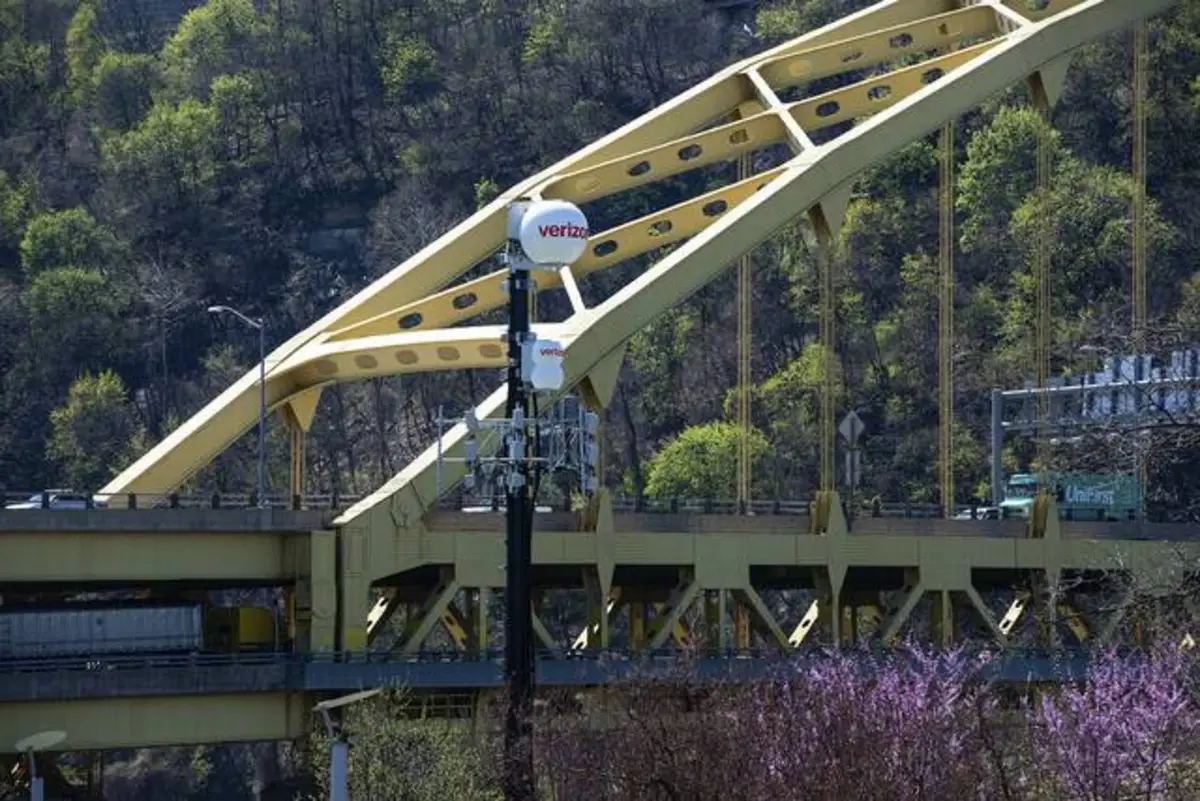
While large macro sites — which are just large cell towers — have been constructed to temporarily provide broad, foundational coverage, Verizon has also installed small cell structures that are permanent to the area. Verizon is paying for the upgrades, officials said.
Along North Shore Drive, there are several small cells installed on streetlights and poles to increase capacity in high-traffic urban areas, utilizing high-frequency millimeter waves for faster speeds, Rickard said.
“We refer to the coverage area [of small cells] in hundreds of feet, whereas a traditional macro cell site would be miles,” Rickard said.
Larger macro sites have been set up in areas such as Point State Park and on top of the former Pittsburgh Post-Gazette building on the Boulevard of the Allies.
Aimee Knox, a spokeswoman for Verizon, said in order to handle the dense clusters of fans at the draft experience and the main stage area, Verizon has also added temporary portable cell sites. These mobile units provide targeted “bursts” of connectivity in high-traffic areas.
Knox and Rickard said Verizon has been working to map out the city for the draft since the announcement, two years ago, that Pittsburgh would be 2026 host city.
“We calculate how many people could be in an area in working with the NFL, understanding the size of the area that they’re going to have. When we design our network, we back into that number to make sure we have enough assets in place to support the users,” Rickard said.
Verizon will also have its very own “mission control” team at a 24/7 command center located in the North Shore. The team will be made up of network engineers monitoring performance in real time across the North Shore, Downtown and Point State Park.
Knox said the team uses advanced analytics and live heat maps to track where crowds go to gather.
“As crowds densify and fan out, that allows us to make adjustments, so that we know exactly how to adjust the [service] capacity,” Knox said.
Pittsburghers not making their way into the city for the draft should not experience any change in their service. Rickard said having good service outside of the city boils down to the existing network infrastructure.
“As far as the crowds in this area and what effects on the network, it’s isolated to the sites that serve those areas,” Rickard said.