
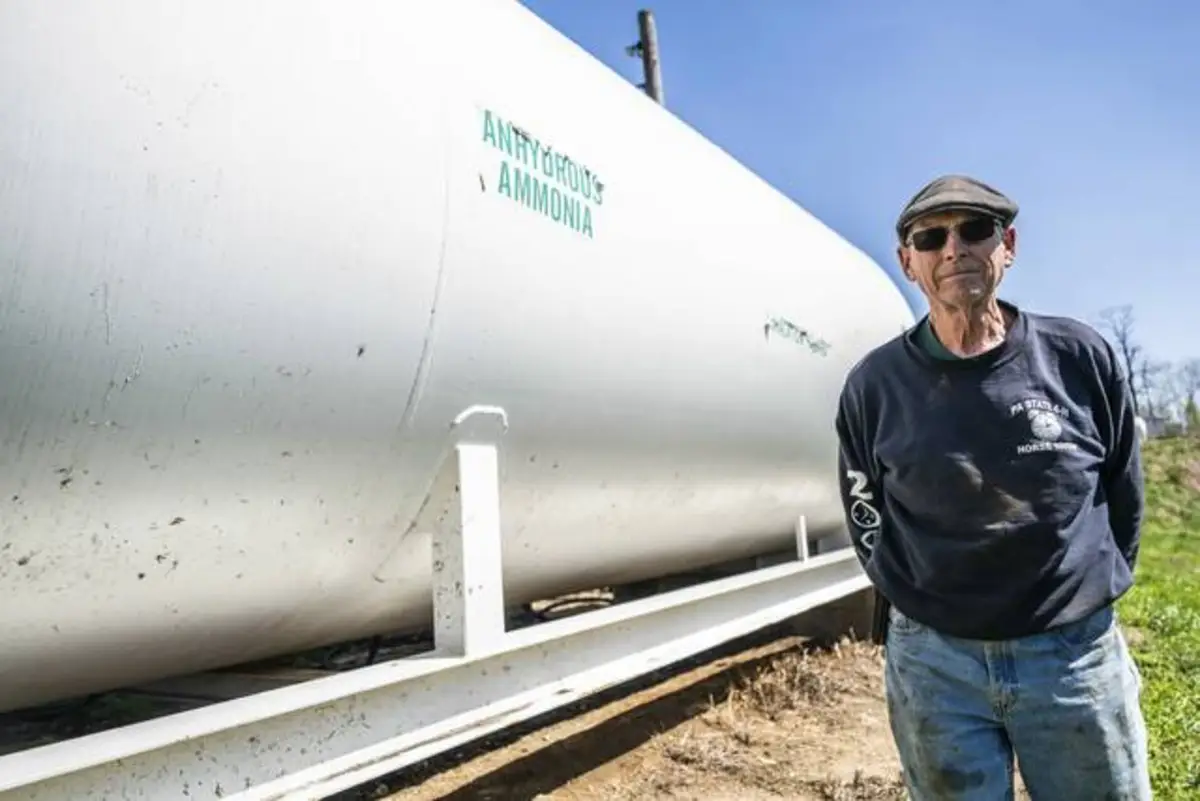
As Pennsylvania farmers prepare for planting season, a new volatility in the Middle East is threatening a commodity they cannot grow: nitrogen fertilizer.
The effects of the U.S. and Israeli military campaign against Iran have already rippled out into the world economy through higher oil prices. Those have translated to higher costs at the gas pump in the near term. Crude oil prices hit their highest level since 2022 in early April. That means transportation costs for everything go up and are likely to be felt by consumers in places like the grocery store.
But as the planting season nears in agricultural regions across Pennsylvania, farmers are looking ahead to a different commodity — fertilizer.
The Persian Gulf is the center of the world’s nitrogen-based urea fertilizer production, and Iran itself is among the top three producers in the world. The Middle East overall plays a pivotal role in global fertilizer trade, according to the International Fertilizer Association. Russia is also a major player in the urea market.
“The first number on the back of a fertilizer bag is the nitrogen content, because that’s the most important thing,” said Fred Slezak, owner and operator at Lone Maple Farms off Route 119 in Salem. “Nitrogen helps you increase crop production.”
In 2024, Iran, Qatar, Saudi Arabia, the United Arab Emirates and Bahrain together accounted for 23% of global ammonia trade, 34% of global urea trade and 18% of global ammoniated phosphate trade. Across the wider region, the Middle East supplied close to 30% of global exports of major fertilizers, according to the association.
“There’s two big types of fertilizer that come from that region,” said Phil Lempert, a consumer behavior analyst and author of the “Supermarket Guru” newsletter. “One is nitrogen that’s used for corn — that’s fed to cows, which is really important and will likely drive up the cost of beef. The other is urea, which is used on a lot of crops. So it’s a really big deal not to have these types of fertilizer. And it’s coming at a really bad time, which is planting season.”
In 2024, nearly 18.5 million tons of urea were exported via the Strait of Hormuz, according to the fertilizer association. Any prolonged disruption to shipping in the corridor would quickly ripple through global fertilizer markets, its analysts said.
Slezak said the price of fertilizer he’s ordered so far this season is up 20% to 25% over last year.
Eric Rosenbaum, a senior agronomist with Rosetree Consulting in Shillington, said there are a lot of unknowns as farmers prepare to order fertilizer that’s crucial to large-scale crop production.
“In the past week, nitrogen prices have jumped 12%,” Rosenbaum said in March. “In the fertilizer raw materials market, you have nitrogen, potassium and phosphorus. A lot of potassium comes from Canada and Russia; some of our phosphorus is domestic, but a lot comes from Morocco. Nitrogen comes from all over the place.”
Rosenbaum said that price volatility for fertilizer right now is likely due more to speculation than outright availability.
“Something I’ve told the farms we consult right now is that 90% of the fertilizer they’ll use in the next 60 days is already onshore, or on a boat heading to shore,” he said.
Lempert wasn’t sure he agreed with that assessment.
“A couple of weeks ago, the U.S. Department of Agriculture said that about 40% of farmers had not placed their fertilizer orders prior to the start of the war, and that’s significant,” he said.
Lewis Frame is an agronomist with Team Ag, an agricultural consultant in Lancaster. He also is a family farmer.
“I priced some fertilizer out on Feb. 10, and those prices had stayed pretty steady,” Frame said. “I ordered that fertilizer on March 2, two days after the first air strike in Iran — and it had gone up about $45 per ton, and my supplier was uncertain whether they could source more. By the end of the week, it was $90 more per ton.”
When Frame looked up prices last week, a ton of fertilizer cost about $490 per ton, nearly $140 higher than its cost in February.
“You’re looking at about a 40% price hike, and that’s just for nitrogen,” he said.
Each farm is unique in its fertilizer needs. At Palmer’s Farm in Unity, owner Neil Palmer doesn’t need all that much fertilizer for his 30 acres of vegetable crops.
“We’re pretty small, and on top of that, we have a lot of animals and a lot of manure production, which we use and compost,” Palmer said. “Now my neighbor up the road? He probably has 1,000 acres of soybeans, so he’s going to need a lot more fertilizer than us.”
Frame said he’s advising his client farmers to have their soil tested and see exactly what nutrients they truly need.
“You can figure that out and make sure you’re not over-buying and over-applying,” he said. “Supply really has not been the issue, historically or now. That’s the way the fertilizer market has worked. The price goes up like a rocket, but comes down like a parachute. When this kind of thing happens, the price goes up.”
Frame said if he were in charge of farm policy in the U.S., he would advise ramping up domestic nitrogen production.
“We do have a decent amount of it happening in the Midwest and South,” he said. “And if you look at global fertilizer prices, ours is actually about $100 cheaper per ton than the rest of the world. If we’re looking at America as the priority, we really should emphasize domestic nitrogen fertilizer production. It’s an energy-driven process using natural gas — which we also have a lot of — to produce the energy that makes nitrogen.”
Frame’s advice comes on the heels of two events envisioned as worst-case scenarios by Josh Linville, vice president for fertilizer at StoneX, a commodities consultant based in New York City.
One is the country of India releasing a purchase tender seeking 2.5 million tons of fertilizer, a move related to difficulty importing liquefied natural gas, much of which comes to India from the Middle East. The other is Ukraine’s recent targeting of nitrogen plants in its war with Russia.
“If they can hurt Russia’s ability to export nitrogen, that takes a bad situation and makes it worse,” Linville said in a StoneX video analyzing the fertilizer market. “Russia is the largest single urea exporter in the world. … If they start to be impacted on what they can export, this global market gets very, very bad, very, very quickly.”
Slezak said if he gets a good corn crop in 2026 — his 50th year of farming — that will do a lot to make up for the bump in fertilizer prices. What concerns him more is the damage done to his and others’ crops by deer.
“We have variable weather conditions, especially the past couple of years,” he said. “If we have adequate rainfall, there’s enough food that the deer don’t end up feeding on crops as much. But we have such a huge uncontrolled amount of deer out there. I’m concerned about the fertilizer price, but moreso I’m concerned about how devastating deer can be to our livelihood.”