
Rebecca Price, a psychiatry professor at the University of Pittsburgh, diagnosed a problem: Patients with depression were suffering too long until finding the right treatment. So she developed technology that helps them change habits and thinking patterns, working alongside traditional treatments like medication.
Price published her findings — and her email inbox got flooded with messages from patients, their family members and providers.
“They were telling me they really want and need something like this,” Price said. “I knew my life as a researcher needed to change.”
With help from Pitt’s Office of Innovation and Entrepreneurship, Price worked to bring her research into the mainstream. The efforts resulted in her work being optioned by Taja Health Technologies PBC.
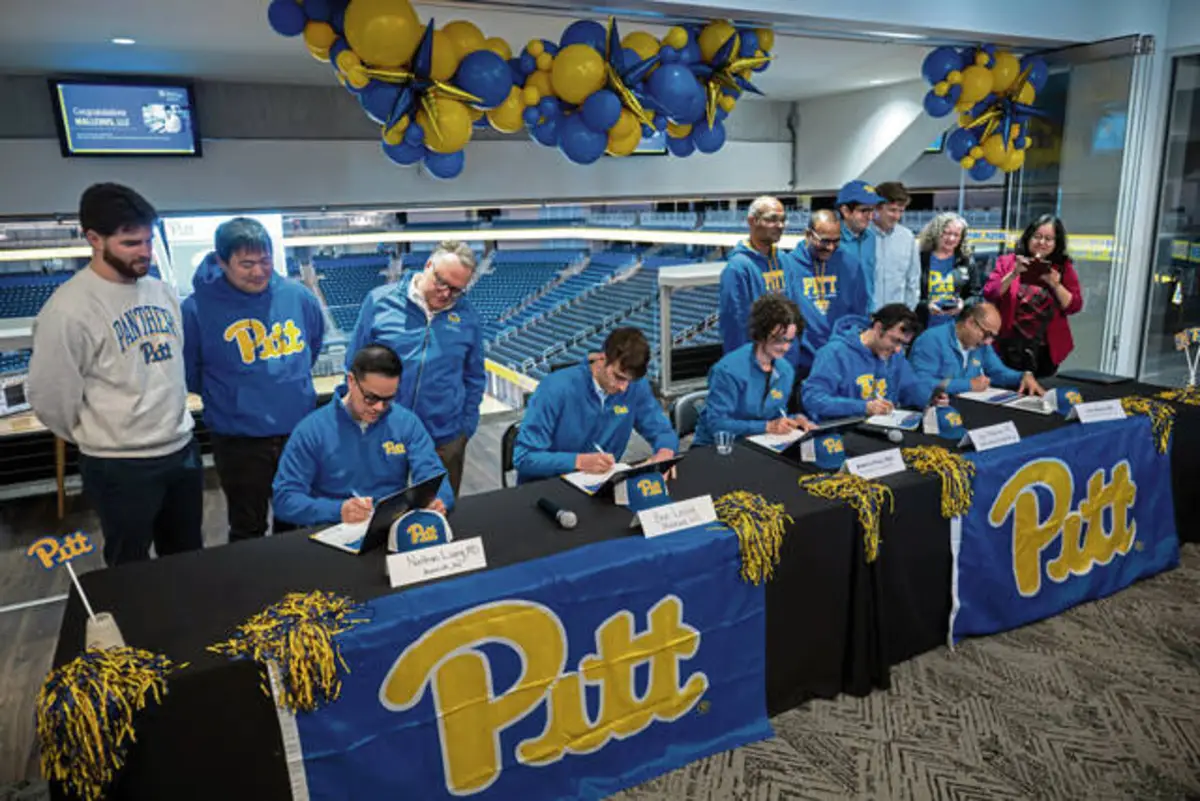
Price and four other Pitt researchers were recognized by Pitt with a “startup signing day” held Tuesday at the Valasek Club in the Petersen Events Center.
The signing day — similar to when student-athletes sign their commitment to play a sport collegiately — was Pitt’s way of celebrating scientists working to commercialize their research. It was the second such event held by the university.
“It’s a fascinating journey, having my hand held every step of the way through meeting with different entrepreneurs and companies external to Pitt (and) getting a patent application filed,” Price said.
With a stadium backdrop, researchers and attendees decked in Pitt gear, and an appearance from university mascot Roc the Panther, the celebration felt like a sporting event.
The event gave a different meaning to NIL, said Pat Bostick, a former Pitt QB and current associate athletic director for the university. In college athletics, NIL — standing for name, image and likeness — allows student athletes to monetize their personal brand through endorsement deals, sponsorships and appearances.
“What these faculty founders are doing isn’t so different,” Bostick said. “They’re taking their name, their intellect, their life’s work, and licensing into something that can tackle some of the biggest challenges facing our society.”
In the 2025 fiscal year, Pitt had a record 444 inventions disclosed and 15 startups. Filing an invention disclosure is the required first step to evaluate commercial potential and initiate property protection, like patents, before publicly disclosing research.
Among the signees were Nathan Liang, a vascular surgeon and professor of surgery. His company, Aneurisk, is an AI-enabled startup providing imaging analysis and predictive analytics for aortic pathology.
The way clinicians image, analyze and evaluate aortic aneurysm risk is simplistic and inefficient, Liang said. An aortic aneurysm is a bulge in the wall of a person’s aorta, the body’s main artery.
“Our intention is to revolutionize the way physicians approach aortic disease by drastically improving the consistency and the efficiency of advanced aortic disease, by drastically improving the consistency and the efficiency of advanced aortic imaging, and by bringing artificial intelligence to aortic risk prediction, changing the standard of care by which we practice,” Liang said.
The other signees were Ben Leslie, a medical student whose company is working on a surgeon instrument integrating suction and retract devices into one tool designed for skull-based or neurosurgery; Jay Chhablani, a vitreoretinal surgeon whose company is developing AI-powered tools to help clinicians diagnose and track eye diseases like macular degeneration; and Ajay Wasan, vice chair for pain medicine whose company uses machine learning to predict how patients will respond to different therapies based on data from 100,000 patients.
“I realized there is life beyond science,” Chhablani said of the process to commercialize his research. “It is great to do research, but how to commercialize, how to take it to every patient, that truly matters.”