
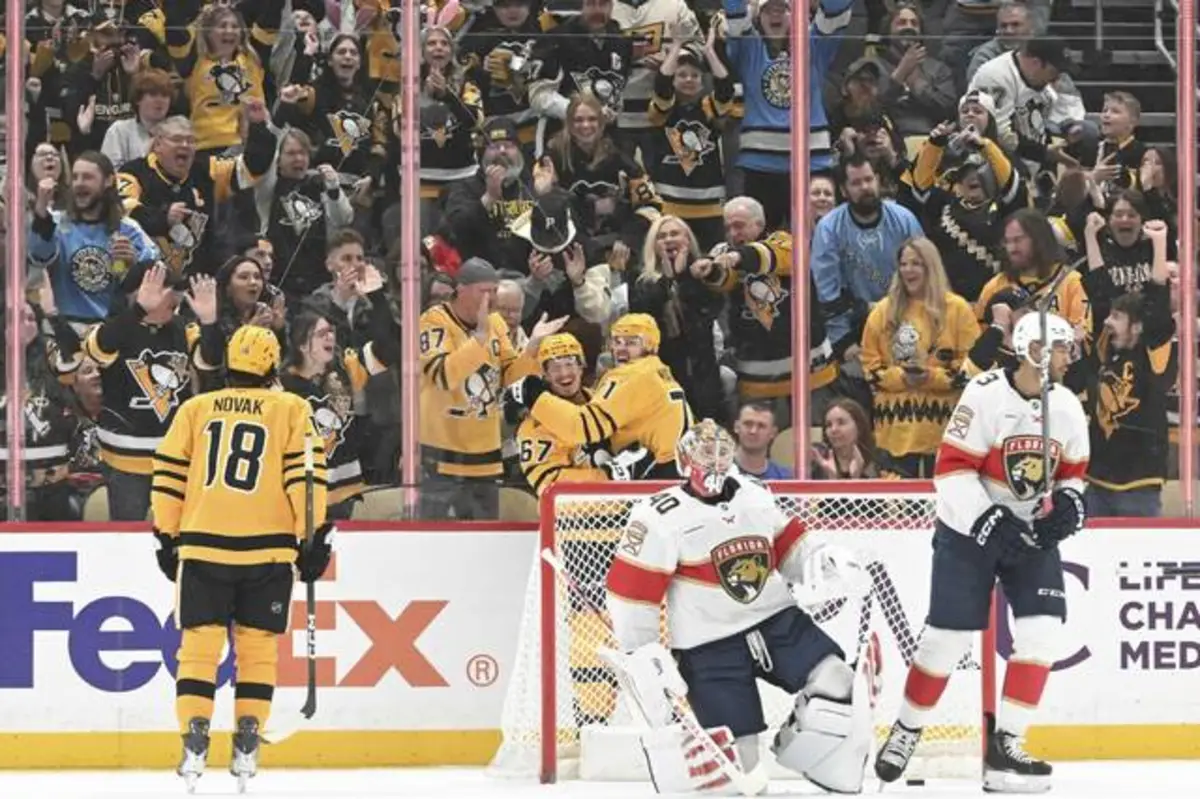
Penguins broadcaster Josh Getzoff got it right when the buzzer sounded on the playoff-clinching win Thursday in New Jersey.
“This was a team everyone said was lottery bound!”
They said it, all right, and for good reason: It was a team that was lottery bound. Nobody in their right mind thought differently. Not if they looked at the roster.
I’ve made my share of bad calls over the years, and I’ll sometimes look back and ask, “What was I thinking?” (Kenny Pickett Year 2 springs to mind). I don’t feel that way on this topic.
I know exactly what I was thinking, and it was the same thing you were thinking: This is a lottery team.
If somebody tells you they saw this coming, they’re lying.
I’m not sure even the Penguins saw this coming.
It wasn’t just the “talking heads” and “national media” that wondered if Sidney Crosby might have to be traded to ever see a playoff game again. It was Crosby’s agent, Pat Brisson, who reignited that noise before the season.
Remember when Brisson piped up about the franchise’s downward turn and how Crosby “deserved” to be in the playoffs? He sure didn’t sound hopeful.
Here’s what none of us — not me, not you, not Pat Brisson and likely not even president of hockey operations Kyle Dubas — could have guessed:
• Anthony Mantha, a journeyman forward coming off a bad knee injury, would be reborn and score a career-high and team-best 31 goals at age 31.
If you predicted that, you should really be in a different line of work.
• Erik Karlsson, a total bust his first two seasons here, would suddenly recapture his Norris Trophy-winning form at midseason, at age 35, and become the Penguins’ most dynamic offensive defenseman since Paul Coffey.
• Twenty eight-year-old Justin Brazeau, who played for the Providence Bruins of the AHL two years ago, would eclipse his career-high for goals by the end of December.
• A man named Elmer Soderblom would become a key part of the stretch run.
• A man named Parker Wotherspoon would become the ideal defense partner for Karlsson.
• No fewer than 11 Penguins would have career-best seasons.
• These Penguins would become the highest-scoring team of the Sidney Crosby era.
• Evgeni Malkin — Dubas justifiably delayed any contract talk with him — would be rejuvenated near 40 and have maybe his best season in six years, making another contract seem like a foregone conclusion.
• Egor Chinakhov, an underachieving Columbus Blue Jackets forward, would wind up in Pittsburgh and become a borderline star.
• Tristan Jarry would become viable and even good again, to the point where the Edmonton Oilers would see him as desirable and trade for him. And then a goaltending tandem of Arturs Silovs and Stuart Skinner would play well enough to backstop a playoff team.
Do not forget that Jarry helped stabilize this team early in the season.
• An 18-year-old rookie named Ben Kindel would be an immediate impact player.
• Dan Muse would bring it all together and become the NHL Coach of the Year (which he should be).
I’m not sure I would have predicted one of those things happening, let alone all of them, and I don’t know that I can remember a more unlikely playoff team in Pittsburgh sports.
Maybe the Mason Rudolph-led Steelers from a few years ago? But that team was underachieving until Rudolph took over late in the season.
Maybe the 2006-07 Penguins, who went from 58 points to 105? But they were dotted with first-round studs and clearly on the rise. Maybe the 1997-98 Penguins under Kevin Constantine?
The 2013 Pirates broke a 20-year losing streak, but they’d been knocking on the door for a few years and were very obviously a younger team on the rise.
I’ll go with the 1989 Steelers, who were considered to be pretty wretched — they’d gone 26-37 over the previous four years — but rebounded from a 51-0 loss in the opener to make the playoffs and beat the Houston Oilers.
These Penguins were obviously an older team in decline. Until they weren’t. I still don’t know quite how it all happened, but I know this: It feels great to have been wrong.
I’m sure you can relate.