
All eyes of the football world will be laser focused on Pittsburgh when the NFL Draft is hosted by the city and Steelers April 23-25.
Hundreds of thousands of spectators will descend upon the North Shore to watch the three-day event and attend a football festival that will last a week. Millions more around the world will be watching the seven-round selection show on TV.
That wasn’t the case nearly eight decades ago, the previous time the draft was held in the city.
Broadcast television was in its infancy, and a cable outlet — three decades away from becoming a reality — wouldn’t show the draft live until 1980.
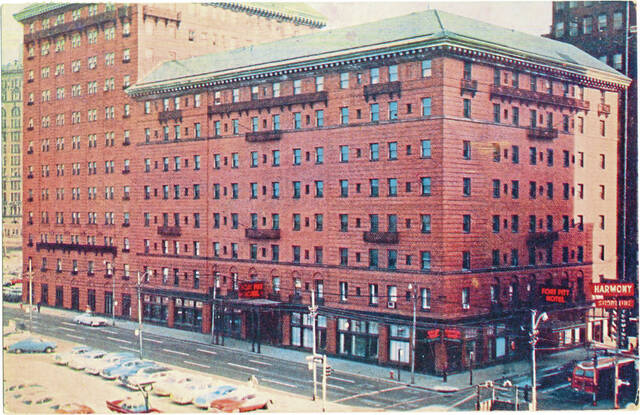
The picks weren’t announced from a makeshift stage in an outdoor venue with fans cheering — or booing — each choice. Instead, the proceedings were done in relative anonymity at a boardroom inside the Fort Pitt Hotel, which hasn’t been a part of the city landscape since the 1960s.
That draft, which would allocate players to NFL teams for the 1948 season, wasn’t even held that calendar year. It was conducted in December 1947, a few weeks before the college bowl games would take place.
Heck, the current NFL season wasn’t even finished, which is partially how the event arrived in Pittsburgh in the first place.
Suffice it to say, more important proceedings were on the minds of Steelers fans as owner Art Rooney Sr. and coach Jock Sutherland convened with nine other franchises for that NFL Draft.
“The draft was overshadowed by the Steelers playing a major game two days later,” said Anne Madarasz, director of the Franco Harris Sports Museum and chief historian for the Sen. John Heinz History Center. “The big news was what was going on with a playoff game.”
The Steelers, in their 15th year of existence, crafted an 8-4 record under Sutherland, who led Pitt’s rise to dominance in the 1930s. The NFL Championship Game was scheduled two weeks later, and the draft was supposed to be held in Chicago during the bye weekend.
The Philadelphia Eagles, however, won their final game to also finish 8-4, putting them in a tie with the Steelers for the Eastern Division lead. That resulted in a playoff game being scheduled for Pittsburgh on Dec. 21.
It was the first postseason game in franchise history.
With the Steelers and Eagles occupied by playoff preparations, the NFL shifted the draft to Pittsburgh. Two days after the draft, the Steelers would lose 21-0 to the Eagles, who then were beaten by the Chicago Cardinals for the NFL title.
Fun fact: the Steelers wouldn’t score a touchdown in a playoff game until the waning moments of a 1972 postseason game against the Oakland Raiders, with Franco Harris scooping up a deflected pass and running into the end zone. Yep, the Immaculate Reception accounted for the Steelers’ first postseason touchdown.
“In 1947, the Steelers really had a chance to move the program forward, but they lose 21-0 and they don’t get back for many years,” Madarasz said.
Back to the ’48 draft. Owners sat inside the Steelers offices at the Fort Pitt Hotel and didn’t leave until they had conducted 32 rounds of picks. The process lasted 13 hours.
According to Pro Football Reference, the Steelers selected 30 players. The website, though, doesn’t list the No. 3 overall pick as belonging to the Steelers. That’s because soon after the Steelers drafted quarterback Bobby Layne, they realized they weren’t going to be able to sign him, so they traded him to the Chicago Bears.
A month earlier, the Steelers had acquired the pick from Detroit in a deal that sent halfback Bill Dudley to the Lions. It backfired on the Steelers.
Some accounts suggest Layne didn’t want to play for the Steelers because they were still deploying the single-wing formation. Madarasz offered another theory.
“Even though Pittsburgh is in the playoffs, he didn’t know the city, he was worried about his pay and worried about the future of the team,” Madarasz said. “Until Jock Sutherland became coach (in 1946), they were terrible. He wanted to take his talents to a higher, more established, possibly higher-paying enterprise.”
Layne eventually cultivated a Hall of Fame career with the Detroit Lions, but he found his way back to the Steelers in 1958 when he was acquired in a trade. He spent his final five seasons wearing the black and gold and went 27-19-2 as a starter.
“Those were probably the best few years we had of football before the ’70s,” Steelers president Art Rooney II said.
Had Rooney II’s grandfather gotten Layne to sign in 1947, perhaps the Steelers’ rebirth would have happened sooner.
The 1948 draft spawned three future Hall of Fame players: Layne, Y.A. Tittle and Lou Creekmur.
Three other undrafted players also are represented in Canton: Joe Perry, Emlen Tunnell and Len Ford.
Layne, though, wasn’t the only player from the ’48 draft class to spurn the Steelers. The upstart All-American Football Conference was trying to poach NFL draftees, and the Steelers’ other first-round pick, end Dan Edwards, signed with the Brooklyn Dodgers of the AAFC. Fifth-round pick John Wozniak, a guard, also chose Brooklyn, meaning the Steelers didn’t retain three of the first four players they drafted.
The exception was third-rounder Jerry Nuzum, a halfback from New Mexico State whose Steelers career spanned four seasons. Defensive end Bill McPeak, taken in the ninth round out of Pitt, is another. He spent nine seasons with the Steelers and earned three Pro Bowl selections.
In all, just six of the players taken by the Steelers at the ’48 draft suited up for the organization.
“The NFL thought by holding the draft earlier, it would help teams get out in front of signing players,” Madarasz said. “But it doesn’t help the Steelers very much.”
The NFL also was trying to establish itself in 1947 after World War II had depleted many of the rosters. It was a time of transition in the country, and playing in the NFL wasn’t a priority.
“It also wasn’t a job that paid enough for most players to live on,” Madarasz said. “They were going back to school or they played one season and quit. It was difficult to have a stable environment.”
The next two years, the draft returned to Philadelphia, home of the league’s headquarters at the time. The event was held there, Chicago or New York until 1965 when it became a fixture in the Big Apple.
The draft didn’t return to a rotational format until 2015. The Steelers were awarded this year’s draft two years ago, ending a nearly eight-decade absence.
“It’s something we were hoping to bring to the city for a long time,” Rooney II said. “It’s great to see it’s finally going to happen.”