
One of Art Rooney II’s first tasks with the Pittsburgh Steelers was assisting in the NFL Draft.
Actually, assisting might be an inaccurate term.
“In those days, everything was done on paper, and we had big boards with the players’ ratings,” Rooney II recalled recently. “My job would be when somebody got drafted to use a magic marker and cross off the name.”
That was 1972, the year the Steelers famously drafted Franco Harris in the first round, a move that helped turn the franchise’s fortunes from an NFL bottom feeder to the winner of four Super Bowls in a six-year span in that decade.
Rooney, now the franchise’s president and primary owner, has another memory of that draft doesn’t involve a pick, but rather a smell.
“I remember we had a lot of cigar smokers, and the draft room was full of smoke,” he said. “My uncle Art (Rooney Jr.), my grandfather (Art Rooney Sr.) and some of the coaches smoked. (Scout) Bill Nunn smoked cigarettes, but half the other people were smoking cigars. It filled the room.”
Morning solitude to 3-day extravaganza
Fast forward to this April when the Steelers will host the NFL Draft. While much of the national attention will be on the pomp and circumstance on the North Shore, where the draft will be held, most Steelers execs will be at UPMC Rooney Sports Complex on the South Side inside the so-called war room.
There will be plenty of bottled water — which didn’t exist in 1972 — and likely nary an ashtray in sight.
The other differences will be as plentiful as the players being selected by the 32 NFL teams.
Five decades ago, when Rooney II took a break from his college studies to cross names off a list, the draft was held in early February, on a Tuesday and Wednesday instead of a three-day weekend extravaganza.
It was conducted in the morning in solitude, not in prime time with millions watching on TV. In fact, the draft wasn’t even televised.
It consisted of 17 rounds, not seven.
It also was held inside a hotel in New York, not in an open-air constructed venue adjacent to Acrisure Stadium.
And it will be attended by an estimated half a million spectators — not just the occasional onlooker cramming for a view of the festivities from a hotel balcony.
“The growth of fans watching on TV was probably somewhat expected,” Rooney II said. “In terms of becoming a football festival where hundreds of thousands of people attend in person, I honestly did not see that coming.”
Modern era transformation
The scope of the draft changed in 2015 when it was taken on the road, leaving the confines of New York’s Radio City Music Hall for a two-year stint in Chicago. The host city has changed every year since 2016 with the exception of 2020 when the draft was held remotely because of the pandemic.
NFL teams now bid to host the event, which is usurped in importance only by the Super Bowl. And for northern teams such as the Steelers it’s the next best thing to hosting a Super Bowl.
“It’s an opportunity for cities and teams to get something big,” said Jim Steeg, a former NFL executive who oversaw the Super Bowl and draft setup for 26 years before leaving the league office in 2004. “You can’t have a Super Bowl in Green Bay because of worry about playing in a foot and a half of snow. This event can be spread around to everybody, and it’s a celebration now.”
When the draft 1st came to Pittsburgh
This year’s draft is the second time Pittsburgh has hosted the NFL Draft. The previous instance, in December 1947, was a matter of convenience. And it was not a celebration, but a matter of survival that was at the epicenter of the league’s agenda.
The first NFL Draft was conducted in 1936, and it was instituted to keep newer franchises such as the Steelers — founded in 1933 — from being at a competitive disadvantage.
“At this point, we think of the NFL as a behemoth, as an incredibly successful, rich business,” said Anne Madarasz, the director of the Franco Harris Sports Museum and chief historian for the Heinz History Center. “What the draft shows us is how important controlling the game and the quality of players and product on the field is to the survival of the NFL.
“There was a lot of ownership working together in the beginning. (Chicago’s) George Halas works with Art Rooney Sr. and (Philadelphia’s) Bert Bell to make the draft happen. He recognized that we’re not going to get franchises unless they can be successful on the field. They weren’t going to draw people to games, and it wasn’t going to fly economically.
“Even in this period, the draft was incredibly important to the future of the league and its advancement. Competitors were out there waiting to grab the business away. The economic model and growth of the NFL was at a critical flashpoint.”
In 1947, a few years removed from World War II, NFL teams were trying to replenish their rosters, and the result was a 32-round draft among the league’s 10 franchises.
Originally scheduled to be conducted in Chicago, the draft switched to Pittsburgh when the Steelers and Eagles tied for the Eastern Division lead with 8-4 records. A playoff game was scheduled for Sunday, Dec. 19 at Forbes Field. To save expenses, the NFL shifted the draft to Pittsburgh, and it was held two days prior to the playoff game at the since-razed Fort Pitt Hotel.
The college football regular season was barely in the rear-view mirror, but that wasn’t the only reason the 1948 draft was held in 1947. The NFL was trying to fend off the upstart All-American Football Conference for talent, and the league wanted to get a head start on teams signing their drafted players before the AAFC could swoop in with contracts.
“The AAFC was paying more money,” Madarasz said.
Thus, the draft was conducted in relative secrecy inside Steelers offices located inside the Fort Pitt Hotel.
“Newspapers cover it, and radio covers it,” Madarasz said. “But Art Rooney Sr. literally won’t tell anyone who he picked. Some of the better-heeled clubs talk about who they chose, but Art won’t tell anybody, and newspapers were complaining about why was he keeping it a secret? It’s because (Rooney) was running around trying to get players to come to Pittsburgh.”
The cloak-and-dagger nature of the draft also existed in the 1960s when the upstart American Football Conference was bidding with the NFL for top college talent. Rooney II heard the tales from his father, Dan, the team’s late chairman. Drafts continued to be held in the same calendar year as the college season.
“The idea was to have the draft in secret, then have teams go out and sign players right away to keep them from going to the AFL,” Rooney II said.
It wasn’t until 1976, a handful of years after the NFL-AFL merger, that the draft was shifted from the winter to the spring.
“It fits into the league calendar now,” Steeg said. “We scheduled it where we thought it was the first weekend of the NHL playoffs or the last weekend of the NBA regular season. We didn’t think that was much competition for attention.”
When the cameras arrived
The draft was televised for the first time in 1980 by a fledgling cable network called ESPN. It was a year after Steeg joined the league to spearhead the event.
Owners were against it, with Steeg saying a proposal from commissioner Pete Rozelle to broadcast the draft was voted down unanimously.
“I think they were afraid of it because they thought agents would get too much time on the air,” Steeg said. “Once it got going, teams embraced it and started holding events and watch parties. In the early ‘80s, not everybody had ESPN.”
One of Steeg’s early objectives was to move the draft from its Tuesday-Wednesday roots to the weekend. And away from a morning timeslot.
“It was insane,” Steeg said. “It started at 8 a.m. I always thought that was wrong. It was dumb. We couldn’t gain any traction.”
That change ultimately transpired in 1988. One constant carried into the next century — the draft’s location. The venue varied — it went from the Sheraton to the Marriott Marquis to the Theater at Madison Square Garden to Radio City Music Hall — but the draft was held annually in New York from 1965 until 2014.
“We went from maybe 150 fans in the balcony at the Sheraton to about 800 at the Marquis,” Steeg said. “We outgrew that and ended up in the theater. That got us to about 3,000 people. It always was driven by attendance.”
Steeg began to think the draft could travel in 1999 when the expansion draft for the reformed Cleveland Browns attracted thousands to the proceedings held at the Pro Football Hall of Fame in Canton. A similar number of fans flocked to the 2002 expansion draft for the Houston Texans.
“They were the ultimate non-events of non-events,” Steeg said. “I thought, this thing could move and we could really do something with it.”
Slow to act, the NFL didn’t take its draft show on the road until 2015. In the ensuing decade, attendance has skyrocketed with an estimated 600,000 fans taking in the three-day event last year in Green Bay.
Pittsburgh’s turn on stage
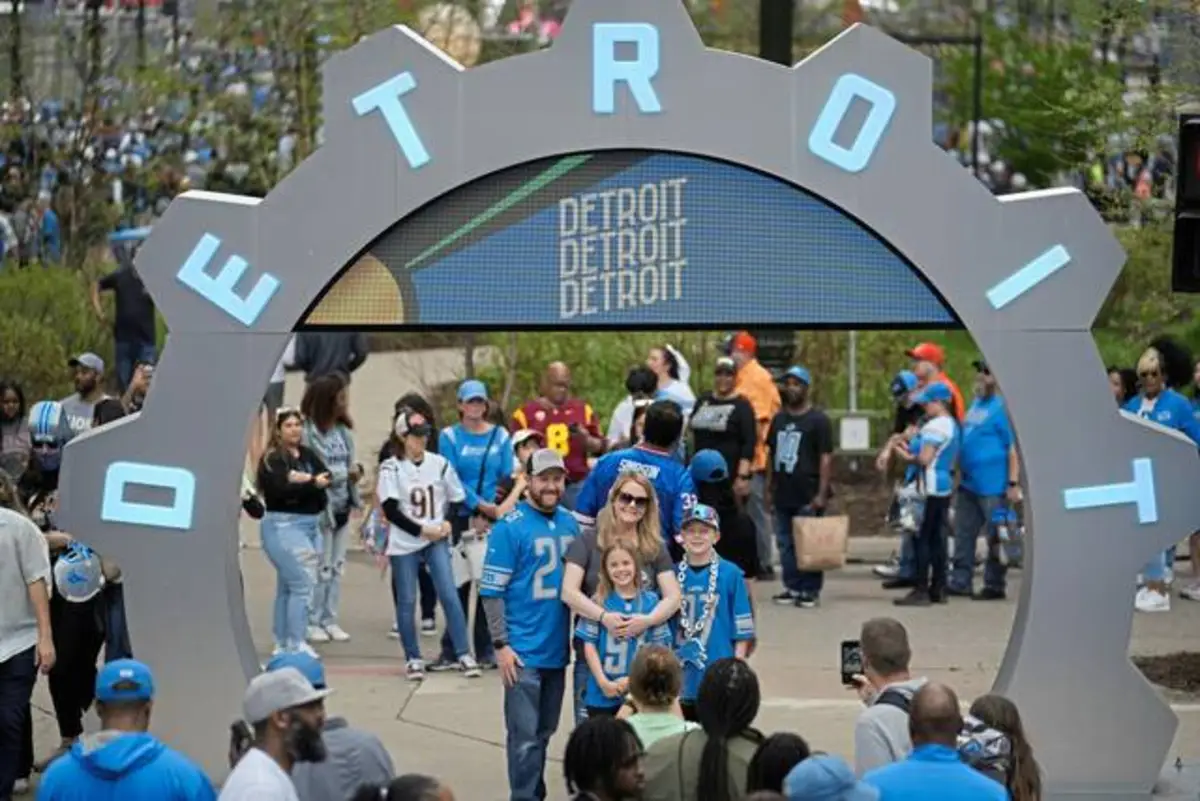
Now it’s Pittsburgh’s turn to step into the spotlight. City officials are planning for between 500,000 and 700,000 fans to descend on the North Shore and downtown for the event being held outside Acrisure Stadium and across the river at Point State Park.
“It’s a great showcase for the city,” Madarasz said. “You see what a Steelers game draws normally. This is a chance for people who love the Steelers and are in the region to see it. It also draws people from around the country. It’s a great opportunity for people to see what Pittsburgh has to offer.”
The event will culminate several years of planning for the Steelers, who were awarded the draft in May 2024.
“This is kind of our Super Bowl,” Rooney II said. “That’s what makes it so exciting.”