
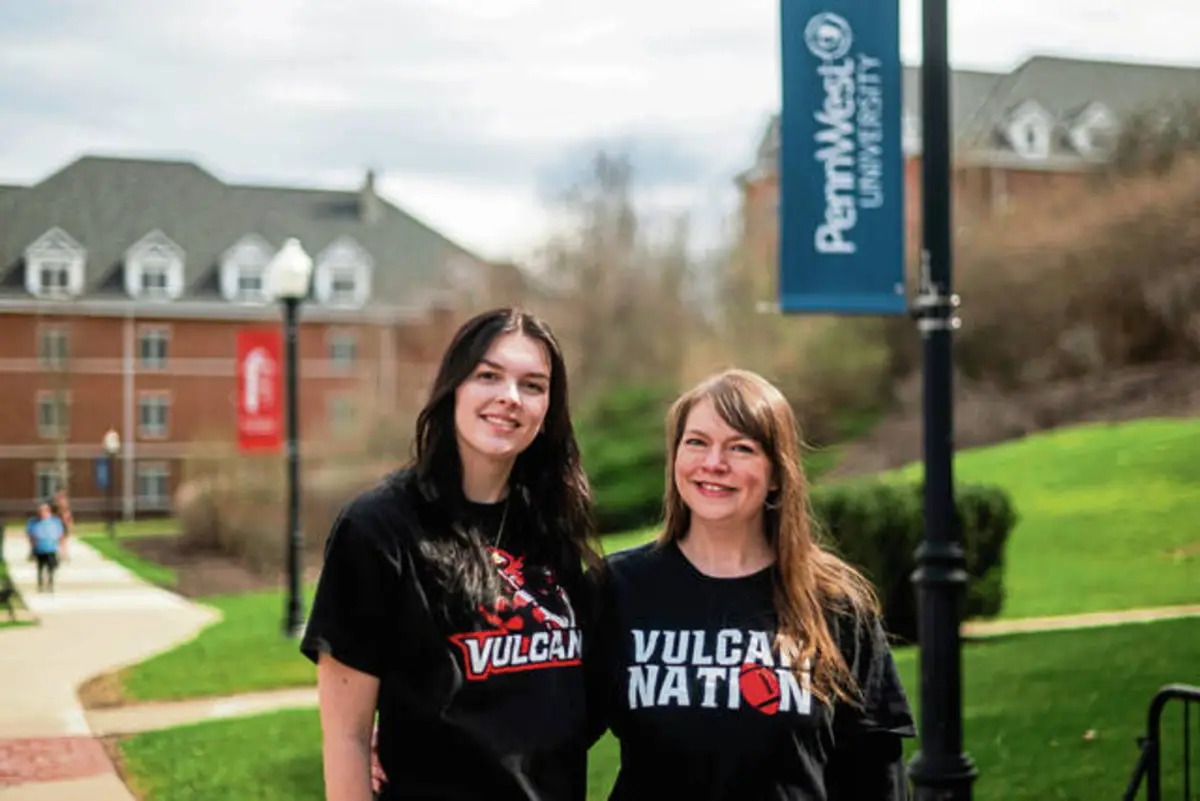
Jessica Wheeler isn’t joking when she says she’s old enough to be the mother of her fellow students at Pennsylvania Western University’s California campus.
Her daughter, Alivia, is also a student at PennWest California.
Jessica, 43, graduates in May with a bachelor’s degree in secondary English education. Alivia, 20, is a sophomore studying early childhood education.
“I’m the age of everyone’s mom, but none of the students treated me any differently,” said Jessica of Carroll Township, Washington County. “If we’re working in a group, maybe some hesitated, ‘Is this lady going to be in charge?’ ”
Even during her student teaching assignments, some of Jessica’s mentor teachers are younger than her.
“I make it clear: I’m a student, and my classmates — we’re students together,” Wheeler said. “The only difference is I might bring a different perspective.”
Wheeler’s story is one colleges and universities nationwide are trying to replicate — especially with a shrinking pool of prospective college students graduating from high school.
Led by a post-2008 birth rate decline, experts anticipate the impact of a college enrollment cliff to peak this year and next, with the number of high school graduates to fall by nearly 500,000 or 13% by 2041. Nationwide, colleges and universities saw a collective 15% decline in enrollment between 2010 and 2021, according to the National Center for Education Statistics.
“In general, the goal is to align and understand how learners learn today,” said Jennifer Moore, PennWest’s senior associate vice president for strategic enrollment management. “We’re thoughtful of how students work and learn. For adults, they want affordability, accessibility and direct career outcomes.”
Colleges navigating students
In five years, Wheeler will have obtained two degrees — her bachelor’s from PennWest and an associate degree from Community College of Allegheny County in general education, which she earned in spring 2023.
But it wasn’t always easy. During her first semester at PennWest, she observed a class at Ringgold High School and remembers a feeling of self-doubt.
“I’m 38 years old and in the parking lot of the high school, and I’m thinking to myself, ‘This is crazy. What are you doing?’” Wheeler said. “I had all the self-doubt in the world. But I pulled myself together and went in.”
Ultimately, the experience was positive. At the end of the school day, she returned to her car and had a newfound feeling of confidence.
Barriers — including self-doubt, finances, work and family life — can prevent an adult from starting or returning to higher education, noted Stephen Wells, CCAC’s provost and chief academic officer.
“Many nontraditional students have jobs, family responsibilities and school-age children, and many have limited resources to come back to school,” CCAC President Quintin Bullock said. “The college has worked diligently to strengthen support for nontraditional students.”
Overall, nontraditional students make up 36% of CCAC’s total enrollment.
Nontraditional student enrollment at CCAC was 1,292 in the 2022-23 school year, 1,456 in 2023-24 and 1,590 in 2024-25. The average student age is 26.
Wells, himself, was an adult learner.
Upon graduating high school, he attended Virginia Tech but did not do well. He enlisted in the Air Force and, after completing his duty, went on to construction jobs. Following a layoff, he decided to enroll at CCAC.
Despite military and workforce experience, CCAC only recognized three physical education credits from his time in the military.
“It’s a whole lot better now than it was when I was a student,” Wells said.
CCAC opened the door for Wells. After getting an associate degree there, he went straight to Duquesne University, eventually earning a Ph.D. In 2002, he returned to CCAC to teach English and worked his way to a top position in administration.
CCAC has streamlined onboarding and orientation for new students and has established a prior learning assessment that can identify and recognize students’ credits when they start CCAC with prior learning or work experience, said Dorothy Collins, vice president for enrollment services.
“We stopped asking students to navigate CCAC,” Collins said. “CCAC is navigating students.”
PennWest also offers a prior learning assessment for adult learners, Moore said, which can help with a student’s future planning for coursework.
“Knowing what you’ve already accomplished and knowing the university knows what you’ve accomplished makes it easier and clearer to access that pathway,” she said.
Work-family-college balance
For Bobbi French, a mother of six, returning to college was a waiting game.
French graduated from high school in Tioga County in 2002 and moved to Florida to study at Santa Fe College in Gainesville. But three months in, French learned she was pregnant. She dropped out.
“I never got back around to it,” said French, 42, of White Oak.
When her youngest two children came of school age, she began to plot a route back to higher education. The covid-19 pandemic delayed her plans, along with the health care needs of daughter, now 10, diagnosed with Type 1 diabetes.
In summer 2024, French enrolled at CCAC Boyce in Monroeville to study anesthesia technology. She is scheduled to graduate this fall from the program.
At times, it was challenging, she admits. She would have to leave class or miss coursework to tend to her children, but professors were accommodating with makeup work. She also got a job working in the admissions office at CCAC Boyce.
Bullock points to scholarships and emergency funds for students’ unexpected expenses to help adults ease the financial burden of college.
To accommodate work and family life, CCAC is increasing class availability on evenings and weekends, Bullock said. CCAC is also developing and offering fully online programs for students.
“We see it as an advantage to meet students where they are and do anything we can to accommodate a nontraditional student in a timely and efficient way,” Bullock said.
Wheeler, the PennWest student, maintained part-time work up until her last semester of college.
“I did all I could to earn money,” she said. “I’m very lucky my husband has a good job in contracting.”
While Wheeler earned financial scholarships, her family — husband Mike, daughter Alivia and eighth-grade son Michael — still made some sacrifices for her to attend college.
“I had to look at the resources available to me, and I utilized them to the best of my advantage,” she said.
At the University of Pittsburgh, the McCarl Center for Nontraditional Student Success offers academic resources, programming and career planning to adult students, said Klaus Libertus, director of Pitt’s College of General Studies.
“The goal of (the College of General Studies) was to have programs that meet the educational needs of adult learners, and I think that is more important now than ever, with more people who wish to go and get a second degree, or complete a degree they already started, or just acquire some additional certificates to stand out in the workforce,” Libertus said.
Stabilizing enrollment
The nontraditional student population at CCAC is stabilizing the overall enrollment, Bullock said. Among first-time, full-time students, nontraditional student enrollment has increased from 7% to 9% over the past three years.
“CCAC and other community colleges are uniquely positioned to serve nontraditional students,” Bullock said, citing the college’s accessibility, affordability, faculty focused on teaching, small class sizes, programming that aligns with the workforce and student support services.
The adult learner population at state-owned colleges in Western Pennsylvania — PennWest, Slippery Rock and Indiana University of Pennsylvania — has remained mostly steady over the past years.
PennWest reported 1,120 adult undergraduate students last fall compared to 1,177 in fall 2024, 1,267 in fall 2023 and 1,490 in fall 2022.
There were 2,468 graduate adult learners at PennWest last fall, 2,492 in fall 2024, 2,242 in fall 2023 and 2,498 in fall 2022.
PennWest has the highest adult student enrollment among all state-owned universities.
Moore, the PennWest administrator, believes awareness is a big factor when recruiting adult students.
“We want it to be as clear and predictable, and we want them to know the experience it can be on campus,” she said.
Indiana University of Pennsylvania’s undergraduate adult enrollment was 573 last fall, 618 in fall 2024, 674 in fall 2023 and 627 in fall 2022. The graduate adult learner enrollment was 1,146 last fall at IUP, 1,196 in fall 2024, 1,252 in fall 2023 and 1,276 in fall 2022.
Spokeswoman Michelle Fryling said IUP is working to increase enrollment among both traditional and nontraditional students. Every student has a “navigator,” or staff member, to respond to students’ questions or concerns and proactively offers support and information.
“IUP continues its focus on meeting students where they are, looking at their individual and unique needs and what support and what they need to succeed, whether they be traditional college age or nontraditional age,” Fryling said.
Understanding people’s barriers, and providing support for them, is crucial for colleges to attract adult learners, state Secretary of Education Carrie Rowe told TribLive during a March visit to Point Park University.
More than 1 million Pennsylvanians of working age have some college completed but no credential, Rowe said. The state has established PA EmpowerU, an online hub connecting people to resources like mental health, financial, housing, transportation and food support.
“We have ways that we can help you with that now, and so enticing them to come back and say, if you finish your degree and get that credential, you’re going to be so much more marketable,” Rowe said. “You’re going to be able to have a family-sustaining wage where perhaps you were struggling.”
Workforce demands
Slippery Rock University saw 385 undergraduate adult learners last fall, 360 in fall 2024, 347 in fall 2023 and 340 in fall 2022. SRU had 972 graduate adult learners last fall, 963 in fall 2024, 987 in fall 2023 and 940 in fall 2022.
“With the demographic cliff, what we haven’t heard is that people will stop learning — quite the contrary,” Slippery Rock President Karen Riley testified at a state budget hearing in March. “People’s jobs will not be more static. In fact, they will be much more fluid in the future.
“We have to be nimble; we have to be reactive to the market. And being in community with our industry partners is one way that we’re really working to make sure that options are available to them and that they are aware of them.”
Wheeler’s college journey is exactly that of a changing workforce.
She graduated from Bentworth High School in 2000 and, at the age of 19, opened her own dance and performance center in Bentleyville. She ran the business for five years before starting her family.
While raising her children, she worked delivering newspapers in the Mon Valley area.
Wheeler loved the job, she said, but “saw the writing on the wall.”
“At 38, I was too young to retire, and what am I going to do?” she said.
Through helping her children with cyberschool, Wheeler thought entering the teaching field would be a good fit.
Wheeler is entering a field with a shortage — nearly 1,660 teaching positions were vacant in the state as of October, according to the state Department of Education. She plans to teach high school English.
Wheeler believes colleges could improve on advertising the support they offer to adult learners.
“The feeling of learning something and accomplishing something, especially in your middle age, it’s fulfilling,” Wheeler said. “I think I appreciated my education more as an adult than I would have when I was 20.”
Pitt’s Libertus also thinks his university can capitalize on being ahead of the curve with offerings that are in-demand. Over the past four years, about 2% to 3.5% of Pitt’s undergraduate student population is 25 or older. That percentage amounts to about 450 to 700 students.
“I do think we will see an increase in adult student enrollment because of the changes in what the workforce is looking like, and people are looking to ‘upskill’ and become more prepared for how AI has changed our workforce,” Libertus said.
“I don’t think this is necessarily related to the enrollment cliff coming up,” he said. “But I do think that we are in a very strong position to serve these students because we have expanded our online course offerings tremendously, and we are continuing to work toward offering new degrees that will fit this change in need.”