
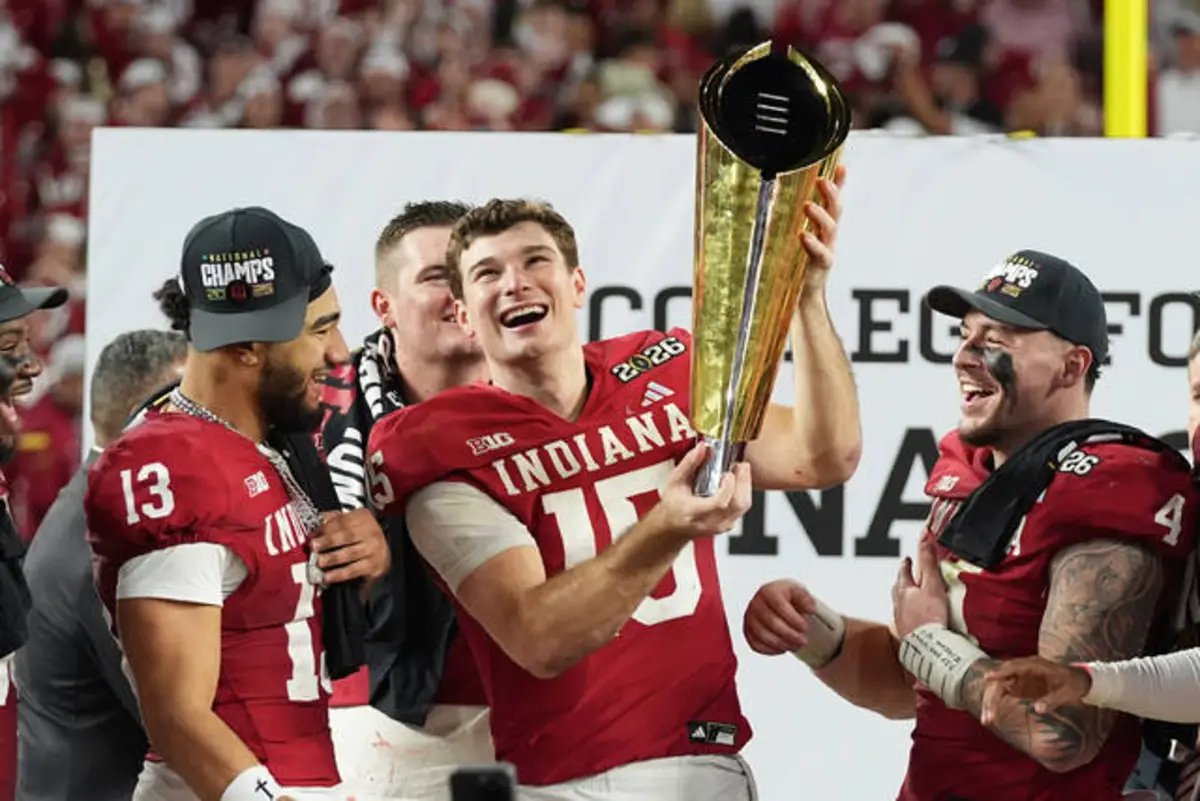
HENDERSON, Nev. — If the Raiders take Fernando Mendoza with the first pick of the NFL draft, as is widely expected, Las Vegas may finally be getting the franchise quarterback who will lead the team to the postseason success it has been seeking for years.
Recent history, however, shows the road to the Lombardi Trophy is far from a straight path, even for teams that land a big name QB at No. 1.
Of the 19 quarterbacks taken first overall in this century, only Eli Manning won a Super Bowl with his original team, and that was only after a draft day detour. Just three others have even made the big game with their original team, each losing in their only appearance.
And when Kyler Murray was released by Arizona last month, he became the fifth straight QB selected at No. 1 who didn’t last until age 30 with his original team.
“It’s hard to identify and evaluate quarterbacks, but probably the bigger picture, these teams all earn the No. 1 pick, so you’re going into a rough situation,” NFL Network draft analyst Daniel Jeremiah said. “If you go back and look at a lot of those, there’s been a lot of upheaval and turnover with the coaching staffs as well. So if you don’t get a chance to have continuity to settle in, to be with a talented team, then it’s a major, major stress on your physical and mental toughness.”
Some QBs have lived up to expectations
It hasn’t been all doom and gloom, however.
Of those 19 taken first in the 2000s, 14 led their original teams to the playoffs at some point, making the postseason 33 times combined. Ten of those QBs combined to win 28 playoff games.
But winning it all has been the challenge, with only four quarterbacks advancing to the Super Bowl with their first team. Manning won it twice, though he actually was taken by the San Diego Chargers before forcing a draft-day trade to the New York Giants.
Sometimes, quarterbacks have flourished when they’ve moved on, with six starting playoff games for other teams and all but one winning at least one postseason game. Matthew Stafford took his game to the next level after moving from Detroit to the Los Angeles Rams in 2021 after 12 seasons with the Lions. He immediately led the Rams to a Super Bowl title, and this past season was named league MVP.
ESPN draft analyst Matt Miller pointed out the Super Bowl appearance numbers have been skewed a bit by the dominance of Tom Brady and Patrick Mahomes, who have combined to win 10 Super Bowl titles in the last 25 years, keeping others from reaching the same heights.
“Obviously, the Super Bowl is the ultimate goal, but it does make it more difficult the two dynasties that just ran concurrently. If that’s what we’re judging quarterbacks by, almost every quarterback in the NFL is a failure because Brady and Mahomes have dominated it for so long,” Miller said.
Raiders won’t rush rookie
The Raiders have been mostly spectators during that time. They last appeared in the Super Bowl in the 2002 season, and have been back to the playoffs only twice since then — going one and out both times.
Now they have the first pick for just the second time as an NFL franchise. To try to make it easier on Mendoza, they have been aggressive in free agency. That includes signing Kirk Cousins, who will likely enter next season as the starting quarterback.
“I think you want to limit the amount of pressure you have on (a rookie QB) from the start,” Las Vegas general manager John Spytek said before the Cousins deal.
Even if he’s eased into the NFL, Mendoza will still face intense scrutiny, beginning with the passes he throws during offseason workouts.
The Raiders know all about drafting a quarterback No. 1 who didn’t work out. They took JaMarcus Russell first overall in 2007, and he lasted just three seasons while going 7-18.
He’s hardly the only such quarterback to come up short, and part of the problem could be outsized expectations that come at that position. Because it might be the most impactful position in all sports, especially in a league with offensive-friendly rules, teams often draft a quarterback higher than they should.
“Talking to scouts and general managers the last couple of years, it’s this idea of, ‘OK, what are we doing wrong?’” Miller said. “It’s too easy to sit back and say these quarterbacks all suck. That doesn’t really matter. You have to have one. There’s only 32 of these jobs in the world, and surely there’s 32 guys that can do it.
“I think there was an adjustment over post-Mahomes where everyone wanted traits over a developed product. That’s not a slight to Pat, who I think is fantastic, but he is an enigma, not a rule. I think a lot of people tried to make him the rule of scouting, and now we’re looking at teams that say, ‘We do want to go back to more traditional quarterback metrics and measurables and values and, say, 25 starts minimum, and you have to be able to perform from within the pocket.’”
Contract rules allow teams to be aggressive
The evaluations might go retro, but the pressure on quarterback-needy organizations to take a QB first won’t go away anytime soon.
Jeremiah said teams are willing to take a chance if the quarterback available in the draft looks better than whoever’s on the roster. Having a quarterback on a rookie contract also gives the team flexibility to surround that player with talent and take more of a risk at the position.
“The risk that used to be there in the previous salary structure, it’s not there anymore,” Jeremiah said. “So there’s no harm, no foul. You end up right back in the top three or five the next year and you feel somebody that’s much better, there’s nothing to stop you from just pulling the trigger on another one.”