
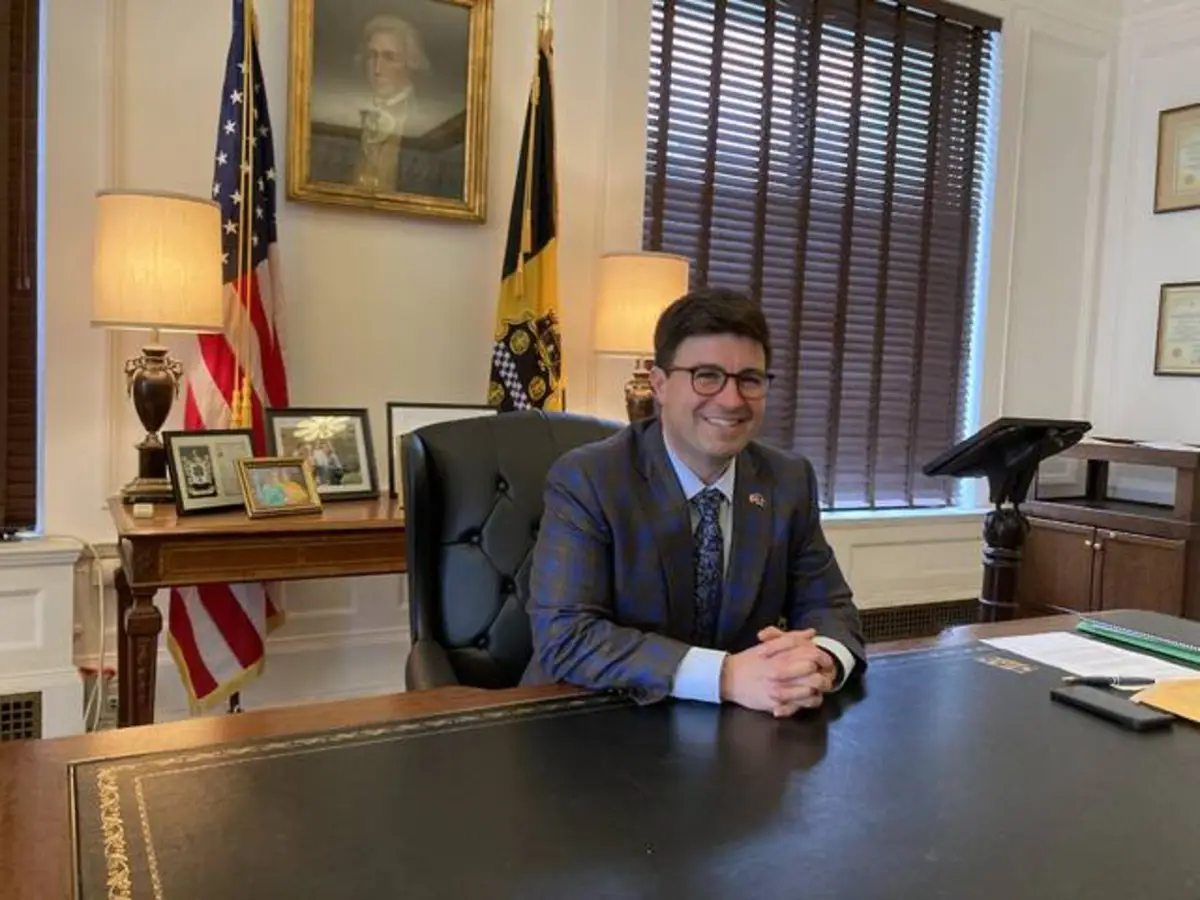
During his first 100 days as Pittsburgh’s mayor, Corey O’Connor has grappled with crises and celebrated successes.
He’s uncovered a roughly $30 million hole in the budget, declared a state of emergency during the first major snowstorm of his term and dealt with a sealed search warrant served on the city by the Allegheny County District Attorney’s Office, the contents of which remain a mystery.
O’Connor has also attracted seven-figure targeted donations from nonprofits, hired a police chief to steady the city’s rudderless force and is pressing to beautify Downtown ahead of the 2026 NFL Draft next week.
Then there are the lighter moments that come with being mayor of Pennsylvania’s second-largest city, like jumping into the pool at the newly renovated Oliver Bath House or touring 65 of the city’s 90 neighborhoods.
“Every day is different in this job,” O’Connor told TribLive on Tuesday, his 99th day in office. “One day you’re jumping into a pool. The next day you’re getting served a subpoena. The next day you have a blizzard. Then you have an NFL Draft. There’s a lot that changes every day.”
Officials are often judged on how they perform in their first 100 days. It’s a tradition that dates to President Franklin D. Roosevelt, who used his first 100 days in office in 1933 to begin shaping the New Deal — and used the hundred-day threshold as a metric to highlight his early successes, said Alison Dagnes, a political science professor at Shippensburg University.
“It’s just a good way to be like, ‘Well, how’s this guy doing?’ ” Dagnes said of the marker. “He seems to be everywhere. The first hundred days land him flat in the middle of a good-vibes narrative.”
Dagnes said mayors often set the tone early in their administration.
If they can build trust with the public and score early victories, people tend to be more forgiving of later shortcomings. If they repeatedly drop the ball or find themselves embroiled in controversies early on, people may have lingering doubts for the rest of their term.
O’Connor told TribLive he’s pleased with his first hundred days and believes his administration is living up to his campaign promises.
“You look back and say, ‘OK, did we do what we said we were going to do in those hundred days?’ I think if you look back on what we campaigned on and what we said we were going to do, it was transparency, how are we going to grow the city, how are we going to invest in families,” O’Connor said. “We started that process. We’ve done exactly what we said we were going to do.”
Kinder, gentler approach
While campaigning for the city’s top office, O’Connor pledged to convince Pittsburgh’s major nonprofits to provide financial support for a city struggling to balance its budget.
It took less than a month for O’Connor to get UPMC to provide $10 million for ambulances and the PNC Foundation to chip in $2 million for snowplows. The University of Pittsburgh pledged $5 million over five years to support city parks, public safety and business districts. The Pennsylvania Laborers District Council and Pirates Charities are providing a combined $600,000 for ballfield improvements.
While campaigning, O’Connor told voters he’d take a different approach to nonprofits, asking them to provide funding for something that fit within their missions instead of adopting the hardball approach of his predecessor, who challenged the tax status of exempt properties.
So far, O’Connor said, his strategy seems to be working.
“He campaigned on it, he came in, and he made it happen,” Councilman Anthony Coghill, D-Beechview, said. “That’s leadership.”
Some, though, believe there’s even more to wring from nonprofits.
Alex Wallach Hanson, executive director of Pittsburgh United, told TribLive he wanted to see nonprofits contributing more — particularly after taxpayers were faced with a 20% property tax hike this year to keep the budget afloat.
O’Connor on Tuesday said the contributions he’s secured so far are “a good start,” but conversations are still underway for longer-term agreements.
Blitzburgh
O’Connor has proposed trimming $2 million from the city budget initially earmarked for ambulances but now covered by UPMC’s donation.
That decision was criticized by Councilwoman Barb Warwick, D-Greenfield.
“I’m concerned that fleet will fall by the wayside,” Warwick said.
Warwick had been a staunch supporter of former Mayor Ed Gainey, who lost the Democratic primary in May 2025 to O’Connor. But she has backed several of O’Connor’s initiatives and credited him for helping secure funding from nonprofits.
“One thing I’ve really appreciated is the blitzes — abandoned cars, litter cleanups, things like that,” Warwick said, referring to a slew of shock treatments by the administration to clean up the city, tear down vacant buildings and fill potholes. “Obviously that’s great. It feels good. It makes residents feel good when stuff gets done that’s been sitting for a really long time.”
‘New energy’
O’Connor said he’s following through on his campaign pledge to make Pittsburgh every family’s first choice.
He pointed to a roundtable he held with his wife to discuss early childhood education, visits to recreation centers and money secured for baseball field upgrades.
He’s also highlighted early efforts to help grow the city and encourage more residents and businesses to come to Pittsburgh. O’Connor launched a permitting reform effort to slash red tape and make it easier to build.
Still, the mayor acknowledged that efforts to foster growth and attract more families will take longer than 100 days.
“That’s not going to happen tomorrow,” he said.
Coghill believes O’Connor is moving in the right direction.
“There’s a new energy, a new optimism in the city of Pittsburgh,” Coghill said. “We have high expectations — and, so far, I think he’s meeting those, if not exceeding them.”
Coghill pointed to O’Connor’s successes with nonprofits, his willingness to address problems in a budget he inherited and his focus on development as reasons the new mayor is earning top marks on his scorecard.
Councilwoman Erika Strassburger, D-Squirrel Hill, concurred.
“There has been a tremendous amount of momentum that this mayoral administration has brought to the city,” Strassburger said, adding that the administration proactively offered to tour streets in her district where there have been code violations to begin working to remedy those issues.
Strassburger said she appreciated that O’Connor was willing to build on efforts started by Gainey, such as forging ahead with a controversial 25-year master plan for the city. O’Connor found outside funding from The Heinz Endowments to get the project across the finish line.
“There’s an effort to not completely shake the Etch A Sketch and start from a blank slate,” Strassburger said.
Budget blues
Strassburger also lauded O’Connor’s willingness to tackle a budget debacle.
Just months after taking office, O’Connor announced the budget drafted by Gainey and then revamped by City Council was still woefully short of money.
City leaders blamed the Gainey administration for failing to share relevant financial information or pay bills on time.
O’Connor proposed dozens of amendments to right the ship.
Council is expected to vote on them Monday.
Strassburger, who serves as council’s finance chair, credited O’Connor for “starting to put some best practices in place for honesty and transparency” in the budget.
O’Connor on Tuesday said he was aware the city faced financial challenges but didn’t realize the scope of the problem until after he was in office.
Uncovering the city’s budget problems, he said, has been the worst part of his tenure so far.
It has forced him to delay some projects and scale back Main & Main, an initiative to support neighborhood business districts.
Looking for more wins
The budget has not been the mayor’s only problem.
Threatening messages broadcast on public safety radio channels targeted him. No one has been charged.
The district attorney’s office’s search warrant sought information about contracts, O’Connor said last month.
On Tuesday, the mayor offered no new information. He reiterated the city cooperated and handed over the requested information, though he refused to say what that was.
O’Connor’s first weeks also were punctuated by a massive snowstorm, which dumped about a foot of snow on Pittsburgh.
He was forced to declare a state of emergency and call in outside crews to help remove snow after dozens of plows broke down.
But O’Connor told TribLive it wasn’t all bad. He viewed the storm as a test of how his administration would react to an emergency and a learning experience.
“Having that early was obviously stressful, but it was also good to get right into it,” he said.
O’Connor will have another major test next week when the 2026 NFL Draft brings hundreds of thousands of fans to the city. The mayor said he feels the city is prepared, and he’s eager to host the “once-in-a-lifetime” event.
He’s hoping the draft will bring a momentum that carries on long after the NFL leaves.
Improvements like a facelift for Market Square, upgrades at Point State Park and a new Downtown outdoor civic space dubbed Arts Landing will offer long-term benefits, he said.
Though the mayor was largely bullish on his first few months in office, he also acknowledged there’s more work to be done.
“We’re saying a lot of these things are wins, but we know we have a lot of wins that are still needed in the future,” he said.