
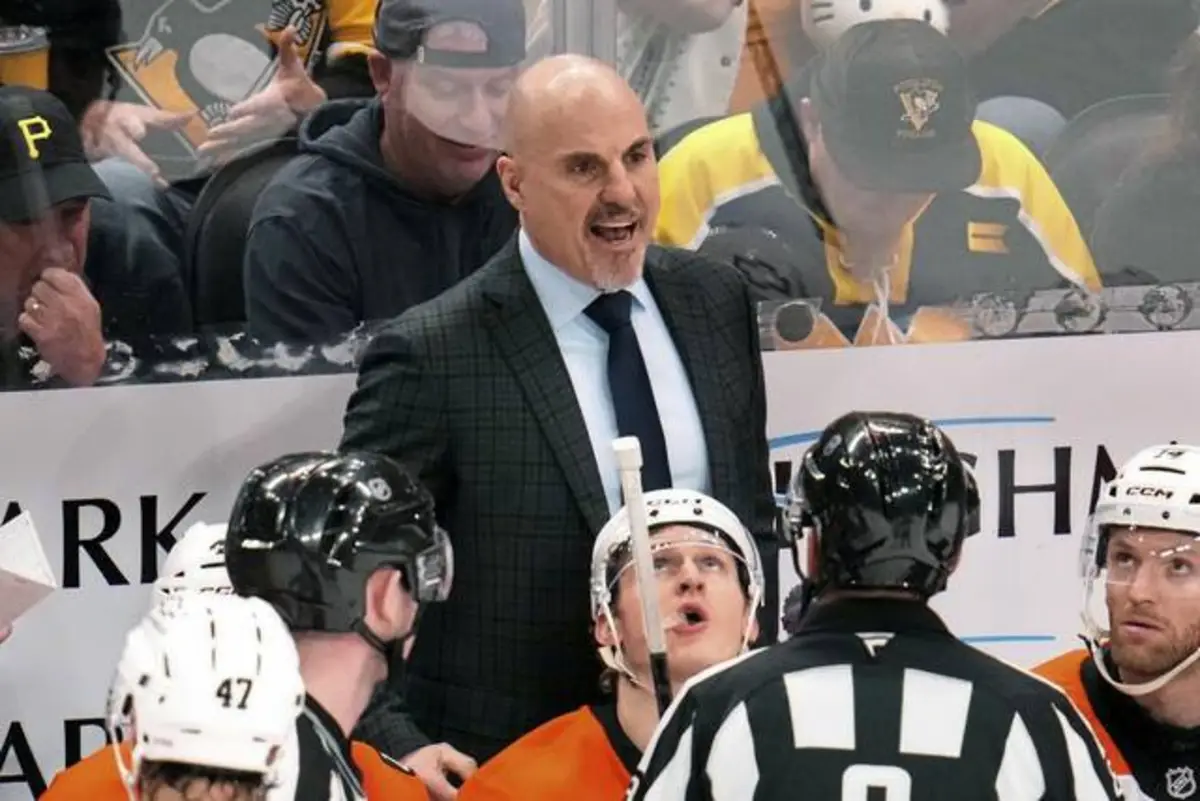
Rick Tocchet recognizes that a large dose of physicality is inevitable during the first-round Stanley Cup playoff series between his Philadelphia Flyers and the Pittsburgh Penguins.
But ahead of Saturday’s series opener, Tocchet pushed back on the way his recent remarks were interpreted in Pittsburgh, with some fans concluding that the first-year Flyers coach was putting a target on the back of franchise pillar Sidney Crosby.
“You’ve got to control the aggression,” Tocchet said following the Flyers’ morning skate Saturday. “I know there are narratives where I said, ‘Let’s go after Sid.’ I didn’t say that. I said we’ve got to be in anybody’s face.
“That’s the way you’ve got to go into a game. You’ve got to organically let the game happen. You can’t keep thinking each shift, ‘I’ve got to bury this guy,’ or ‘I’ve got to do this or that.’ You’ll just be a nervous wreck out there.”
Tocchet, 62, has guided the Flyers back to the postseason for the first time since 2020.
His counterpart in Pittsburgh, Dan Muse, a first-time head coach in the NHL, has overseen the end of a three-year playoff drought.
Before the season, the Penguins and Flyers were viewed as bottom-feeding clubs more likely to have a shot at landing Gavin McKenna in the upcoming NHL Draft as opposed to being Stanley Cup contenders.
Instead, the Penguins (41-25-16, 98 points) and Flyers (43-27-12, 98 points) placed second and third, respectively, in the Metropolitan Division, qualifying for the playoffs.
The Penguins earned home-ice advantage by virtue of a regulation wins tiebreaker.
“They’re kind of like us,” Tocchet said of the Penguins. “I think one of their players said they gave up the middle finger because they, same as us, weren’t projected to be anywhere near (the playoffs).”
It would be an understatement to note that this series takes on a more personal feeling for Tocchet.
Tocchet, whose NHL career from 1984-2002 spanned 1,144 games, was drafted by the Flyers and played parts of 11 seasons in Philadelphia.
Midseason in 1991-92, he was traded to Pittsburgh, where he remained through 1994, capturing a Stanley Cup in 1992.
After his playing career ended, Tocchet served as an assistant under Mike Sullivan from 2014-17, winning two more Stanley Cup championships.
Crosby/Tocchet
Tocchet got his first crack at head coaching with the Tampa Bay Lightning several years before joining Pittsburgh’s staff, and he eventually departed the Penguins in 2017 to lead the Arizona Coyotes. Three seasons (2022-25) at the helm of the Vancouver Canucks also preceded his appointment as the Flyers’ coach.
But Tocchet looked back fondly on his coaching days with the Penguins and credited several figures he encountered with the organization — Jim Rutherford, Bill Guerin, Patrik Allvin, Tom Fitzgerald, Jacques Martin and Sullivan specifically — with helping him cut his teeth.
“I learned a lot about dealing with pressure,” Tocchet said. “The players are watching you, too. If I’m panicking, they’re going to panic. … I’m a period-to-period guy. That’s the way I try to coach. You can’t overthink it as a coach. You can’t lose or win a series in the first period.
“I try to stay calm and personally give players information or put them in good situations if I can. The temperament around the room, even as a coaching staff, that’s how we can help our players.”
On the Flyers roster, veterans who have navigated a playoffs series are heavily outnumbered by those who are preparing to compete in the postseason for the first time.
Only forwards Travis Konecny and Sean Couturier and defenseman Travis Sanheim remain from the 2019-20 Flyers team that advanced to the second round in the covid-19-impacted postseason.
“I think we’re going to have to expect pushes,” Konecny, Philadelphia’s leading scorer (27 goals, 41 assists) said. “You’re going to have momentum changes back and forth, so in those moments, just talking on the bench, communicating with each other, helping one another out and then you get through those pushes. You stay within your structure and when you break (a team), that’s when you capitalize.
“I’m excited that we’re back, but we’re not satisfied yet. Big picture: It’s great we made the playoffs, but, right now, we’re not done.”