
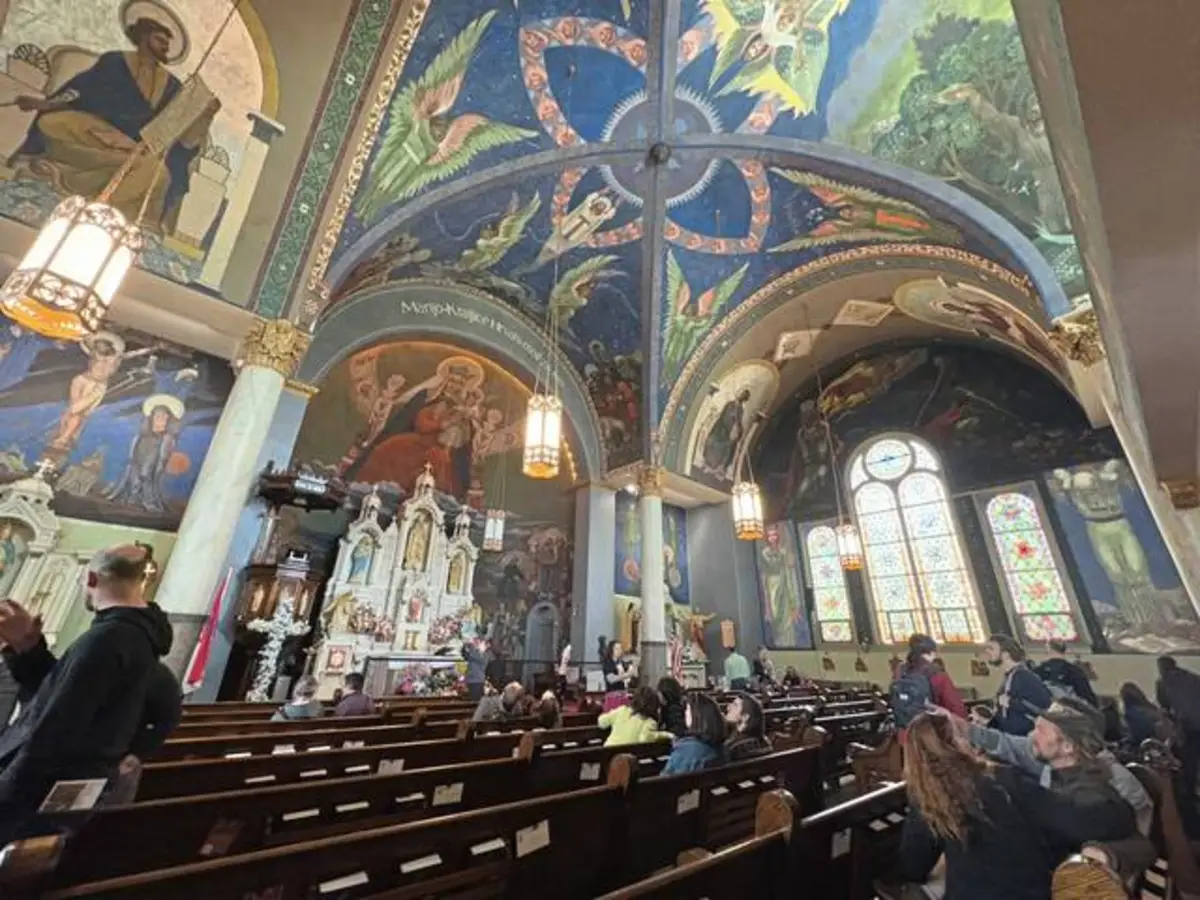
While heads are often bowed in prayer inside churches, many were looking up in awe at a Millvale church on Sunday.
For some, St. Nicholas Church was something like a man-made geode, its unassuming yellow brick walls containing a colorful treasure within.
The treasure inside the 125-year-old Croatian church perched over Route 28 are the murals of Croatian immigrant Maxo Vanka, who painted them in 1937 and 1941.
“I think it’s pretty breathtaking,” said Max Morrow, who despite living in Millvale for eight years was seeing the murals for the first time. “I think it’s moving in a way I didn’t expect when we first walked in.”
His wife, Santana Morrow, herself a painter, was equally impressed.
“I’m kind of taken aback right now. It’s definitely a lot more than I expected,” she said. “We’ve been meaning to get here. I’m proud to have it in our community.”
The Morrows were among several hundred people at a block party at St. Nicholas, the fourth hosted by the Society to Preserve the Millvale Murals of Maxo Vanka, a nonprofit founded in 1991 by members of the parish and community.
The block party brings the community into St. Nicholas to see the murals and learn about them, said Anna Doering, the nonprofit’s executive director. About 600 attended in 2025, and close to 700 were expected this year.
It was held a week earlier this year to avoid conflict with the NFL Draft.
A national historic landmark, St. Nicholas is one of the six shrine churches of Pittsburgh. The others are St. Anthony and Most Holy Name of Jesus in Troy Hill, Immaculate Heart of Mary in Polish Hill, and St. Patrick and St. Stanislaus Kostka in the Strip District.
“If they’ve never been here before, it’s an introduction to a recognized national treasure in their backyards,” Doering said. “It’s a little bit of shock and awe. The murals are themselves unique in an otherwise unassuming church.”
Lifelong church member David Bursic said he loved being able to share his church with visitors. He is a member of the society’s board, and his maternal grandparents were among the founding members of the church.
“It’s a good opportunity for the society and the church to introduce ourselves to the broader community,” said Bursic, 64, who grew up in Millvale and now lives in Cranberry. “It’s a treasure that’s underappreciated here in Pittsburgh.”
A project to conserve the murals is about 90% complete, with the mural behind the main altar remaining. Doering said they hope to start work on it in 2027.
To help protect and preserve the murals, the society has supported roof repairs and provided most of the funding for new heating and cooling, which keeps the interior temperature and humidity levels constant and removes the need to open windows to cool the church, exposing it to the dirt and pollution from Route 28.
The congregation, with under 200 members, has a strong partnership with the society and supports it, Bursic said. The society has raised $3 million to conserve the murals, which he said would be beyond the capacity of the church.
“The parish could not in any way, shape or form handle the conservation work,” he said.
In addition to the church, St. Nicholas has a separate rectory to one side, where the society has its offices, and on the other a former school, which Bursic had attended. A former convent is across the street.
The society is awaiting approval from the Catholic Diocese of Pittsburgh to buy the school building and turn it into a welcome and education center. Doering said she expects the project at the school, which she described as a gutted shell, to take three to five years to complete after a sales agreement is finished.
“Our hope is to bring it back to life,” she said.
Having seen the murals his entire life, Bursic said he kind of takes them for granted. But before the conservation work, they were much darker, impacted by everything from steel mill pollution to incense and candles.
“All that smoke darkened the murals,” he said. “They did a great job on conserving the murals. It’s night and day.”
The imagery of the murals, painted following World War I and at the beginning of World War II, can be surprising to some visitors.
“They’re powerful,” Bursic said. “You normally don’t walk into a church thinking you’ll see soldiers with bayonets and rifles.”
The society’s guided tours give context — artistic, historical and religious — to the imagery, which Bursic said may vary based on the guide.
“You can see the same tour five times and walk away with five different experiences,” Bursic said.
Kathy Carney of Shaler said she’ll want to return for a guided tour. While she had attended Mass at the church a few times, she hadn’t really looked at the murals until coming to the block party.
“I kind of hate to say it, but some of them are a little disturbing,” she said, pointing to images of a mother sending her son off to war and another of women gathered around a casket.
“It’s not something you usually see in a church,” she said. “I don’t understand all the symbolism behind them. They’re kind of dark, but I appreciate the artistry.”