
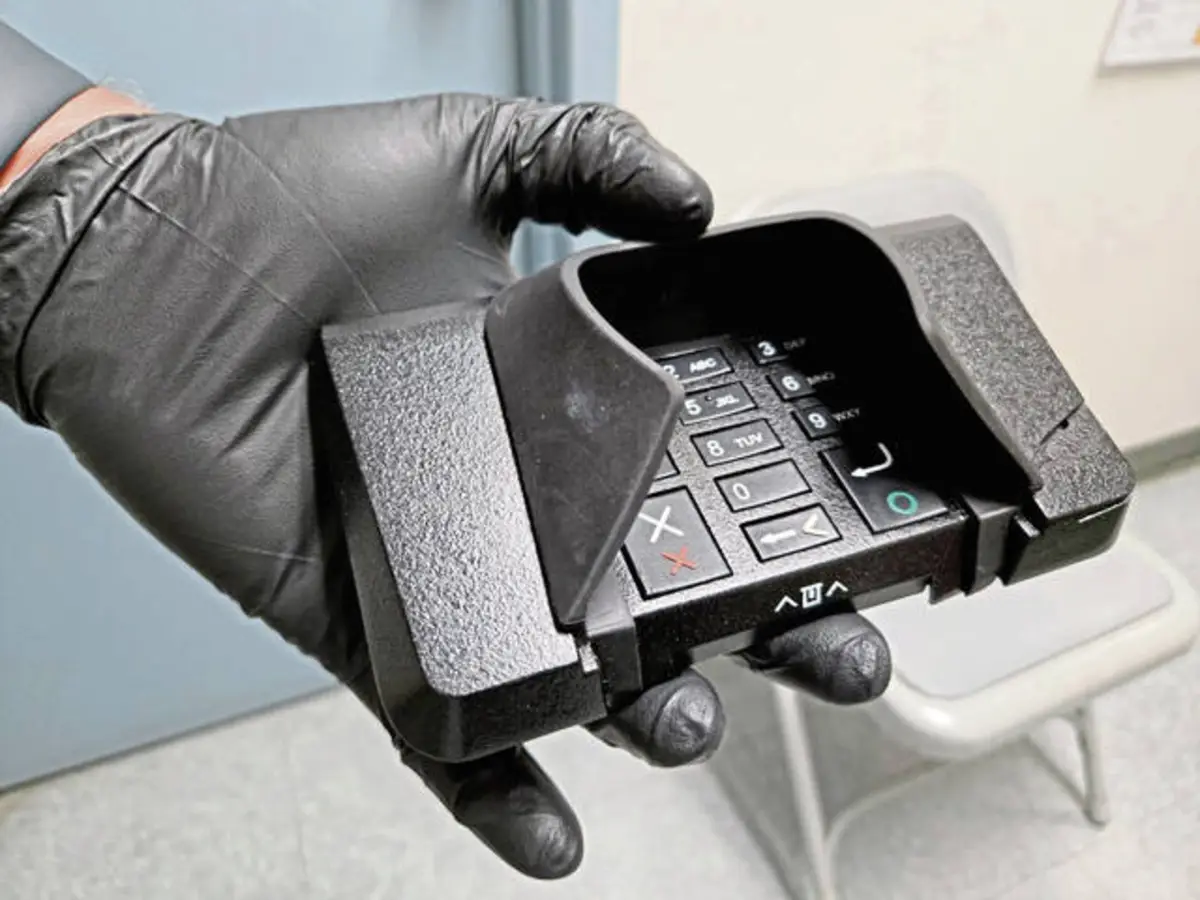
A two-day joint operation among federal, state and local law enforcement in the Pittsburgh area this week netted nine illegal card-skimming devices, potentially saving the public more than $9 million in fraud losses, according to authorities.
The U.S. Secret Service, working with Allegheny County Police, Pittsburgh police, the state attorney general, the U.S. Postal Inspection Service and the state inspector general, visited 272 locations on Monday and Tuesday, examining 883 point-of-sale terminals, 775 gas pumps and 170 ATM terminals.
Officials would not identify where the nine illegel skimming devices were located. The skimmers capture credit card and Electronic Benefit Transfer information that can then be encoded on another card with a magnetic strip.
Officials estimate that skimming costs financial institutions and consumers more than $1 billion each year.
“Card skimming is a growing and insidious crime with the potential for far-reaching impacts on victims,” said Pittsburgh police Chief Jason Lando in a news release. “Not only do criminals have the ability to gather personal and financial information once a card is skimmed, but they’re also able to use that information to commit more crimes.”
Michael Peck, the assistant special agent in charge of Secret Service headquarters in Washington, D.C., told TribLive that operations like the one this week in Pittsburgh have netted more than 500 skimming machines from locations across the country over the last two years preventing an estimated potential fraud loss of more than $428 million.
The criminal organizations running this type of fraud generally are transnational groups that specifically come to the U.S. to target people receiving government benefits, Peck said.
“They’re stealing from the poor,” he said.
The government offers benefits from as many as 88 different programs on cards like those that are subject to skimming, Peck said, which means people can be victimized multiple times.
It’s not just Electronic Benefit Transfer cards used for food; it can also be cash benefits, refugee funds, prison relief funds and more.
The first operation to seize skimmers was in Las Vegas two years ago. In that one, Peck said, they seized 18 skimmers.
Since that time, there have been law enforcement operations across the country targeting the machines.
Each skimmer is responsible for approximately $1 million in losses, he said.
In addition, law enforcement has also shut down manufacturing plants making card skimmers in Alabama, New York and Los Angeles.
In those instances, federal criminal charges were filed, Peck said, and thousands of skimmers were seized.
“We want to cause mass disruption to deter and stop the loss,” Peck said.
In addition to working the law enforcement angle, Peck said, their agencies also work to urge providers to switch to chip technology in their cards.
With the 2026 NFL Draft in Pittsburgh this week, Pennsylvania Attorney General Dave Sunday said his office will be continuing to protect against scams that target consumers.
“Law enforcement is well aware that criminals see large-attendance events — like the NFL Draft in Pittsburgh — as opportunities to steal, defraud, and harm people,” Sunday said in a news release.
The Secret Service offered several tips for consumers to protect themselves:
- Inspect ATMs and point-of-sale terminals before use. If anything is loose, crooked, damaged or scratched, don’t use it.
- When possible, use tap-to-pay technology, or debit and credit cards with a chip.
- When using a debit card at a gas station, run it as a credit card so no PIN has to be entered. If a PIN must reused, shield the PIN entry in the event scammers have installed a tiny pinhole camera to record entries.
- Use ATMs in well-lit, indoor locations.