
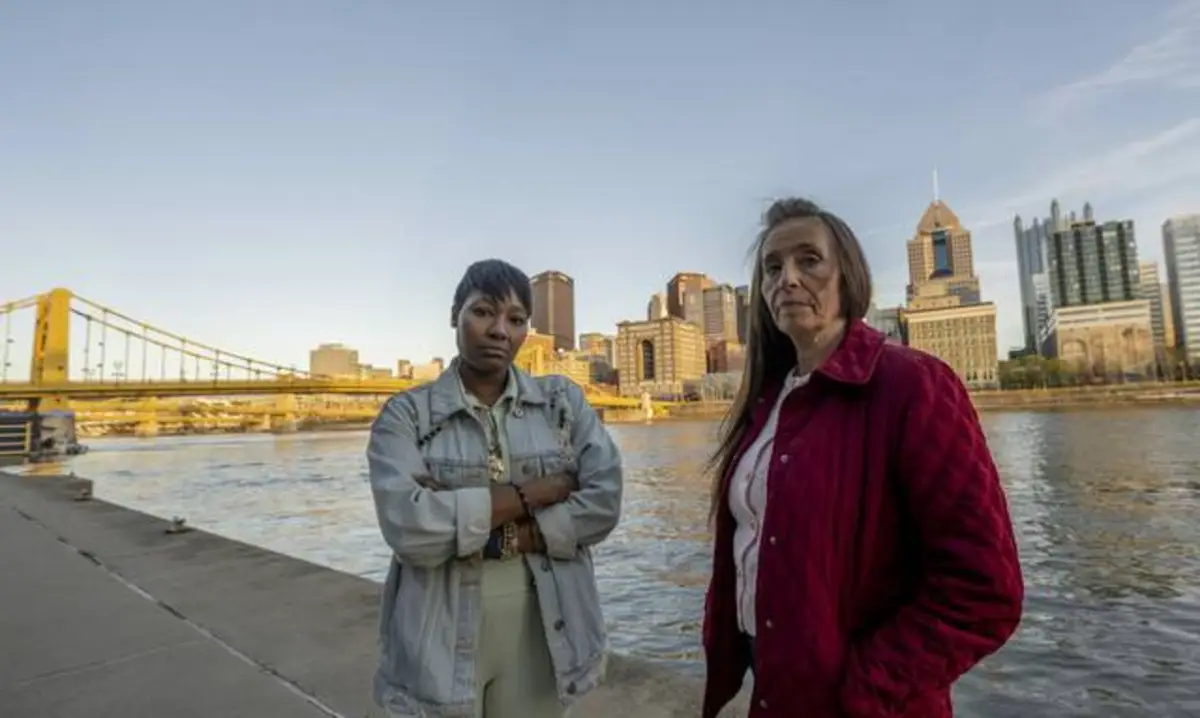
Bridgette Mehalic settled wearily into the wooden chair of a Downtown Pittsburgh courtroom in January expecting justice.
Instead, she got heartache.
Mehalic was sure jurors would convict the man charged with killing her daughter Jacquelyn, 33, at a North Side bus stop during a wild shootout more than three years earlier.
To her left on the trial’s final day, clutching Mehalic’s hand, sat LaRonda Averytt, once a stranger, now an unlikely partner in shared grief.
Averytt’s 59-year-old mother, Betty, also was gunned down at the bus stop that Saturday night. She and Jacquelyn were innocent bystanders as two groups battled each other.
There was a third casualty: 20-year-old John Hornezes Jr., who police suspected was involved.
The killings on Oct. 15, 2022, marked the city’s deadliest spasm of violence that year, a triple homicide that spawned revenge shootings, terrorized residents and frustrated politicians desperate to stem the tide of guns onto city streets.
“It was one of those boiling points,” recalled Councilman Bobby Wilson, a lifelong North Sider whose district includes the spot where the women were standing. “The community was going forward, and this really was like two steps back.”
Less than a month later, police had arrested three people. But homicide charges against two of them were later dropped, leaving Jaylone Hines as the sole person facing a possible murder rap.
Mehalic and Averytt had traveled a long road together, propping each other up through trauma and trial. Now their journey appeared to be nearing an end. They believed justice was within their grasp.
But, when the foreman handed in the verdict, Mehalic’s confidence evaporated.
She doesn’t remember much after hearing “not guilty” except a searing pain radiating throughout her body.
“I never saw that coming, not in a million years,” Mehalic said.
The jury convicted Hines on a gun charge. When it came to securing a homicide conviction in the triple shooting, prosecutors were 0-for-3.
Averytt scrambled into the hall as she wept.
“It wasn’t the system that failed, that’s something I do know. It was those people,” Averytt said of the jurors.
Averytt and Mehalic left the courthouse that day feeling empty-handed.
Hornezes’ mother, Tamika Hornezes, bristled with frustration.
“I know the police did everything they could,” she said. “But I’m disappointed that nobody is being held accountable for the three lives taken that day.”
Crips vs. Commons
No one knows why Jacquelyn and Betty were at the Cedar Avenue bus shelter that night.
Betty had walked from her nearby apartment to the convenience store at the Sunoco gas station. She wanted to pick up a pack of Newport cigarettes.
Jacquelyn, who lived in Shadyside, ate dinner with friends at a Japanese restaurant at The Waterfront and planned to grab an overnight shift at the food packaging plant in O’Hara where she worked.
The women, both recovering addicts who found stability after years of turmoil, weren’t strangers. Betty had helped Jacquelyn out of a few tight spots — provided a couch to crash on, a meal, a place to shower.
In 2022, the Sunoco on Cedar Avenue in East Allegheny had a bad reputation. The police chief dubbed it the city’s largest open-air drug market.
That October, it became ground zero for a conflict between warring groups.
At 9:36 p.m. Oct. 15, a black Hyundai Tucson pulled into the Sunoco parking lot. Charron Troutman, labeled by authorities as a Brighton Place Crips gang member, stepped from the SUV’s front passenger seat and onto what some viewed as rival turf.
That meant trouble. Prosecutors said a group known as The Commons claimed the Sunoco as their territory.
Hines, a Hill District man whom police linked to The Commons, rushed to the gas station from a nearby apartment complex, police said. A white SUV with Florida plates, which carried Hines’ friends, followed.
“This carload of Brighton Place Crips knew what they were doing when they went to this Sunoco,” attorney Adam Bishop, who represented Hines, told TribLive. “It was a threat.”
Troutman flashed a 9 mm pistol at Hines, according to a criminal complaint.
Hines ran across Cedar Avenue to an apartment parking lot behind Allegheny Commons Park, police said. Troutman then pulled a black mask over his face, pistol in hand, as the SUV left the Sunoco.
As the Tucson turned right onto Cedar, its passengers aimed their guns toward Allegheny Commons park and fired.
Gunmen in the park shot back. The SUV then took a hard right onto Pressley Street and hopped a curb as gunfire continued. A passenger tossed a pistol out of one of the SUV’s open windows.
At least 27 bullets volleyed between the two camps in 11 seconds.
As the bullets flew, Jacquelyn and Betty stood at the bus shelter at the corner of Cedar and Pressley, minding their own business.
At that moment, there was no place more dangerous in the city of Pittsburgh.
A foreboding note
For Jacquelyn, childhood was a 90-acre farm outside Latrobe. As a pre-teen, she tended to cows and wood shacks packed with chickens. In winter, she rode quads in snow. In spring, she hunted deer with her “Pappy.”
Jacquelyn’s parents separated around her 12th birthday. She moved with her mother to Indiana County but kept returning to “Mehalic Farm,” its faded name still visible on an aging wood-plank sign near State Route 981.
Jacquelyn was sassy — and expressive. She dabbled in airbrushing T-shirts, sketching henna art and tattoos, and painting with acrylics. She did nails and showed a knack for braiding ethnic hair. Her mother said she experimented with everything from crayons to calligraphy.
Betty was a firecracker. She loved dancing at parties and feasting at family cookouts in the park. She had a soft spot for junk food; she often carried around banana-flavored Now and Later candies.
Betty prided herself on “being able to beat anyone down to their socks” — her daughter’s words — in Tonk, a fast-paced card game like rummy. Sometimes, she bleached her short-cropped hair platinum blonde; when she died, it was blue.
But Betty also had a hesitant side. She didn’t drive and loathed riding with someone who drove too fast. She hated roller coasters. Tattoos weren’t her thing.
Betty feared the North Side’s violent streak. In a handwritten letter to her daughter in 2019, she said the quiet part out loud.
“I don’t want to be shot and die in the streets,” she wrote, according to Averytt.
‘We never stopped’
As the Tucson rolled down Cedar, a bullet struck Betty in the head. She was dead before she hit the ground.
Jacquelyn was shot in the chest.
First responders rushed her to nearby Allegheny General Hospital. She died within a half-hour, alone in a hospital trauma bed.
Hornezes, a North Sider who police say fired a shot in the exchange, collapsed in the park. An officer’s body-worn camera footage showed him on the grass as police frantically performed CPR. A woman nearby wept hysterically. “Come on, John, come on!” another kept shouting.
He died in the same hospital as Jacquelyn — six minutes later.
Investigators blamed Hornezes’ death on “friendly fire” from inside the park. At least two gunmen, one of them Hines, fired shots from the park, police said. A gun lay in the grass near where Hornezes collapsed.
It took Pittsburgh police two weeks to track down and arrest Hines and Troutman. A third gunman also was arrested for homicide; the charge against him was later dropped.
As prosecutors took over the case, patrol officers, detectives, partner agencies and staffers at the Allegheny County crime lab logged thousands of hours filling in the details and collecting evidence.
“We never stopped,” said Pittsburgh police Sgt. David O’Neil, the case’s lead investigator. “We never stopped trying to tighten up the case. We never stopped trying to find justice.”
Talismans
Troutman last year cut a deal with prosecutors. He pleaded guilty on an aggravated assault charge and received eight years in prison.
Nobody ever was charged with Hornezes’ death.
The Allegheny County District Attorney’s Office declined to comment for this story.
Mehalic sat through 10 bitter days of Hines’ trial and four separate hearings before that. She indulged in sweets: each day a Venti-sized Starbucks sugar-cookie latte and an almond biscotti.
She rejected what she called the court system’s tendency to erase murder victims like her daughter or focus only on how they died, not how they lived.
Those watching the trial in the Downtown courtroom learned little about Jacquelyn or Betty. Mehalic responded by carrying her daughter’s memory into court.
Every day, she wore an Ed Hardy perfume that Jacquelyn ordered from Amazon shortly before she died. It was called Love Kills Slowly. Mehalic followed the same daily ritual, dabbing the scent on her neck and wrists before tapping her nose.
Mehalic last visited her daughter’s home to pick up the perfume four days after the shooting. She wears Mehalic’s silver cross around her neck every day.
Averytt carried talismans, too: necklaces adorned with a black stone engraved with Betty’s name, and a golden pendant of ancient Egyptian royal Nefertiti — like Betty, she said, a Nubian queen.
Prosecutors introduced nearly 800 pieces of evidence: ballistics tests, maps, seemingly endless surveillance-camera footage. Jacquelyn appeared only in footage from a police officer’s body-worn camera. Her face was blurred out as she lay dying on the sidewalk.
Mehalic sat quietly in court and watched prosecutors repeatedly play the video. She refused to cry. She told herself that she wouldn’t show weakness.
Averytt, too, clutched back tears.
Her mother’s face was blocked out in autopsy videos. A forensic pathologist’s narration — including details about how Averytt’s brow was cut when she fell to the sidewalk after the fatal shot — was not.
Jurors capped a two-week trial with just three hours of deliberation.
Hines, 25, was acquitted of seven charges, including two counts each of homicide and attempted homicide. On April 21, a judge sent Hines to prison for 12½ to 25 years on two gun charges, one of them linked to the 2022 shooting.
Averytt wasn’t there to hear the sentence, which neared the maximum legal guidelines allowed. After the homicide acquittal, she refused to enter the courtroom again.
“We felt the case was strong, but we did not get the result we hoped for,” O’Neil, the sergeant, said. “We 100% feel it when the result is not we wanted. But we continue to the next case.”
A long ride
Averytt said Mehalic understands her. A strong-willed, no-nonsense woman like her daughter, Mehalic was not a shoulder to cry on. She was foundational — a load-bearing wall.
They came from vastly different backgrounds, as did Betty, a child of the Hill District, and Jacquelyn, who grew up in the country.
Averytt lives in Swissvale, Mehalic in Indiana County. They were born 20 years apart.
The women talked — and listened — to each other daily in the courthouse. Outside the trial, they texted. On the trial’s last day, Averytt knew where to sit.
“When they were coming in with that verdict, I said to Miss Bridgette, ‘I need to sit next to you. It’s been a long ride for us,’ ” Averytt said.
Gun violence had united Betty and Jacquelyn in death. It did the same for LaRonda and Bridgette in life.
Moving through tragedy
The survivors are holding tight to who their loved ones were.
Since Jacquelyn’s death, Bridgette has been caring for what she said was most important to her daughter: her four children. The youngest was just 11 months old when her mother was killed.
“Nothing’s gonna bring her back,” Mehalic said. “I guess, for all of us, it’s hard to say she’s just a memory now. So it’s like we talk about her like she’s at the store: ‘She’s not here right now.’ It’s just really hard.”
Averytt grew increasingly nervous after the shooting.
She wouldn’t let her sons ride the bus to school; her eldest was still in high school when his grandmother was gunned down. Instead, Averytt hired Lyft drivers. She refused to ride Pittsburgh Regional Transit buses anywhere.
Her home became an emotional fortress, her living room a makeshift shrine.
An urn holding Betty’s ashes stands on the room’s cluttered table. Her beige but bejeweled Cat Eye glasses lie at the urn’s brass-accented base. An uncharacteristic photo of Betty — eyes fixed forward, no smile, pensive stare — sits framed nearby.
Mementos from other tragedies consume the wall. There’s a photo of one son’s father, who was 29 when he was fatally shot in the Hill District in 2010.
Nearby, Averytt framed the funeral program for a friend who was shot dead and dumped on a roadside in 2018. Another for a cousin felled by a brain aneurysm. And a third for her friend’s mother, who died from cancer.
The hearth of Averytt’s black-bricked fireplace is filled with a slate memorial to her mother that’s shaped vaguely like a tombstone.
But optimism persists. The wall features a collection of signs with words painted in silver: Family. Love. Blessed. “Life is tough … and so are you,” one reads.
Averytt grew up in the Hill District, the third-oldest of six daughters. Her mother had moved to a 10th-floor apartment in the Pressley Street High Rise five years before the shooting.
From Betty’s apartment window, visitors could take in cinematic city views, her daughter said. They also could see the bus shelter where she was killed.
Averytt waited until the last day possible to clear out her mother’s apartment. She dreaded every minute of it.
‘John John’
Allegheny County reported 122 homicides in 2022, its highest count in 20 years. Seventy-one of the victims were killed in Pittsburgh.
Tamika Hornezes never wanted to see her son’s name on that list.
“My son was a good person who didn’t deserve to be murdered on the street — no one does,” she said.
Hornezes — “John John” to his mother and sister — graduated in 2020 from Allderdice High School in Squirrel Hill and was studying to become a commercial truck driver.
In 2022, Hornezes welcomed his first child into the world. She was 8 months old when her father was killed. Now 4, she knows him only through photos.
Hornezes’ sister still laughs about him hunting for sensitive-stomach infant formula — then scarce — in the midst of the pandemic.
“It was amazing to see him step into fatherhood and take his responsibilities seriously,” said Iraya Hornezes, 29, of McKees Rocks.
Records show Hornezes had only one minor brush with the law: a careless driving charge from 2020 in West Mifflin. It was resolved when he paid two $25 fees.
Regardless, Hornezes’ tendency to hang out with friends around Allegheny Commons worried his mother and sister. They’re upset about how right they were.
“He wasn’t perfect. But he had a really, really good heart,” Tamika Hornezes said. “At the end of the day, I don’t know if there’s anything more I could have done.”
Claiming self-defense
Hines’ attorney argued his client fired in self-defense while retreating amid a hail of bullets.
He argued The Commons was no gang and Hines no gangster. Hines had never been jailed for gang crimes, Bishop said. He had no gang tattoos, wore no gang colors, didn’t flash gang signs in rap videos. Police and prosecutors disagreed.
Hines, though, knew his history, his attorney said. Bishop said the Crips had stormed the Allegheny Commons before.
“They knew what the Brighton Place Crips were capable of,” said investigator Keri Bozich, part of Hines’ defense team.
“These guys,” Bishop added, “had every reason to be on high alert.”
Hines was raised in crime-ridden neighborhoods by a single mother who didn’t attend his trial. One sibling came to court during Hines’ trial — and then just for two days.
A second sibling, Jabree, was fatally shot a decade ago in McKees Rocks, at age 18. The murder, which remains unsolved, led Hines to tattoo the nickname “Breezy” on his forehead.
In 2016, Hines, still a juvenile, helped carjack a driver stranded with a flat tire on Cedar Avenue, not far from where the 2022 shooting unfolded. An accomplice forced the victim to drive through the city at gunpoint.
Four years later, Hines got three to six years in prison on a gun charge, court records show. He had been out just six months before the Cedar Avenue shooting.
Hines declined an interview with TribLive for this article.
Police said a bullet found near the bus shelter and bullet casings in the park were linked to Hines’ gun. Surveillance video put him near the scene, as did DNA evidence, the case’s lead investigator said.
But his defense team insists he didn’t fire the shots that killed Jacquelyn and Betty.
“He’s not some cold-blooded killer … he feels remorse about being involved in this shooting that killed these two women,” Bishop said. “But we put a lot of stock in these juries for a reason. And this jury determined he was acting in self-defense.”
Averytt rarely says Hines’ name these days. “The coward,” she calls him.
“There’s a lot I have to say,” Averytt said recently. “But he’s got to answer to God.”
In the same place
The temperature hovered just above freezing as Averytt and Mehalic marched with determination into the Allegheny County Courthouse around 8:45 a.m. on a Tuesday last month.
As they waited in a hallway, the case’s lead prosecutor, Deputy District Attorney Emma Schoedel, approached Mehalic. The two hugged.
“I’ll never really wrap my mind around any of this, really — I don’t think I ever will,” Schoedel told her. “We gave it our all. … The chips didn’t fall where we wanted them to. But we went down fighting.”
Averytt, seated on a nearby bench, wore a jean jacket emblazoned with photos of Betty and Jacquelyn. “Senseless and unfair,” it read.
There was no celebration after the judge read the sentence. No tears. No release from all the years of struggle and anticipation.
There was no next step — nothing left for the families to brace themselves for.
But Mehalic said reading her victim impact statement in court comforted her, if only slightly. She felt the judge heard her.
“People think because time has passed things should be normal. There is not a normal. You just move forward as best as you can,” Mehalic read, standing alone at the microphone.
It took Mehalic nine minutes to read her entire statement. She kept her back to the courtroom audience — and to Hines — the whole time.
Mehalic’s voice cracked when she talked about Jacquelyn’s compassion: “She would always help someone before herself. She truly cared.”
In the end, Mehalic’s story — the yearslong journey birthed by her daughter’s murder — lacked a satisfying ending, as did Averytt’s.
“We will continue to live our lives without justice, resolution or peace,” she read to the judge. “We were not given anything. We were given nothing. We are in the same place we were when we started this tragic journey on Oct. 15, 2022.”