
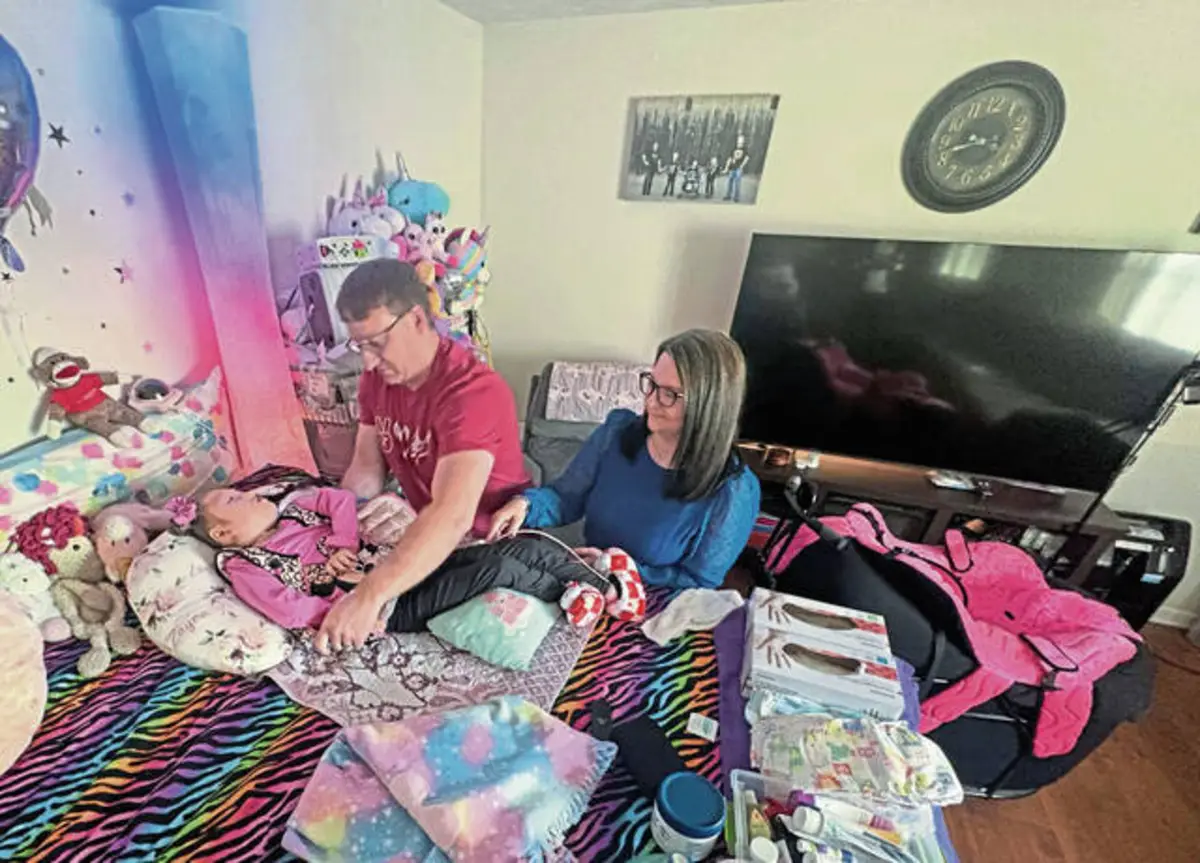
Zayva McCachren is one of the oldest living children in the world with a rare terminal condition known as sphingomyelin phosphodiesterase-4, or SMPD4.
She is 7.
SMPD4 is a gene in the human body, and deficiencies cause severe neurodevelopmental disorders, including a significantly smaller head and stiff or fixed joints. Because Zayva is also dependent on a tracheostomy ventilator and a feeding tube, she requires professional medical monitoring every hour of the day.
But a deepening shortage of home healthcare nurses and high turnover are leaving families like the McCachrens in a constant battle to secure that life-sustaining care.
Industry experts say the crisis is fueled by Pennsylvania’s stagnant Medicaid reimbursement rates, which keep home care wages low and make it nearly impossible for agencies to recruit or retain staff in a competitive labor market.
“There just weren’t nurses in our area,” said Zayva’s mother, Cassie McCachren, who lives in New Florence, a rural community near the northeastern corner of Westmoreland County. “There are a lot of local hospitals where they can make a lot more money. So they didn’t want to leave the hospital and take a pay decrease to come into home care.”
McCachren and her husband, Tim, lost their first child, Zayne, to the same genetic condition. Early in Zayva’s life, the family discovered that Bayada Home Health Care was preparing to open a branch office in Blairsville, only a 20-minute drive from their home.
“Bayada was one of the only home nursing care agencies we spoke with who were willing to come out this far,” McCachren said. “Even when they started coming to take care of Zayva, we continued trying to seek nurses from other agencies, because we weren’t completely covered.”
With Zayva requiring constant supervision, the gaps in their schedule are a heavy burden.
“One of the things we truly appreciate is the night nurses who come so we’re able to get some sleep,” McCachren said. “She has seizures, and someone has to be awake to make sure she’s monitored and taken care of. We have day and weekend nurses who help us with household things so we’re able to go grocery shopping.”
‘It’s insane’
Sean Coit, a consultant with the Pennsylvania Homecare Association, said stories like the McCachrens’ are, unfortunately, all too common.
“In-home caregiver pay rates are largely determined by the states, and through Medicaid’s reimbursement rate,” Coit said. “Private businesses have their own rates, but because so many folks who rely on these services are enrolled in Medicaid, that kind of sets the tone for the statewide market.”
Coit said Pennsylvania has the lowest reimbursement rate in the region, largely fixed at $20.63 for agency personal assistance services.
“Even West Virginia has raised its rate, paying at least 25% more than Pennsylvania,” he said. “This is really a Pennsylvania-specific crisis. Agencies just aren’t able to retain home healthcare workers. The rates vary, but a lot of home caregivers make about $15 or $16 an hour for some very difficult, emotionally and physically taxing work.”
According to data collected by the association, more than 112,500 potential home healthcare shifts go unfilled every month in the state.
“It’s insane, it’s only getting worse and, on top of it all, Pennsylvania is one of the most rapidly aging states in the country,” Coit said.
Adrienne Rash, area director for Bayada Home Health Care, said hiring and retaining home nurses is a challenge, especially since hourly rates can vary widely depending on the level of care.
“A lot of new nurses are only familiar with ‘visit’ nursing, where you see seven clients in a day and you’re there for an hour and you’re charting and kind of driving all over the place,” Rash said. “So I think one of our barriers in general is the ability to pay people a fair wage to have them commit to working full time in someone’s home.”
Rash noted that local hospitals employ licensed practical nurses, or LPNs, who may engage in some home healthcare.
“It’s really exciting for LPNs to have the chance to work with a child as complex as Zayva, whereas they could never do something like that in a hospital setting,” she said. “But pay is definitely the detractor in seeking staff.”
The McCachren family is covered by Medicaid for 16 hours of home nursing each day. Cassie McCachren works during the day, and her husband works mostly swing shifts.
“It varies depending on our schedules, but we usually end up with several open night shifts,” McCachren said. “It’s very, very hard to find nurses who want to come work overnight, so that’s our main stumbling block.”
Starting from scratch
Bayada’s Blairsville branch has a staff of about 350, but its service area spans from McKean County south to Westmoreland and Somerset counties, and east to Cambria and part of Jefferson counties.
High turnover means families frequently start from scratch with new nurses who are unfamiliar with a child’s specific medical needs.
Cora Kuhn, 6, of Verona was born during the pandemic with heart issues. At 5 months old, she had her first seizure. After months of advocating for testing, her parents, Jenn Marasco-Kuhn and her husband, Chris, received a diagnosis in 2021: Dravet syndrome, a rare genetic form of epilepsy. She is also on the autism spectrum.
“I’m a geriatric social worker, so I’d been in the healthcare world to some extent,” Marasco-Kuhn said. “But navigating it for your child is a big learning curve.”
The Kuhns also connected with Bayada, receiving eight hours of care, five days a week. They grew particularly close to a nurse named Kim.
“These nurses provided emotional validation and comfort,” Marasco-Kuhn said. “They were in it with us more than anyone else. The nurses saw how it impacted Cora, and us.”
However, the family eventually lost their entire nursing team within a month. Kim sought night shifts they couldn’t provide, another found a job closer to home and a third had to leave to care for her own family.
The Kuhns worked with a care manager from UPMC and transitioned to Care Options for Kids in March 2022, but the “nursing carousel” continued when their new nurse left to care for a family member.
Today, a nurse named Tai and a second nurse, Sarah, provide the care Cora needs. The professional bonds have become personal.
“I know Tai’s three sons, and I love learning about their lives,” Marasco-Kuhn said. “If Sarah is watching Cora on a weekend evening, she’ll sometimes bring her daughter, who’s become great friends with her.”
Despite the frequent personnel changes, Marasco-Kuhn said they feel “uniquely blessed” for the consistent care they have secured.
The family also recently received a major boost from the nonprofit Semper Gratus. At the organization’s annual event in March, the Kuhns found out they’d be getting an addition built onto their home that will include a sensory-friendly room for Cora.
“This is like a validation for us special needs parents,” Marasco-Kuhn said. “There’s no real road map for what we do. You never know if you’re making any of the right decisions.”
‘Unsustainably overwhelmed’
Advocates say the state government is not doing enough.
Rob Lattin, area director of government relations for the Philadelphia-based Hearts for Home Care, expressed disappointment in Gov. Josh Shapiro’s proposed 2027 budget, noting it offers no funding increases or changes to Medicaid reimbursement rates for home care workers.
In a statement, Shapiro spokesman Brandon Cwalina said the governor believes “that all workers need a raise” and has therefore, in the 2026-27 budget proposal, asked legislators to raise the state minimum wage to $15 an hour beginning Jan. 1. “The Pennsylvania Department of Human Services works every day to help older Pennsylvanians and Pennsylvanians with physical disabilities access vital supports and services they need. … Part of this work includes actuarily-sound state investments in payment rates – while operating within the funding appropriated by the General Assembly – to support home and community-based services (HCBS) providers and the members of the direct care workforce.”
Noting that the state doesn’t regulate wages paid by HCBS providers, “we continue to work with the General Assembly through the ongoing budget process,” Cwalina said, adding that the Shapiro administration “has already worked to increase rates to help HCBS providers raise wages and bring their workers closer to $15/hour.”
Shapiro recognizes, he said, “that direct care workers in the participant-directed model needed more support, and his 2025-26 budget invested a $21 million rate increase to raise rates in this program. Workers are now seeing an increase of $1-$5 per hour from their previous hourly wage and are better positioned to access health insurance and take personal time off.” The proposed 2026-27 budget proposal “sustains these new investment” and “we continue to work with the General Assembly on additional proposals.”
In Lattin’s view, home care providers across Pennsylvania hoped this ”would be the year that our dire workforce crisis would begin to get addressed. Instead, we have yet again been ignored to face a worsening and impossible reality: Too many seniors and people with disabilities need help, and too few caregivers can afford to stay in this line of work.”
Even a proposed bump in the minimum wage would not help home- or community-based care services, according to the Pennsylvania Homecare Association.
“Without a corresponding Medicaid rate adjustment, providers will face significant challenges in implementing higher wages,” association officials wrote in an April 10 letter to Shapiro’s office.
“We’ve sort of hit the iceberg here,” Coit said. “Officials from both parties have done nothing to address this. Pennsylvania is underfunding home healthcare by about $800 million, according to a state-commissioned study.”
For the McCachrens, the policy failure results in daily anxiety.
“You get used to a nurse being here, the routine, you feel comfortable that they know your child,” McCachren said. “And then you end up with a brand-new nurse having to come in and learn your child’s care.
“It’s just hard to feel comfortable while I’m sitting and work and wondering, ‘Is the new nurse going to pick on the things our other nurse did?’ ”
Rash said some of Bayada’s nurses have dealt with pay rates that have been stagnant for a decade.
“The Medicaid reimbursement rates have not gone up,” she said. “So we’re not able to give the kind of pay raises we want in order to keep the nurses here.”
Lattin said state officials need to take action.
“Without meaningful state investment, authorized care goes unfilled, families are left scrambling and the home care system continues to be unsustainably overwhelmed — to the detriment of the very people it’s meant to protect.”