

General manager Kyle Dubas and the Pittsburgh Penguins front office got a taste of what some of the organization’s top prospects were capable of during stints of varying length in the NHL this past season.
Goalie Sergei Murashov, defensemen Owen Pickering and Harrison Brunicke, plus forwards Rutger McGroarty, Avery Hayes, Tristan Broz and Ville Koivunen appeared for the Penguins in 2025-26, leaving a wide array of impressions in Dubas’ eyes.
But whatever observations Dubas made from the club’s prospects competing at the highest level, none crystallized.
With all those aforementioned players at Wilkes-Barre/Scranton and fresh off an Atlantic Division Semifinals postseason triumph versus the Hershey Bears, Dubas is intrigued to keep evaluating as the Calder Cup playoff run continues.
“It will be a great ability for us to learn a lot about our prospects,” Dubas said Tuesday in Cranberry during his season-ending sit-down with reporters. “It’ll be a massive test for our young players in terms of whether they can play through that; Sergei, whether he can continue to carry the load as he has in the playoffs so far. So we’ll learn a lot about our guys here on this stretch, them continuing to push, compete and win together.
“Every round they win is an opportunity to continue to develop and make our decisions harder for next fall, where they’re going to have to earn it. That will guide a lot of our decision-making, so we’ll watch that closely.”
Significant implications could be in store at the NHL level.
Take Murashov, for example.
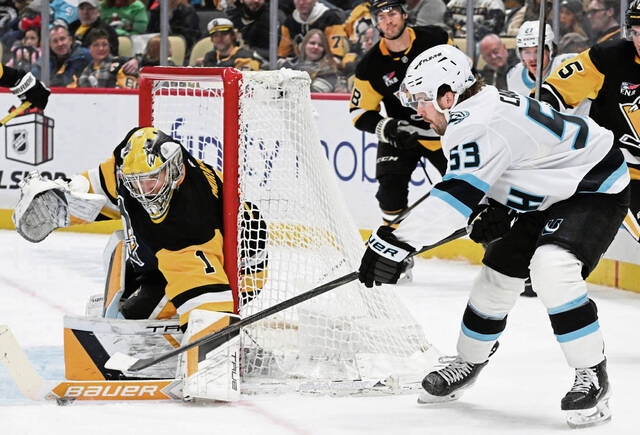
This season, he went 1-1-2 with a 2.56 goals-against average and .897 save percentage at the NHL level, making his debut Nov. 9.
Murashov earned a spot on the AHL All-Rookie squad and went 29-9-4 with a 2.20 GAA and .919 save percentage during the regular season.
In four games versus the Hershey Bears, with an Atlantic Division Final showdown versus the Springfield Thunderbirds upcoming, Murashov went 3-1 with a 1.99 GAA and .937 save percentage.
Should the 22-year-old Russian netminder demonstrate he can “carry the load,” as Dubas put it, that might give the Penguins’ general manager the necessary confidence to part ways with veteran Stuart Skinner or Arturs Silovs once the free agency period begins July 1.
“Obviously, Sergei’s run with the ball here in the playoffs, so we’ll see how that continues to progress and use that as a measurement,” Dubas said. “But my full expectation is that Sergei and Joel (Blomqvist) will be competing for a roster spot here this year.”
The same dynamic exists among the wingers prospectively knocking on the door of the NHL, like McGroarty, Hayes, Koivunen and Broz.
Koivunen led that quartet with 39 NHL appearances this season, recording two goals with five assists, whereas McGroarty had three goals and as many assists in 24 games.
Hayes had two goals in his NHL debut Feb. 5 and finished with five in 16 contests. Broz, whose campaign was limited considerably because of injury, skated in just one game.
As with Murashov, Dubas is eyeing how those players perform with Wilkes-Barre/Scranton chasing a Calder Cup championship.
“When we go through how we sort through the free agents and what’s there, a lot of it for me is balancing what we have,” Dubas said. “If you look on the wing, in our top-six at the end of the year, you have Rickard Rakell, Bryan Rust, Egor Chinakhov and (Evgeni Malkin). And then you have a bunch of others who are pushing from the bottom.
“It’s trying to do the dance of providing enough room for young guys to grow, take opportunity and not having them boxed out. … It’s trying to thread that needle on it.”
Dubas took more than 30 minutes’ worth of questions from reporters Tuesday in Cranberry, offering specific evaluations of several of the team’s top prospects:
• Koivunen, 22, is the Penguins’ last remaining return piece from the Jake Guentzel trade in March of 2024, following fellow winger Vasily Ponomarev’s return to Russia and Dubas announcing in April that Arizona State’s Cruz Lucius wouldn’t be signing with the club.

The left-shooting Oulu, Finland, native showed flashes late in the 2024-25 campaign, registering seven assists in eight games.
This season, Koivunen struggled to fully adjust to the demands of the NHL, averaging 12:44 of ice time.
Navigating an injury in mid-November, he was frequently shuttled between the AHL and NHL as the regular season progressed.
At the AHL level, Koivunen was the Penguins’ second-leading scorer, recording 13 goals and 28 assists in 41 games.
Granted, those numbers were a tick down from an electric 2024-25 campaign, when he led Wilkes-Barre/Scranton with 56 points (21 goals, 35 assists).
Overall, Dubas was encouraged by Koivunen’s arc.
“We felt objectively his speed improved, his power improved, his strength improved — he had improved and was creating more,” Dubas said of Koivunen’s season-long trajectory. “ … I felt he got a lot better as it went on and I really thought in the (AHL playoff) series against Hershey, they were obviously keying on him, trying to get after him, be physical against him and I thought especially in the clinching Game 4, he was at his best.
“He’s a player who we think has a very bright future and for us, behind the scenes, really responded well during the year to being challenged to push and become more at his best.”
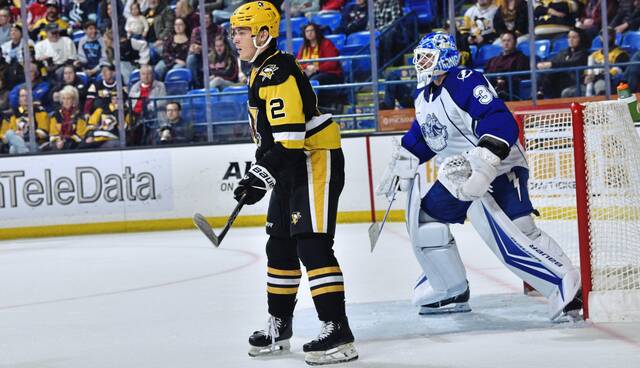
• McGroarty, like Koivunen, constitutes a significant investment for Dubas, as the Penguins acquired the 22-year-old winger in exchange for their first-round (No. 13 overall) 2023 draft pick, Braden Yager.
Since arriving in Pittsburgh from the Winnipeg Jets in August of 2024, McGroarty has been viewed as being in the vanguard of young reinforcements that could make the Penguins younger and contribute in franchise pillar Sidney Crosby’s final seasons.
But injuries, dating to the end of 2024-25 when a promising late-season stint with the Penguins was cut short, have continued to hamper McGroarty, whose shot at cracking the opening night roster was compromised by a pre-training camp ailment.
McGroarty went on to navigate additional ailments, including a concussion, wrapping the AHL regular season with 10 goals and 24 points in 30 games.
Despite the slew of injuries, Dubas’ optimism on McGroarty’s NHL potential has not dimmed.
“What I’ve seen over the year is (that) his skating continues to improve,” Dubas said. “He’s put in a lot of work, and I think it’s evident when you’re watching games, for me, anyway, especially without the puck and on the forecheck, (he’s) able to generate much more speed and pressure the opponents. I think that’s the game he’s going to have to play.
“I think, with Rutger, he’s proven to be an excellent penalty-killer, an excellent net-front power-play guy with Wilkes-Barre. The skating has always been the thing with him, and he’s put in the work and improved on it, so we expect next year that he’ll have every opportunity to earn a spot here. How high in the lineup that is will be up to him, and earning a spot, largely, will be up to him. But, we know he’ll do the work.”
• Pickering, the Penguins’ first-round (No. 21 overall) pick in 2022, got an extended NHL look in 2024-25, appearing in 25 games.
But this season, he skated in only four, spending the vast majority of the campaign in the AHL, where he made 68 appearances for Wilkes-Barre/Scranton, scoring seven goals with 21 assists.

Is Pickering ready or capable of pushing for a full-time NHL roster spot?
That remains to be seen.
While Pickering, 22, hasn’t been able to take a straight, direct path to the NHL, Dubas is pleased with how the 6-foot-5, left-shooting blueliner is coming along.
“We’ve been very happy with the way Owen has come on here in the second half of the year,” Dubas said. “I don’t think you could look at it and say there’s anything truly dynamic, but it was just steady, solid, reliable hockey and that’s what we’re looking for him to develop into.”
• Dubas, the Penguins and fans alike have reason to feel excitement about the 20-year-old Brunicke, who enjoyed a nomadic hockey season in 2025-26.
Making the NHL club out of training camp, Brunicke played in nine games, the maximum permitted before the first of his three-year NHL entry-level deal would have kicked in.
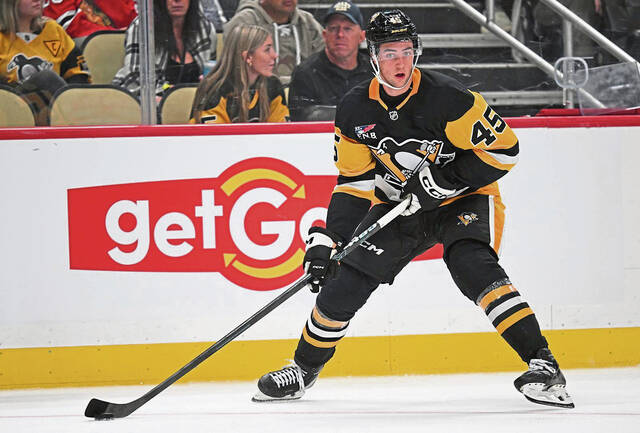
From there, Brunicke stayed with the Penguins but was a consistent healthy scratch. He then joined Wilkes-Barre/Scranton, played for Canada in the International Ice Hockey Federation’s (IIHF) World Junior Championship and finally returned to his junior club, the Kamloops Blazers of the Western Hockey League, in early January.
With the Blazers, Brunicke scored two goals with 22 assists in 24 games, managing one goal with seven assists in 11 regular-season AHL contests.
These days, Brunicke has made his way back to the AHL, where he’s seeing first-pair minutes and reps in the Calder Cup playoffs.
Dubas feels Brunicke’s busy season split between three leagues will have a positive impact on his long-term future.
“I think, maybe, on the ice, the results were erratic,” Dubas said. “But, I think in terms of how it served him long-term, that’s on display now in Wilkes. I think we’re very happy with how the year went. I don’t hold it against anybody for looking at his plan and saying, ‘Well, it wasn’t great.’
“But, I think, for us, it’s the long run with Harrison, and the way the beginning of the year went allowed him to do great work, and it’s manifested itself now.”