
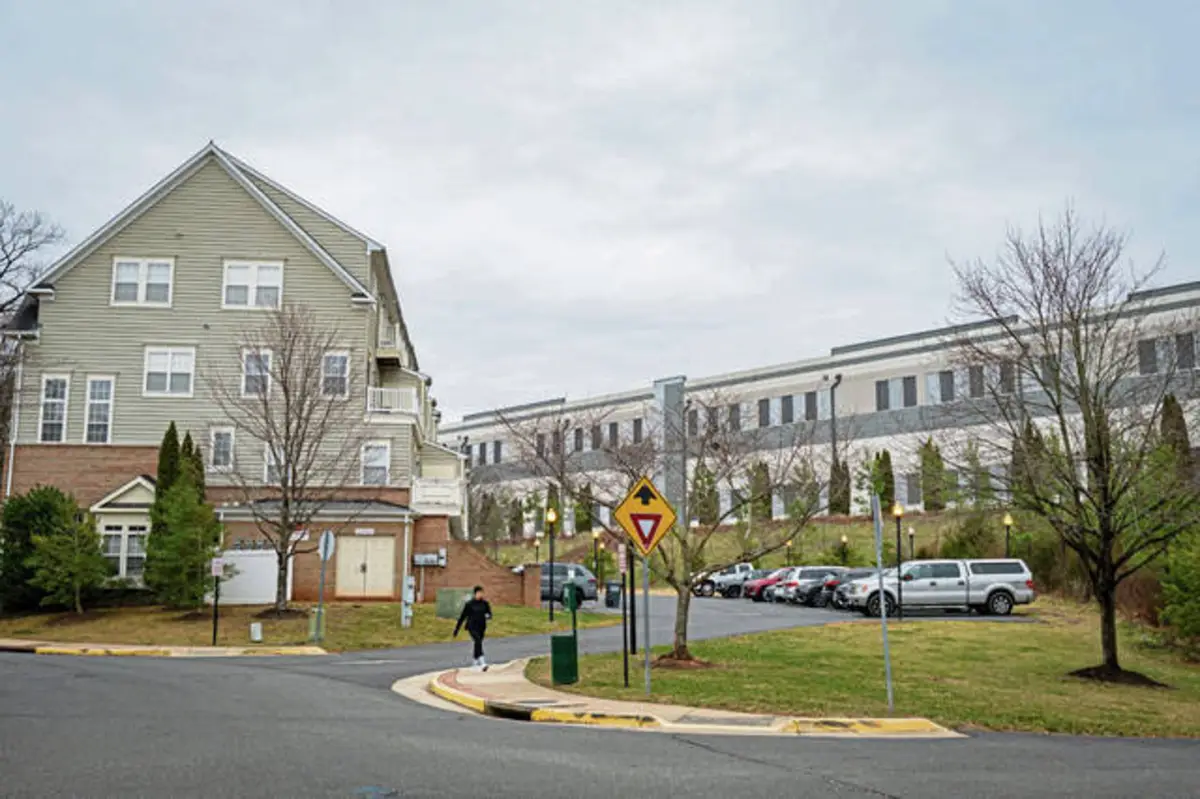
This is the second installment of a TribLive occasional series on data center development in Western Pennsylvania. Today’s story looks at the boom in data center construction in Northern Virginia and what life is like living next to a data center.
PRINCE WILLIAM COUNTY, Va. — Greg Pirio says the data center boom of Northern Virginia is like the Industrial Revolution.
The difference for Pirio, 75, of Sterling, Va.: This revolution is in his backyard.
For a little more than a year, an 800,000-square-foot natural gas-powered data center has let out a constant drone from across the fence line of Pirio’s townhome.
“Sometimes we’ll go days with all this noise at a high level, and then other times it’ll be fairly quiet,” Pirio said of his Virginia neighborhood.
Pirio’s experience, and that of many other Northern Virginians, offers a glimpse of what could be in store for Western Pennsylvania as residents here prepare to live within the footprint of the rapidly expanding industry.
Several data center projects loom, spanning multiple counties, including in Springdale in Allegheny County, Homer City in Indiana County, Shippingport in Beaver County and Upper Burrell in Westmoreland County. The proposed data center in Upper Burrell plans to use natural gas generators for its electricity, like that next to Pirio’s home.
A California native, Pirio bought his townhome more than a decade ago in what was then a generally forested stretch of suburbia with some nearby shopping centers and office parks in Loudoun County.
The data center industry already had a firm foothold in the county by the time Pirio arrived, but in the past decade — and especially since the rise of artificial intelligence — the build-out has expanded rapidly.
“We bought into this place knowing that it’s zoned to have a suburban feel to it, and we’ve lost that,” he said.
Most data centers draw power from the local electric grid, but as electricity providers increasingly struggle to supply the power-hungry industry, some companies have opted for alternatives.
Pirio’s noisy neighbor — built by Colorado-based Vantage Data Centers — is powered by on-site natural gas turbines.
While the turbines take some burden off the grid, Pirio said their constant whirring and the environmental impact of burning fossil fuels isn’t worth it.
“Last year, I bought a birdbath, but there are no birds to use it,” he said, referencing the constant noise in his neighborhood.
Vantage Data Centers did not respond to a TribLive request for comment.
New neighbors
About a half-hour drive from Pirio’s home, neighbors in the Village Place townhome complex in Gainesville, Va., are waiting for the other shoe to drop.
A complex of four data centers remains in various stages of construction, though one — which sits closest to the neighborhood — was granted its occupancy certificate in November, according to Prince William County spokeswoman Nicole Brown.
The centers are owned by Link Logistics, one of the largest industrial real estate firms in the nation. It was founded by investment and private equity giant Blackstone in 2019. The firm did not reply to a request for comment.
“There was nothing there … and then all of the sudden it appeared,” said Tammy Taylor, 55, a nearby resident.
Taylor has lived in Northern Virginia for more than 20 years and works in Loudoun County. Driving to work through the data center capital of the world, she’s no stranger to the hulking structures.
But now it’s the view from her front door.
“You see it, and it kind of doesn’t bother you, but when you actually have one built right next to your house, that’s the shock effect,” Taylor said.
But to Allison Bradley, another nearby neighbor, the data center is better than most alternatives.
In an expanding community less than an hour from Washington, D.C., Bradley said development is inevitable. The data center is preferable to housing or commercial space that would bring even more people to the area, she said.
“I cared about it at first, and I don’t really anymore,” said Bradley, 44. “There’s a ton of reasons why it’s not thrilling to live next to it or near it, but you also have to consider what else these pieces of land could be.”
Another Village Place resident, Sarah Haller, has lived in Northern Virginia her entire life. She believes the region is being overdeveloped.
One of the things that attracted Haller, 44, to her Gainesville townhome was the nearby greenery, a grassy hillside with trees beyond.
“It was a good mix of buildings, but there was a lot of green space. That’s what made it so special, and now they’re destroying it,” she said.
Soon, she fears, the region will be saturated with data centers.
Haller said she’s not waiting around to find out.
“As soon as I get the money to get out of here, I’m out of here,” she said.
Like Haller, several Springdale residents who live near the site of the proposed 565,000-square-foot data center told TribLive they would seek to move away from their longtime homes if the project advances. They mostly cited worries about noise.
But developers of the former coal-fired power plant site have leaned on a similar refrain as Bradley’s: “If not this, then what?”
Virginia economic boom
Northern Virginia’s economics can’t be ignored.
In 2024, data centers accounted for more than 90% of commercial real estate growth in Prince William County, drawing nearly $300 million to county coffers, according to a county tax report.
In neighboring Loudoun County, taxes derived from the data center industry account for more than one-third of general fund revenues, according to the county. And, in recent years, Loudoun consistently has slashed property taxes, which now rank among the lowest in the area.
The region is also among the nation’s wealthiest.
Loudoun ranks the highest of more than 3,100 counties across the country in median household income, pegged at $170,000 by the U.S. Census Bureau. Neighboring Fairfax and Prince William counties rank fifth and 25th, respectively.
In comparison, median household income in Allegheny County is about $80,000, according to the Federal Reserve Bank in St. Louis. In Westmoreland County, it’s about $75,000. That places the region slightly below the national average of $83,000.
Northern Virginia’s wealth — thanks in no small part to its proximity to Washington, D.C. — is not solely derived from data centers. America’s largest defense contractors, as well as several banking and technology firms, make their homes in Northern Virginia.
But as AI and data center development continues to be one of the largest economic drivers in the United States, the industry is an increasingly relevant part of Northern Virginia’s prosperity.
Despite some concern among locals about declining property values, a 2025 study by George Mason University — located in Fairfax County — found that homes closer to data centers tended to fetch higher prices than ones farther away.
That’s not necessarily because it’s desirable to live next to a data center, but because data center developers often seek out the same traits in an area that attract homebuyers.
They tend to be built in areas with strong infrastructure — good roads, reliable utilities and proximity to jobs and airports,” according to a university release about the study. “Those same features also make surrounding neighborhoods more attractive to homebuyers.”
Still, data from a new Gallup poll shows seven in 10 Americans oppose constructing AI data centers in their areas, including majorities of both Democrat and Republican respondents.
Energy costs
There’s debate within the industry about the effect of the data center build-out on residential electricity costs.
Some — including Harvard’s Environmental and Energy Law program — accuse data center developers of pushing the cost of new energy infrastructure for the data center boom onto residential consumers.
A 2024 study by Virginia’s Joint Legislative Audit and Review Commission found that the data center industry currently pays its fair share, but without policy chances, costs would likely increase for all customers in the future.
Since 2020, residential energy costs for Virginians have risen by 30% to about 15.96 cents per kilowatt-hour, according to federal Energy Information Administration data.
That still places Virginia below the national average of 17.65 cents per kilowatt-hour and well below the Pennsylvania average of 20.30 cents per kilowatt-hour.
In an effort to insulate residential ratepayers, Virginia’s State Corporation Commission approved a proposal by utility company Dominion Energy last year to place its largest users — mostly data centers — into a separate rate class.
The order from the commission — the equivalent to Pennsylvania’s Public Utility Commission — also compels large-load customers to enter into 14-year contracts. Under those agreements, customers would pay a minimum of 85% of their contracted distribution and transmission costs and 60% of generation costs even if the project fails or is smaller than originally planned.
If a company closes before the end of their 14-year contract, the order requires them to pay the minimum demand costs for the entire 14 years.
The move is designed to offer protection to residential customers so they are not hit with increased electricity costs should a large power consumer, like a data center, close operations, leaving Dominion’s residential customers to pay for substations or transmission lines added to supply the company.
Although he doesn’t have the power to set rates, Pennsylvania Gov. Josh Shapiro recently has been at odds with utility companies, saying he would “vocally and forcefully” oppose their requests for rate hikes that he deems “unacceptably high.” His comments were prompted, in part, by data center proposals across the state.
Environmental impact
The increase in energy demand from data centers in Virginia has led suppliers to lean harder on fossil fuels such as natural gas and coal, much to the ire of groups like the Piedmont Environmental Council.
Julie Bolthouse, the Virginia nonprofit’s director of land use, said the fossil fuels required to power data centers are one way the industry contributes to environmental pollution, but on-site pollution is also significant.
Most data centers come equipped with dozens of diesel backup generators that can be flipped on in case of a power outage. Outages may be rare, but companies have to regularly run each generator to ensure they’re in working order.
Bolthouse said her group has identified about 13,000 permits for diesel backup generators in Virginia, though not all are yet operational. Her group hasn’t seen air quality plummet in the region, but that may be because of limited data, she said.
“We’re concerned, though, that’s going to be a problem as we start to actually turn on more of those generators,” Bolthouse said.
That anxiety among Virginians prompted the state’s Department of Environmental Quality to announce its intention to place air sensors throughout Loudoun and Prince William counties to determine whether further air quality testing is necessary.
On-site gas turbines, like the ones powering the data center near Pirio’s home, are cause for particular concern, Bolthouse said.
“When you’re running gas turbines 24/7 and it’s next to someone’s house, that household is now having 24/7 exposure,” she said. “That child grows up playing in that backyard that is constantly exposed, which is a different exposure level than the child that’s across from a data center that has diesel generators that are run periodically.”
The Pittsburgh metro area ranks 16th worst in the nation for daily particulate pollution and 12th worst for year-round particle pollution, according to a study by the American Lung Association.
That made the metro the worst in the Mid-Atlantic region, which also includes Delaware, Maryland, the District of Columbia, New Jersey, Virginia and West Virginia, for daily and year-round particle pollution.
Another recent study by researchers from several universities also concluded that large-scale data centers often create “heat islands” that warm the land around them an average of about 3.5 degrees, though some examples saw temperatures increase upwards of 16 degrees.
Neighbors push back
Environmental costs of the structures are among the many reasons Virginia residents have pushed back against the data center industry.
In his townhome complex, Pirio has emerged as a sort of unofficial leader, speaking out at local government meetings and joining regional anti-data center groups like the Coalition to Protect Prince William County.
If there’s one upside to the recent expansion, Pirio said, it’s that residents have become more involved in local government.
“People don’t know how to use their voice with local government, with state government and all of that. And so when we’re organizing, it really takes a lot of work to get people involved,” he said. “I see this crisis as: If we work at the local level like this, it’s an opportunity to revitalize our democracy.”
Local environmental groups in Western Pennsylvania such as Protect PT have taken up a similar cause, organizing residents in Springdale against the proposed center there, while Concerned Residents of Western PA drew about 200 people to a community meeting in February to oppose the 4.5-gigawatt proposal in Homer City.
The electricity required for the Homer City project, which will sit on a 3,200-acre campus, could power nearly 60% of homes in Pennsylvania.
In Haymarket, Va., in Prince William County, Linda Liebenstein lives in the Carter’s Mill housing plan recently built next to a set of boxy gray-white Amazon data centers.
She said there was concern among neighbors, but many opted to work with the company to improve the aesthetics of the neighborhood. Amazon eventually agreed to plant trees to block the view of its center, Liebenstein said.
“Maybe you can’t stop it, but you can insist on them being good neighbors,” she said.
An Amazon spokesperson said the company is “constantly innovating” its centers to “minimize the impact on our neighbors and the environment, and to ensure the highest levels of security and performance for our customers.”
“Amazon is committed to being a good neighbor, and we value our role as a community member in Prince William County,” Amazon spokesperson Simone Griffin said. “Our commitment goes beyond operating data centers in the area. We actively invest in communities to help address local challenges. We listen to residents and local leaders and incorporate their feedback into our development and operational processes to strengthen our presence in the community.”