
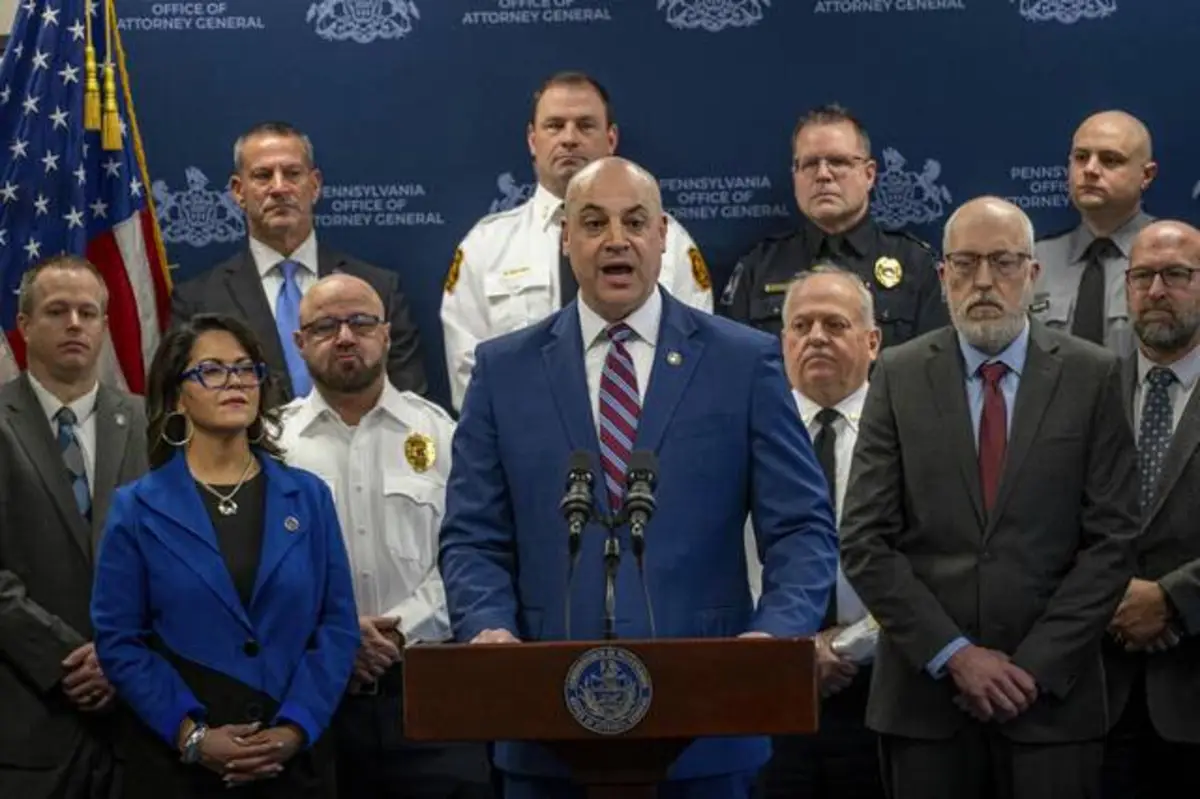
Q: On local stations, when police or emergency personnel are giving an update on an event, what is the purpose of the people standing behind the person giving the update? They never offer any additional information. Is their purpose just to get on TV? Also, if they are vital to the situation, why are they just standing there and not out doing their jobs?
— George, Greensburg
Rob: My assumption has always been that the background folks are subordinate to the person talking but perhaps closer to events on the ground.
News conferences have a lot of theater, including of the political variety, so are these personnel necessary? I wanted to get more insight, so I reached out to my friend Glen Barbour, who worked as a TV news reporter in several markets before moving into government communications roles, including his current job in Loudoun County, Va.
“In a news conference setting, a group of folks is often assembled to participate in the news conference because they have some type of subject matter expertise that theoretically could be called upon to support the questions and answers with the news media,” Barbour said. “Usually, the top official is out front, along with elected officials, and they are serving as the ‘spokespersons’ for all of those who are standing behind them.
“For example, the police chief may be doing all the talking, but the deputy chief, district station chief, homicide detective, responding officer, crime scene investigator, etc., may all be present,” he continued. “They don’t all need to speak if the chief can answer the questions, but they are on hand, ready to support the chief in the event he needs details or data that he doesn’t know.”
Barbour noted the designated spokesperson is often not the one doing the actual investigation and therefore is reporting what has been told to him or her by the collective group — not from first-hand knowledge.
“For efficiency, it makes sense to designate a spokesperson to speak on behalf of the body,” Barbour said. “They don’t typically just grab random cops off the street to stand there to be filler or to make a pretty backdrop. Usually, the folks have had some role in the event.”
And, no, the folks in the background have not abandoned the emergency just to get on TV.
“News conferences are now a standard part of emergency responses, so taking the time to do this is important to properly manage the media’s needs within the greater emergency response,” Barbour said. “They would not jeopardize the emergency response by taking away any critical personnel. When a bunch of generals, the President, the Secretary of Defense, etc., are all standing there for a news conference, does that mean the war on the front lines stops? No. The soldiers on the front lines are still working. Those in the background are also a physical display of the notion that ‘it takes a team’ — not just the chief of police — but many stakeholders to respond to the emergency.”
Q: Did “Will Trent” kill off Angie’s husband (Scott Foley) because he got a new show or was this plot twist planned all along?
— Peter, via email
Rob: An ABC publicist declined to seek a response from any “Will Trent” producers and pointed to this quote from co-showrunner Liz Heldens, who told TV Insider about this season’s character deaths, “Going into season five, it just really felt like we needed a reset and some new energy, and some new dynamics … These were really hard and emotional decisions for the writers. There was a lot of back and forth in the room, but, eventually, we did what we thought was best for the future of the show. But yeah, both of them are heartbreakers for sure.”
Here’s the reality of contemporary scripted TV: When an established, ongoing show hires someone like Scott Foley, who’s been a series lead before and is again on Amazon Prime Video’s “It’s Not Like That,” he’s probably not going to be around for the long haul. His role was likely always intended to be of limited duration, whether he landed a new series lead role or not. Whether the plan on how to exit Foley’s character from the show changed is irrelevant; it was always likely to be a short-term gig.
Additionally, as shows get older, they get more expensive. More and more we’re seeing networks cut cast to contain costs, which was likely the impetus for earlier killing off GBI Deputy Director Amanda Wagner (series regular Sonja Sohn) on “Will Trent,” saying goodbye to Dr. Owen Hunt (Kevin McKidd) and Dr. Teddy Altman (Kim Raver) on ABC’s “Grey’s Anatomy,” jettisoning almost all of the original supporting cast on CBS’s “Tracker” and killing director Leon Vance (played by Rocky Carroll) on CBS’s “NCIS.”
Q: What is happening with “Say Yes to the Dress”? It was back for a brief time, then disappeared again. I wouldn’t think it would be too pricey to produce. I really miss it!
— MD, via email
Rob: It is a mystery how TLC handles this series. The show returned in spring 2025 for its 23rd season of six new episodes, but before that, it took a two-year break. Now the show is on ice again with no new episodes planned for 2026.