
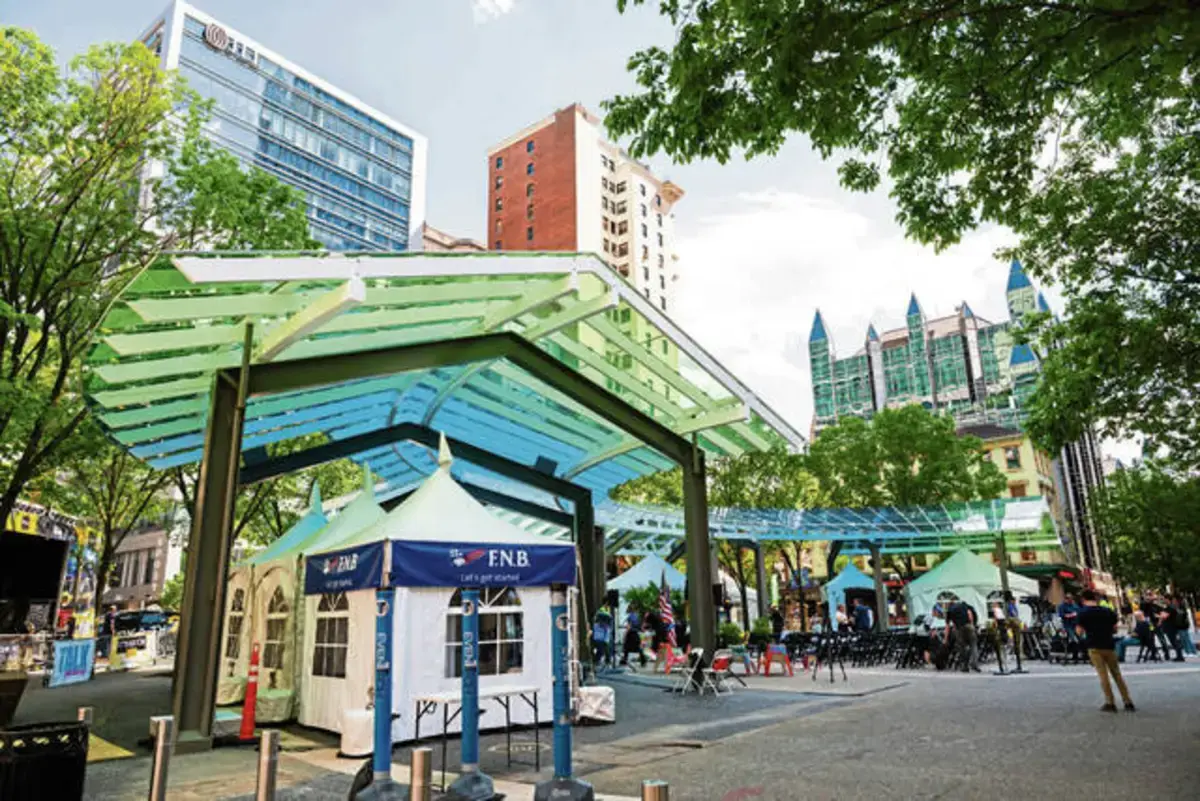
Weeks after a controversial policy restricting unaccompanied minors in Market Square took effect, advocates urged Pittsburgh officials to include young people in conversations about potential solutions.
They also called for more programming and additional “third spaces” — communal gathering places outside the home and school.
Councilman Khari Mosley, D-Point Breeze, who convened the conversation Wednesday, said there has been a spike in “large, spontaneous gatherings primarily made up of young people.” He said the gatherings — which have at times turned rowdy or violent — have raised concerns among some business owners and residents.
The gatherings, often organized via social media, also sparked a new policy limiting when youth are allowed in Market Square without adult chaperones.
“Draconian approaches will not provide long-term solutions,” Mosley said.
The curfew policy in Market Square has drawn mixed reactions. Paul Levinson, a Fordham University professor who specializes in politics and media, said the policy is “blatantly at odds with the First Amendment.”
Jason Rivers, who oversees violence prevention and intervention efforts at Pittsburgh Public Schools, raised concerns that the measure targets minorities.
“We’re talking about a certain racial group when it comes to young people, predominantly,” Rivers said. “I think we can’t gloss over it.”
Farooq Al-Said, director of operations at the local nonprofit 1Hood Media, said he spent “a good bit” of his senior year of high school in jail and celebrated his 18th birthday in solitary confinement.
He said expanded youth programming and efforts to ensure young people have a seat at the table are key to addressing the issues officials discussed for several hours Wednesday.
The biggest question he’s heard from local teens: “Why are these adults so quick to call for collective punishment?”
They’re frustrated, Al-Said said, that the new Market Square restrictions went into effect without their input. All kids are being vilified because of the actions of just a few, he said.
“That’s the biggest thing that has these young people upset right now,” he said.
Commander Lance Hoyson, who heads the police bureau’s Zone 5 station, said that large crowds are mostly made up of people with good intentions. It’s typically less than 10% of the people there who are sparking problems, he said.
“We obviously don’t want to treat all juveniles like they’re criminals because 50 are gathered in Market Square and two of them get in a fight,” he said. “We need to approach this from multiple angles. I don’t think there’s a one-size-fits-all solution for this.”
Advocates and experts who talked with council members Wednesday said kids need spaces where they’re permitted to gather, programming that engages them outside of school hours and the opportunity to make their voices heard as officials seek solutions.
Valerie Adams-Bass, an assistant professor of childhood studies at Rutgers University, pointed out that no teens were invited to join the conversation that focused on teenage behavior.
“You want to make space for young people to be at the table,” she said.
Mosley said he viewed Wednesday’s meeting as a first step. He said he’d like to include more youth engagement in future conversations.
Younger kids often have more after-school programming available, Adams-Bass said, but those options are also key for engaging teenagers. A “precipitous drop-off in programming for teens,” she said, is a systemic issue plaguing cities nationwide.
But it’s not just about having events that draw teens, she said. Officials also need to ensure teens are able to provide insights on the kinds of programs they want to see and policies that govern youth. They should be involved in creating narratives about how people perceive local youth.
Adams-Bass pointed out that teenagers’ brains are still developing. They need guidance, programs and adult leaders who will advocate for them and help them get involved in the community in productive ways, she said.