
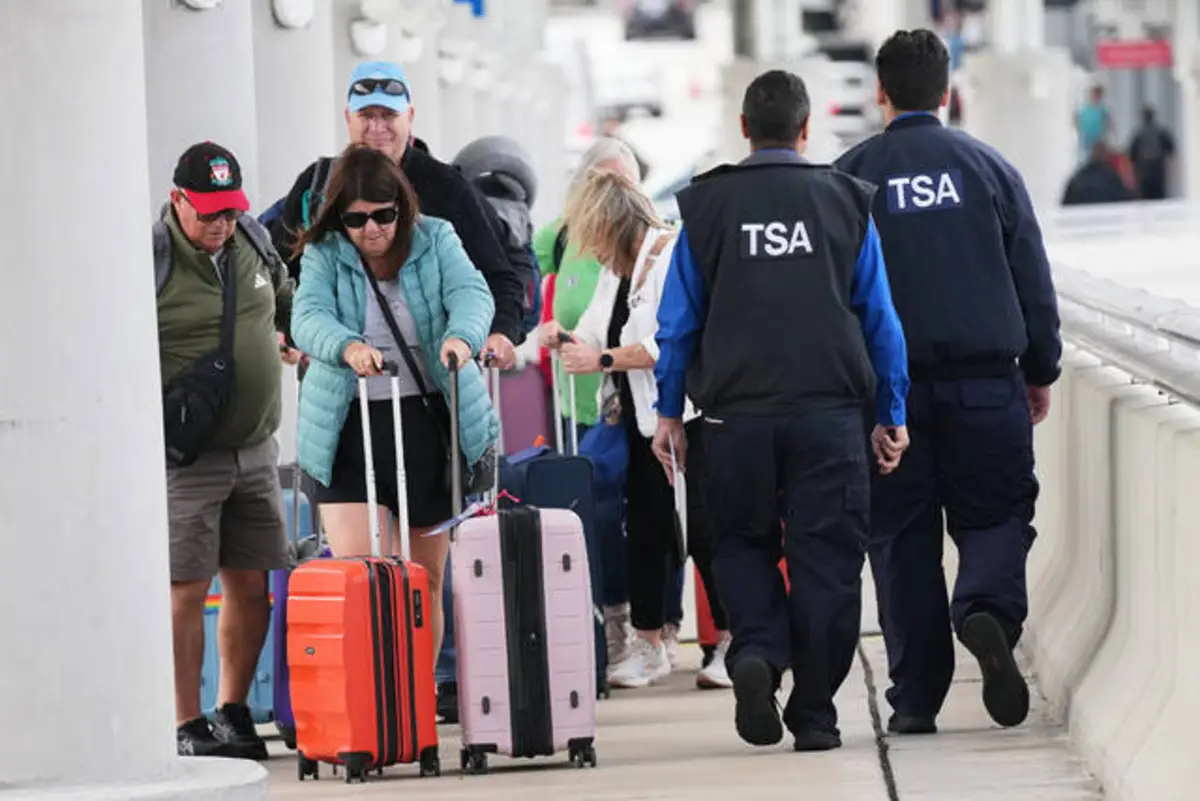
NEW YORK — A House committee on Wednesday expressed bipartisan support for ensuring Transportation Security Administration officers get paid during future government shutdowns and are equipped with the latest technology, discussing the agency’s future as the Trump administration lobbies to make airport screening a job for private contractors.
Members of the House Committee on Homeland Security held a hearing on ways to modernize the TSA nearly 25 years after it was created in the wake of the Sept. 11 attacks. But the morale of TSA officers who went without pay during three funding lapses since Oct. 1, and whom the administration wants to replace at small U.S. airports, overshadowed the talk about better machines and reliable funding.
“Between the 2025 and 2026 shutdowns, transportation security officers endured a total of 119 days impacted by shutdown conditions,” Republican Andrew Garbarino of New York, the committee’s chairman, said in his opening remarks. “That means TSA officers spent roughly 40% of this fiscal year reporting to work without a paycheck while continuing to carry out one of the most important security missions in the federal government.”
Several other committee members noted that Congress has failed to pass any of the pending bills seeking to guarantee continued pay for TSA workers. Rep. Lou Correa, a California Democrat, said if TSA workers don’t get paid during shutdowns, neither should lawmakers.
Correa also took aim at President Donald Trump’s proposed budget, which in addition to spending $477.3 million to have private companies take over airport screening at about 250 smaller airports would cut more than 4,500 TSA positions to save $529.3 million in compensation and benefits. The TSA this week also authorized contractors in its airport staffing program to acquire and maintain screening equipment, which previously was strictly a government function.
“Technology alone can’t replace the experienced people who make the security checkpoints work as they have for the past 25 years,” Correa said. “It’s about pushing an antigovernment privatization ideology.”
About 20 U.S. airports already staff their checkpoints through the Screening Partnership Program. Currently airports choose whether or not to opt in. Under Trump’s proposed budget, smaller airports would be required to participate.
The TSA has proposed letting private screeners handle security at airports with scheduled flights of passenger planes with 10-30 seats and ones that accomodate charter flights and private planes without fixed schedules. Examples include Oxnard Airport in California, Ocala International Airport in Florida, Alabama’s Tuscaloosa International Airport and Gary-Chicago International Airport in Indiana, according to a spreadsheet maintained by the Federal Aviation Administration.
The witnesses at the hearing included Christopher Sununu, president and CEO of the airline trade group Airlines for America; Dallas Fort Worth International Airport CEO Chris McLaughlin; American Federation of Government Employees President Everett Kelley, whose union represents TSA workers. All three said they thoughts airports should get to decide whether to employ private screeners.
“Ensuring SPP remains an option for airports and does not become a mandatory program is paramount to the U.S. aviation industry,” Sununu said.
Kelley took a strong stand against the plans in Trump’s budget.
“I’m totally against the privatization of any airport,” he said. “You don’t contract out the CIA, do you?”
After several more Democrats on the committee said they thought that handing off airport security to businesses would leave U.S. airspace more vulnerable, Garbarino interjected to point out that “the very conservative cities of San Francisco, Seattle and Atlanta” all use private screeners at their airports, “so yeah, maybe it’s not a Republican thing.”
Garbarino and Rep. Tim Kennedy, a New York Democrat, championed legislation he and three other committee members introduced earlier this month that would double, from $250 million to $500 million, the amount of money the TSA administrator is required to set aside to reimburse airports for capital costs associated with security. The bill also would establish an annual TSA fund of $250 million for airport screening technology.
Revenue for both would come from a $5.60 fee that airline customers pay for each one-way trip they take on U.S. flights. The 9/11 Passenger Security Fee has existed since 2002, but Congress decided in 2013 that a certain amount had to be used each year to reduce the federal deficit. Since then, an estimated $15 billion went to the U.S. Treasury for that purpose, according to the bill’s co-sponsors,.
“Americans and Congress expected this fee to directly fund our aviation security system, but that is not the case. Nearly half the fee’s revenue goes to something else,” Garbarino said. “Congress must restore the passenger security fee to its original intent, to fund the next generation of screening technology that protects our people in the skies.”
Trump’s fiscal 2027 budget proposal would end the practice of diverting passenger fees and fund the TSA partly with the $1.68 billion that was expected to go to deficit-reduction.