
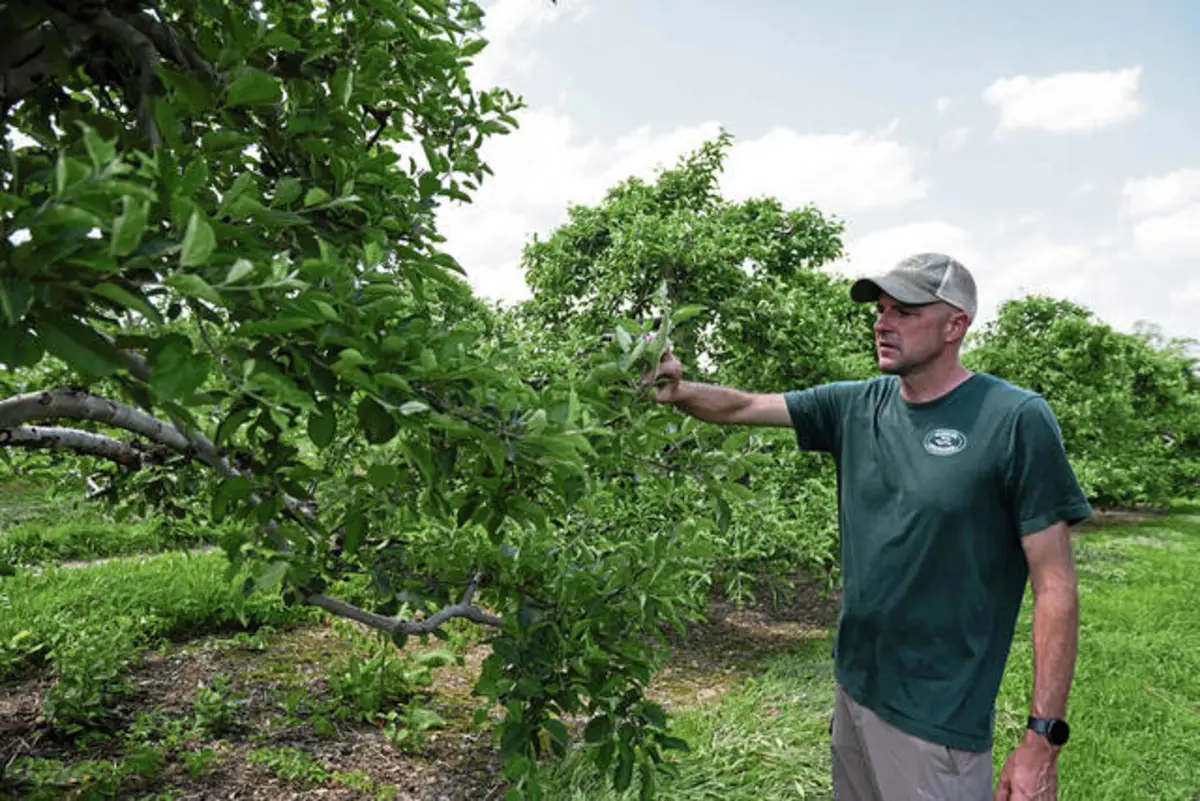
Those looking forward to the annual ritual of picking fruits and berries are likely to be disappointed this year.
Blame Mother Nature.
A late-April frost wreaked havoc with crops, killing many of the buds that would have produced fruit.
Perennial crops such as apples, pears, peaches, strawberries and cherries bloom when the weather starts to warm.
That’s what happened when early-April temperatures climbed into the low 80s in the region. But an overnight freeze April 20-21 killed developing blooms, said Soergel Orchards farm manager Adam Voll.
“Once the flowers are on there, and the buds are starting to come out — once they get out of dormancy — that’s when they’re most vulnerable to the cold,” Voll said.
The Franklin Park orchard took a big loss on its strawberry, apple, cherry, blueberry, peach and pea crops, Voll said.
He said about 95% of the cherry and peach crops are gone.
Some varieties of the apple crops suffered little loss of fruit, but for others, Voll is expecting only about a 25% harvest.
The loss was so big that the farm’s popular strawberry festival, usually held in June, is canceled for this year.
“We just don’t think we can handle the crowd because the numbers (of strawberries) aren’t there,” Voll said.
Across Pennsylvania, it’s a similar story. According to Penn State Extension’s Center for Plant Excellence, many growers, including grape vineyards and tree fruit orchards, are reporting significant losses to all types of crops.
The economic loss could be between $150 million and $200 million, according to Gov. Josh Shapiro’s office.
Jeff Norman, owner of Norman’s Orchard in Frazer, said a freeze so late in the season is unusual. It was the duration of the cold — which averaged about 30 degrees for several hours early April 21 — that made the damage so significant, he said.
Norman lost his entire cherry and pear harvest.
He expects to have a better idea what the apple, blueberry and grape crops look like in the coming weeks.
Of his 31 apple varieties, some bloom later in the season and might have avoided damage, but only time will tell.
“Having people pick their own, that won’t be available because they don’t have enough fruit,” Norman said. “All of our revenue — it’s pretty much gone. … There may be some apples — we can hope for that — but there won’t be much.
“It’ll be pretty much a total loss.”
He said about 70% of the orchard’s business comes from pick-your-own service.
For Sand Hill Berries in Mt. Pleasant, having 200 varieties of apples might be a small life raft because they bloom at different times, said owner Richard Lynn.
“Big orchards only grow two or three or four kinds of apples,” he said. “They all bloom at the same time, so they’re really much more vulnerable to a cold night.”
Still, the orchard saw about 80% of its apple trees suffer from the freeze, along with all of its peaches and cherries, Lynn said.
“The apples will be a problem in the fall because we make a lot of cider and things, and there definitely won’t be a lot of apples left over for making cider,” Lynn said.
Usually, when strawberries are covered with blankets, they can tolerate temperatures below 27 degrees, he said. But this time, the freeze still killed them even though they were covered.
He said the raspberry crops seem unaffected, and the grape vineyard, usually made into wine for Greendance the Winery at Sand Hill, saw between a 15% to 20% loss.
“It’s sort of factored in that some crops are going to have a problem with freezes certain years, but … no way that it doesn’t reduce your business,” he said. “We just have to try to protect what we have left.”
In Kiski Township, Sacred Gate Berries, which specializes in blueberries, blackberries and raspberries wasn’t hit as hard, but the harvest won’t be as strong as previous years, owner Martin Krezolek said.
“We did experience some damage, but not so much at a catastrophic level,” Krezolek said. “(There is) some freeze on the brambles, but they will still be able to rebound and produce.”
At Soergel’s, the orchard still will see a strawberry harvest from the second and third bloom cycles, which are starting to fruit now, Voll said.
Fruit maturity is weather dependent and happens faster with warm weather.
Voll said the orchard is seeing some strawberries ripen now.
After they can assess the harvest from the second and third blooms, they might have a few scattered days to pick your own fruit, he said.
The orchard’s fall apple harvest might be affected as well.
“There’s still some nice apples in there, so I know we will definitely be doing some pick-your-own,” Voll said. “I don’t know if it’ll last quite as long this year as it has in past years.”
The orchard has seen weather damage to crops before, but Voll said this time it’s more widespread.
The silver lining, Norman said, is that if freezing temperatures hold off next year, there will be more to harvest.
“When the trees don’t bear one year,” he said, “then they bear heavy the following year.”