
Pittsburgh Regional Transit had 51% more riders than average who utilized public transportation throughout NFL Draft week in April.
A total of 60,000 riders used the Football Flyers buses, 128,000 used the train, also known as the “T,” and the Gateway Clipper had a record 26,500 passengers travel using river transportation.
On Thursday, Visit Pittsburgh, the city’s tourism agency, released a preliminary report conducted by the NFL, the city and an outside agency breaking down the city’s success over the three-day event.
“Some of the numbers will be updated when the official report comes out,” said Alex Kenzakoski, spokeswoman for Visit Pittsburgh.
Tallying up transport
Wary locals and out-of-town visitors told reporters in April that PRT’s transportation plan and free shuttles were cost-effective and held up well during the record-breaking crowds, which totaled more than 800,000 attendees.
In anticipation of the draft, PRT increased the frequency on the Red Line and Blue Line so that a train cycled through Downtown and the North Shore about every seven minutes. The transit agency also coupled almost all of its trains to make them two cars, increasing capacity to about 432 riders per trip, PRT officials told TribLive.
Throughout draft week, PRT had around 485,000 total riders, the report said.
The Gateway Clipper took 74 total trips across the two days it was available to the public.
PRT officials said they could not immediately provide information and data on ridership over draft week.
Millions spent on local businesses
In March, small business owners criticized the secrecy surrounding vendor contracts.
About 1,700 businesses applied to participate as licensed vendors. More than 165 were accepted, according to the NFL, but beyond that, the league would not provide details.
Visit Pittsburgh’s report said that 164 businesses participated in the 2026 Draft Source Program, which provided opportunities to gain exposure and network.
Myisha Boyce, the lead of the 2026 NFL Draft Source Program, told reporters in December that none of the Source Program businesses was guaranteed a contract for the actual three-day NFL Draft event.
More than 100 of the issued contracts went to local businesses during the event, the report said.
Of the awarded contracts, 64% went to local diverse businesses and 63% went to Draft Source Program members, the report said.
“The Source Program helped ensure that Pittsburgh area companies and entrepreneurs directly benefited from one of the biggest events ever hosted in our region,” Allegheny County Executive Sara Innamorato said.
More than $17.7 million was spent directly with Pittsburgh-based businesses, and over $500,000 was spent with more than a dozen local concessionaires featured within the draft footprint, the report said.
Visit Pittsburgh did not respond to requests for a list of vendors or to clarify the location of the Pittsburgh-based businesses.
Large crowds and little crime
More than 55 million people tuned in to watch the draft worldwide.
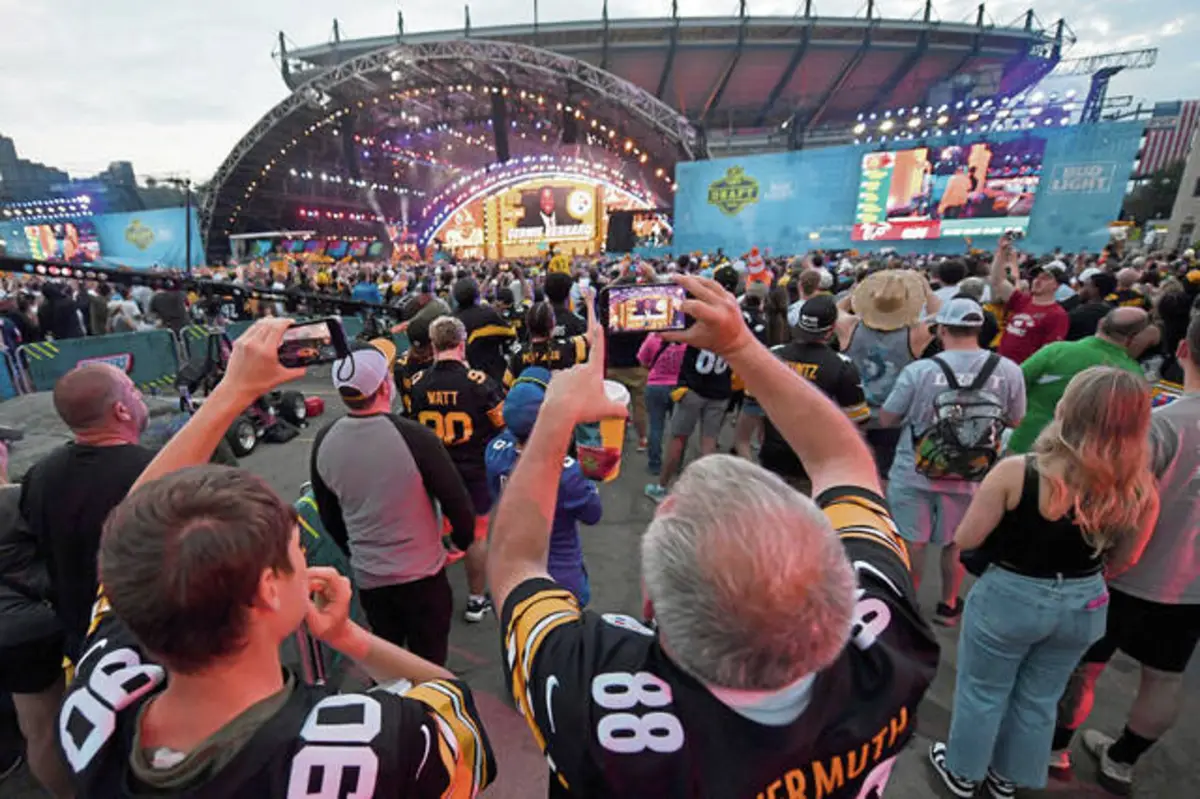
Steelers fans represented 65% of attendees, and 43% of attendees traveled from outside a 50-mile radius of the draft footprint. According to OnePass registrations, there were 105 countries represented at the draft.
“My administration was proud to work with local leaders to pull off an incredibly successful event and took advantage of this opportunity to promote everything our Commonwealth has to offer, breaking ground on three new and revitalized public spaces – Arts Landing, Market Square, and Point State Park – and hosting business leaders and CEOs to drive economic momentum,” Gov. Josh Shapiro said.
City officials told reporters at the end of April that there was not likely to be a financial boon, as initial spending estimates were at least $3 million. Officials were still calculating how much the city spent to host the draft at the end of April.
City officials did not respond to immediate requests for updated spending amounts Thursday.
Preliminary public safety results showed there were 229 calls made to Pittsburgh Bureau of Emergency Medical Services, 45 hospital transports, one fire response related to hot grill ashes, in addition to two arrests and one citation made by Pittsburgh police.
Pittsburgh police did not respond to requests for comment.
Fresh air and full plates
Visit Pittsburgh’s report also included a plan to plant 800 new trees across the region.
Three hundred will be planted by the Forestry Division, and 500 will be planted by the Western Pennsylvania Conservancy and Pittsburgh Parks Conservancy.
Pittsburgh City Forester Lisa Ceoffe told TribLive in April the plan was to use an “inch-for-inch” planting method, in which a removed public tree is replaced by one or more new trees whose total trunk diameter equals or exceeds that of the removed tree.
The city will coordinate with communities to plant trees in neighborhoods across Pittsburgh. Some of the targeted areas include Homewood, Beltzhoover, Hazelwood, Garfield, McKeesport, Clairton and Penn Hills.
It was unclear Thursday what, if any, neighborhoods had been identified yet.
Planting will not begin until 2027.
The report also said that about 59,720 pounds of food was rescued and redistributed to 15 nonprofits across the city.
Last year, the U.S. Open golf championship was held at Oakmont Country Club. Following the event, 412 Food Rescue saved about 55,000 pounds of food.
Josh Weiland, 412 Food Rescue’s vice president of operations, previously told TribLive that the nonprofit began reaching out to businesses outside the footprint after hearing that many had overprepared.
Weiland could not be reached for comment Thursday.