
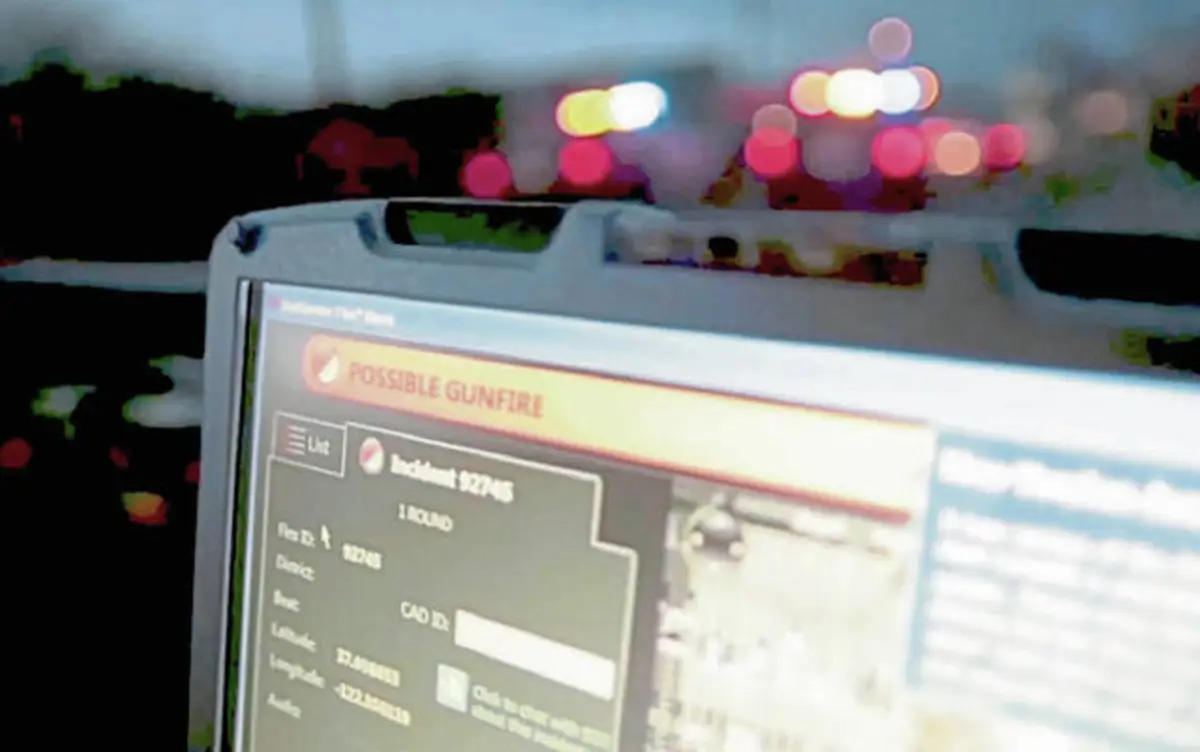
Pennsylvania’s Supreme Court has ruled that a ShotSpotter alert can help justify police searches — but sidestepped whether the controversial gunshot detection system alone can establish probable cause, despite ongoing concerns about the technology’s accuracy, secrecy and oversight.
The legal ramifications of Tuesday’s 5-2 ruling about a Pittsburgh case remain unclear for ShotSpotter, which is used by hundreds of law enforcement agencies nationwide. The market value of its California-based parent company has grown to nearly $120 million.
Experts say the court’s ruling helps justify Pittsburgh police officers’ move to search and arrest a man in the city’s North Side after ShotSpotter reported five gunshots nearby on Sept. 17, 2019.
Police charged Jamar Foster, then 37, of Pittsburgh with DUI — but filed no charges related to the alleged shooting.
Because the arrest violated Foster’s parole on a 2009 drug and DUI conviction, he was sent back to prison for nearly two years, his attorney Domenic Pietropaolo told TribLive.
“The question is ‘What is reasonable suspicion to stop any one person?’” Pietropaolo asked Wednesday. “(Foster) and I maintain this was a wrongful police interaction that violated his basic constitutional rights under Pennsylvania law.”
Tuesday’s decision, however, ruled that using a ShotSpotter alert and other factors to initiate a traffic stop does not violate anyone’s Fourth Amendment protections “against unreasonable searches and seizures.”
“None of the aforementioned factors alone may be sufficient to justify reasonable suspicion here,” Justice Kevin M. Dougherty wrote in the court’s 20-page majority opinion.
But, he added, “we hold the totality of the circumstances — the late-night ShotSpotter alerts indicating gunfire in a residential neighborhood, the rapid police response, the sole presence of (Foster and his girlfriend) at the scene, and the pair’s furtive and evasive behaviors upon the arrival of the police — amounted to reasonable suspicion.”
Pittsburgh’s history with ShotSpotter
Pittsburgh police debuted ShotSpotter in 2014 — at an initial cost of $150,000.
By 2024, the tab grew to nearly $8.5 million, which included $132,000 to expand coverage that year into the city’s Carrick neighborhood.
“Every professional, every law enforcement officer I know — high-ranking ones, too — they support ShotSpotter,” Councilman Anthony Coghill, who chairs the governing body’s public safety committee, said earlier this week. “It’s expensive. But I think it’s worthwhile having.”
SoundThinking boasts that ShotSpotter is 97% accurate at detecting gunfire. But information — or any third-party evaluation of those claims — is hard to find. Its creators refuse to say much about the technology or reveal how SoundThinking trains its call-center workers to interpret what the system’s sensors record.
ShotSpotter keeps the number and locations of its sensors confidential, claiming the information is proprietary. Pittsburgh officials have refused open-record requests from TribLive seeking records about where — and why — sensors are placed in the city. Even a former Pittsburgh police chief said he didn’t know where exactly the company’s equipment was located.
Pittsburgh police also don’t keep data on gunshot victim mortality rates from before ShotSpotter arrived. That makes it tough to evaluate how — or if — ShotSpotter alerts have affected survival rates.
And while officials stress ShotSpotter has improved police response times, there is no evidence locally that the technology makes Pittsburgh safer. Four out of five ShotSpotter alerts in the city, in fact, don’t even lead to a police report, a TribLive review found.
Others have raised concerns.
An October 2021 government study, which analyzed data from 68 metropolitan counties, found that “ShotSpotter technology has no significant impact on firearm-related homicides or arrest outcomes.”
A second study, from 2023, showed ShotSpotter alerts had little impact on evidence collection in Kansas City. In 2024, a Northeastern University study found that ShotSpotter helps police respond to gunshots but it has not created “any public safety gains.”
“The product had proven remarkably effective,” the technology magazine WIRED wrote in 2007. “But that was due to good PR, not good technology.”
Case in question
A single gunshot jumpstarted Foster’s ShotSpotter case about seven years ago.
Around 2 a.m. on a Tuesday in September, ShotSpotter reported one gunshot was fired near 1439 Hoffman St. in Pittsburgh’s Manchester neighborhood. Multiple officers responded.
While Officer Nathan Powers drove to the North Side, a second ShotSpotter alert came in: four more shots, same location.
Powers was a block or two away. About 15 seconds later, he approached Hoffman Street. A car was parked with its headlights on. Foster was in the driver’s seat; his girlfriend, Tiffany Towns, was the front-seat passenger.
Powers switched on his emergency lights as Foster left the car and walked toward a house, court records show. The officer later said it looked like Towns “was moving around in the car trying to grab things … like, her purse.”
Foster and his girlfriend were the only people outside around 2 a.m., police said. Officers said they repeatedly ordered Foster to return to the car. He refused.
The officers, who “feared” Foster was armed, drew their guns, court records show. They ordered Foster to comply at gunpoint, then “forcibly handcuffed him on the ground.”
An error-prone and unvetted gunshot detection system should not dictate how — or if — a suspect is interrogated or taken into custody by police, Pietropaolo, Foster’s attorney, said.
“I think it’s a trash technology … and a poor aid to law enforcement,” Pietropaolo said. “So what is the value to be assigned to ShotSpotter?”
Concerns about the technology
Pietropaolo is not alone.
“The public record establishes that ShotSpotter is an unreliable technology that alerts more often than not when there were no gunshots fired,” attorney Stephen A. Loney, Jr. wrote in ACLU of Pennsylvania’s 39-page brief in the Foster case.
ShotSpotter is based on “opaque, proprietary algorithms that have not been vetted by independent experts,” Loney wrote. The system also “is not, as is widely assumed, a high-tech, automated system, but fundamentally relies on non-expert, fallible human analysts at a call center.”
The Allegheny County Public Defenders Office wrote that “the criminal legal system’s deference towards ShotSpotter has allowed an end-run around … both the United States and Pennsylvania constitutions.”
“Where an officer can testify that a subject was in proximity to both a ShotSpotter alert and a ‘high-crime neighborhood’ … a faulty system creates a free-floating pretext for a stop anywhere in the neighborhoods in which it is installed,” the office wrote in its brief. “And because ShotSpotter is installed almost exclusively in Pittsburgh’s majority-Black neighborhoods, those neighborhoods suffer disproportionately from the systems’ effects.”
SoundThinking lauded this week’s ShotSpotter ruling — but did not respond to TribLive requests for an interview.
“We remain committed to providing technology that supports public safety while operating within established constitutional frameworks,” a spokesman said in a prepared statement.
The Allegheny County District Attorney’s Office, which initially prosecuted Foster in the 2019 DUI case, echoed that — if briefly.
“We agreed with the Supreme Court’s majority opinion,” Rebecca D. Spangler, the office’s chief of staff, wrote in an email. “We have no other comment.”
But state Supreme Court Justices Christine Donohue and David Wecht soured on their peers’ ruling.
Donohue wrote, in dissent, that the majority ruling “does little if anything to aid the bench and bar in resolving future cases involving ShotSpotter.”
“Worse,” she added, “the majority muddles the reasonable suspicion standard with leaps of logic unjustified by the record before us.”
Wecht, in his dissent, said he refused to perpetuate “the legal fiction that the purported ‘high-crime’ character of a neighborhood can (or should) be a relevant factor in a reasonable suspicion or probable cause determination.”
Jay Stanley, a policy analyst with the ACLU in Washington, D.C., went a step further.
“Even a police department that feels (ShotSpotter) is helpful might not be weighing the civil liberties and other effects against police efficiency. Police would be more efficient if they didn’t need warrants,” he told TribLive.
“Effectiveness is not the final criteria in a democracy about whether the police should be doing something.”